Decoupling Transmission Scheduling in Lunar Relay Networks
Large propagation delays and hardware boundaries require decoupling transmission scheduling across lunar relay network architectures.
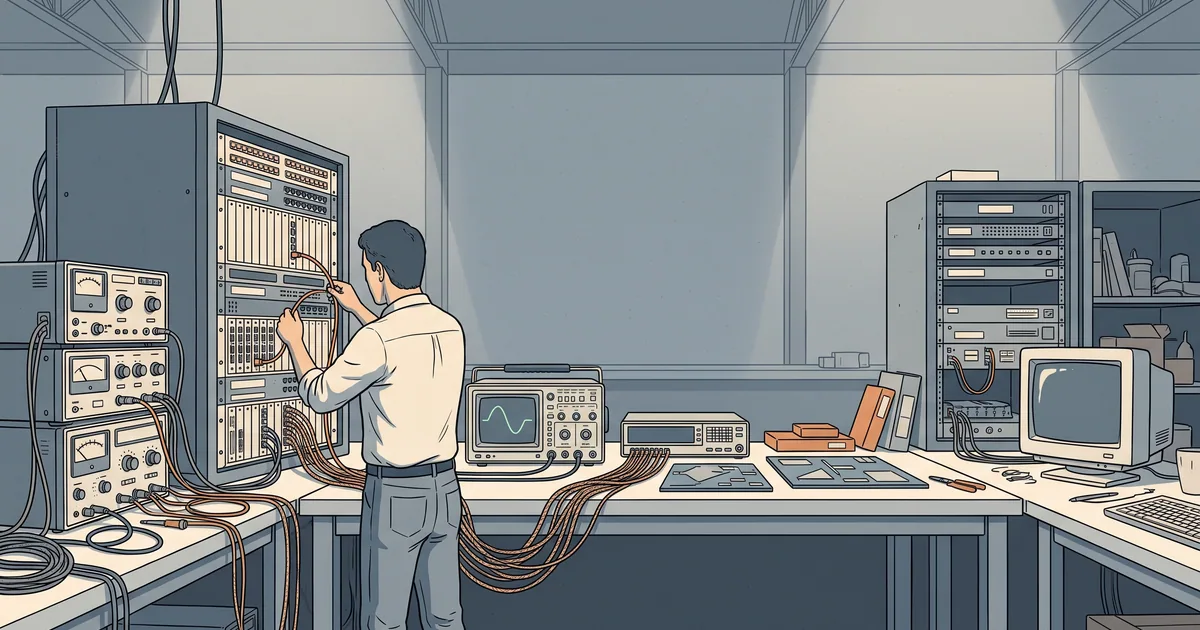
As of June 30, 2006, large propagation delays disrupt terrestrial protocols because standard contention mechanisms rely on instantaneous round-trip acknowledgments, making channel sensing reflect past history.
During June 2006, space communications engineering reached an inflection point as mission architectures expanded toward orbital and surface infrastructures beyond low Earth orbit. The introduction of lunar relay satellite network architectures at the June 2006 AIAA ICSSC, documented by researchers in (AIAA International Communications Satellite Systems Conferen), highlighted the reality that deep-space exploration requires fundamentally restructuring communication layers to handle high link latency. When terrestrial control architectures encounter multi-second propagation delays, basic assumptions governing state distribution collapse. This systemic friction poses a fundamental question:
Why Do Terrestrial Networking Protocols Break Down Over Delay?
The introduction of lunar relay satellite network architectures at the June 2006 AIAA ICSSC marked an important recognition that deep-space exploration requires fundamentally restructuring communication layers to handle high link latency (AIAA International Communications Satellite Systems Conferen). Developing adaptive medium access control and interference nulling designs in June 2006 addressed critical operational bottlenecks where standard channel access assumptions break down over high-interference wireless systems (VTechWorks (Virginia Tech)). Architectural studies in June 2006 detailed how large propagation delays in lunar relay networks disrupt conventional medium access and transport protocols, necessitating adaptive coordination to sustain multi-hop relay throughput (DSpaceMIT (Massachusetts Institute of Technology)). Circuit-aware system design techniques published in June 2006 demonstrated that physical layer power consumption and transceiver hardware limitations directly restrict the throughput achievable in wireless communication links (Computer Networks). The FLAME architecture described in June 2006 provided a programmable network monitoring framework capable of diagnosing transport layer inefficiencies and state synchronization problems in complex data networks (AIAA International Communications Satellite Systems Conferen). Frameworks presented in June 2006 established that space exploration relay nodes require integrated consideration of circuit hardware boundaries alongside network transport assumptions to prevent systemic channel degradation (VTechWorks (Virginia Tech)). Terrestrial networking protocols, from medium access control schemes to sliding-window transports, rely implicitly on instantaneous or tightly bounded round-trip acknowledgments to establish shared state. When control logic assumes that nodes observe identical channel reservations and link conditions concurrently, large distance invalidates every coordination primitive. When two relay orbiters or surface rovers attempt to negotiate mutual exclusion across a multi-second propagation barrier, standard contention-resolution mechanisms fail because channel sensing reflects past history rather than present reality. In environments characterized by spatial separation and severe multi-user interference, control handshakes like request-to-send and clear-to-send consume prohibitive channel capacity while offering stale channel state metrics. When transmission nodes attempt to null interference without fresh cross-node telemetry, the resulting beamforming and power configurations frequently amplify collisions instead of suppressing them. The Virginia Tech research demonstrated that decoupling transmission scheduling from synchronous handshake loops permits nodes to adaptively manage channel contention based on local signal environments and historical traffic distributions. By eliminating the demand for lockstep synchronization, wireless links maintain sustained channel utilization across volatile and delayed links without precipitating complete access collapse.
How Do Physical Hardware Boundaries Constrain Software Control Planes?
Physical hardware boundaries impose unyielding limits on how much abstraction software control planes can afford to maintain. Terrestrial control designs routinely assume that link buffers can scale indefinitely and that radio-frequency chains can be reconfigured rapidly without substantial thermal or energy penalties. In deep-space platforms, however, power amplifier nonlinearities, dynamic clock-frequency limits, and phase noise constraints directly dictate packet processing rates. When a high-level transport plane mandates rapid retransmissions or continuous polling over delayed links, transmitter circuits drain satellite power buses and saturate analog front-ends, triggering dropped frames that higher software layers misinterpret as network congestion. Consequently, frameworks presented in June 2006 established that space exploration relay nodes require integrated consideration of circuit hardware boundaries alongside network transport assumptions to prevent systemic channel degradation (AIAA International Communications Satellite Systems Conferen; DSpaceMIT (Massachusetts Institute of Technology)). A sustainable control plane must maintain strict operational separation between bulk science payload data and delay-tolerant command telemetry. If supervisory signaling shares execution queues with payload traffic under an assumed common clock, an unacknowledged payload burst can starve command processing, blinding operators on Earth. Interface contracts between subsystems must therefore enforce explicit rate-limiting and localized fault boundaries, ensuring that autonomous flight computers validate transactions locally rather than halting operations pending ground confirmation. Operator trade-offs necessitate accepting eventual consistency, where distant nodes operate asynchronously within bounded safety domains rather than waiting for synchronized command authorization. Diagnosing and resolving these distributed anomalies requires visibility into the internal states of asynchronous network layers without imposing significant control overhead. By injecting dynamic, compact monitoring code directly into forwarding elements, network operators can evaluate packet lifetimes, buffer occupancies, and retransmission pathologies across disparate nodes without saturating narrow return telemetry channels. In space networks where link outages and long delays preclude real-time status streaming, programmable monitoring components can synthesize telemetry locally, recording state discrepancies for batch transmission during scheduled downlink passes. This capability provides a viable recovery path, isolating protocol mismatches before uncoordinated retransmissions exhaust vehicle power reserves.
How Much Operational Autonomy Can Flight Computers Safely Retain?
The architectural insights of June 2006 confirm that treating latency as a mere quantitative transport variable rather than a qualitative boundary condition invites systemic collapse. As deep-space communication infrastructures transition from direct-to-Earth point links to complex multi-hop relays, decoupling local node execution from global state consensus becomes essential. Yet, this necessary architectural decoupling creates an unresolved engineering challenge: How much operational autonomy can mission planners safely delegate to remote spacecraft flight systems when physical round-trip communication delays make centralized ground verification impossible during emergent orbital faults?
Sources
- AIAA International Communications Satellite Systems Conferen: Lunar Relay Satellite Network for Space Exploration: Architecture, Technologies and Challenges, 2006-06-11
- VTechWorks (Virginia Tech): Improving the Performance of Wireless Systems via Selective Interference Nulling and Adaptive Medium Access Control Design, 2006-06-26
- DSpaceMIT (Massachusetts Institute of Technology): Circuit-aware system design techniques for wireless communication, 2006-06-29
- Computer Networks: Flexible network monitoring with FLAME, 2006-06-12