Industrial Power Protection Schemes in Contemporary Networks
modernizing power protection schemes reveals critical trade-offs between supervisory accessibility and deterministic control loop latency.
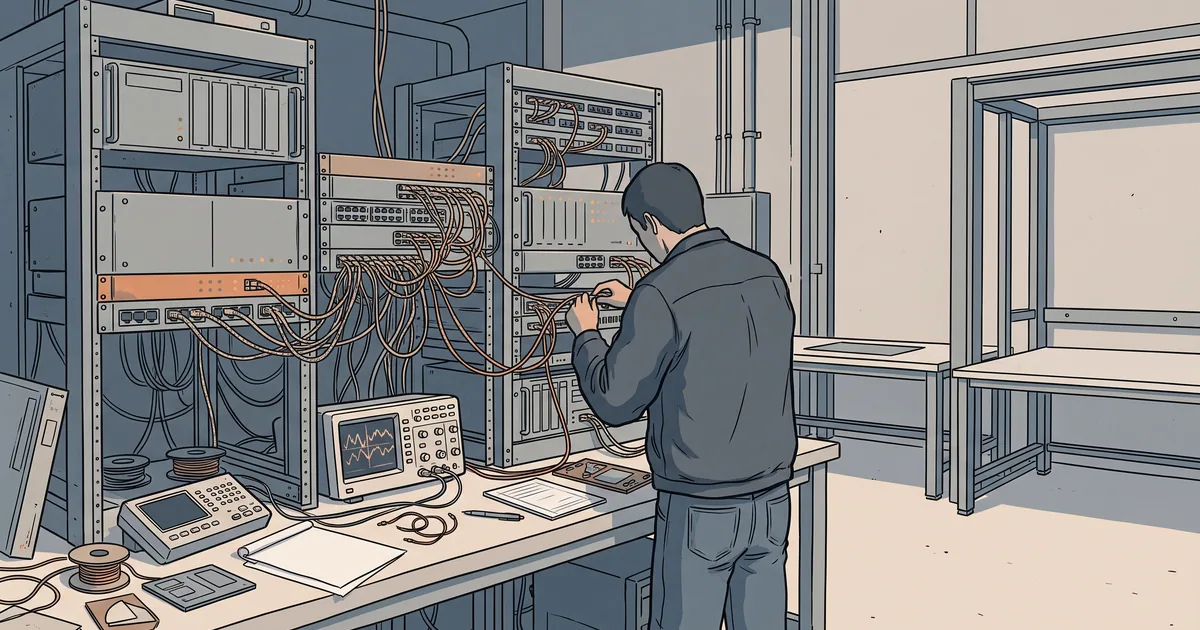
As of February 29, 2012, upgrading industrial power protection schemes to packet-switched environments reveals critical trade-offs between supervisory accessibility and deterministic control loop latency.
During February 2012, industrial automation facilities and distributed power grids faced mounting friction as engineers migrated closed supervisory topologies onto asynchronous packet networks. Distributed architectures sought decentralized spectrum negotiation, highlighted by research in the (EURASIP Journal on Wireless Communications and Networking), while mission-critical control loops struggled against unpredictable jitter. As digital teleprotection interfaces displace isolated point-to-point analog wiring, engineering teams confront the core architectural dilemma:
How Do Packet Networks Impact Power Protection Reliability?
Upgrading industrial power protection schemes to packet-switched network environments revealed critical trade-offs between supervisory accessibility and deterministic control loop latency (EURASIP Journal on Wireless Communications and Networking). Long-term control system modernization initiatives highlighted the operational necessity of validating network reliability and timing deterministic behavior before retiring dedicated hardwired infrastructure (Journal of King Abdulaziz University-Engineering Sciences). Engineers evaluated power system protection up-gradation schemes using MATLAB/Simulink graphical user interfaces linked to TCP/IP network transport to monitor protection triggering and data exchange (DOI Registry). Research into cooperative non-regenerative relay channels quantified symbol error rate behavior across generalized fading conditions to assess wireless transmission reliability under physical channel impairments (International Journal of Wireless & Mobile Networks). Comprehensive reviews of dynamic spectrum access protocols for distributed cognitive networks established operational parameters for coordinating decentralized channels and reducing interference bottlenecks (EURASIP Journal on Wireless Communications and Networking). The long-term vision for instrumentation, information, and control systems modernization defined structural roadmaps for managing digital transitions in high-reliability industrial control plants (Journal of King Abdulaziz University-Engineering Sciences). The transition toward shared packet fabrics exposes latent timing vulnerabilities in legacy protection architectures. Upgrading industrial power protection schemes to packet-switched network environments revealed critical trade-offs between supervisory accessibility and deterministic control loop latency, as demonstrated by findings in the (Journal of King Abdulaziz University-Engineering Sciences). Point-to-point hardwired circuits traditionally guaranteed fixed propagation delays, allowing tripping logic to assume instantaneous remote status updates. When these connections are replaced by routed local area networks, packet queuing, store-and-forward latency, and statistical multiplexing disrupt state synchronization. This empirical modeling demonstrated that while TCP/IP ensures reliable byte-stream delivery, transport-layer retransmissions introduce non-deterministic delays that violate strict fault-clearing time budgets. Physical transmission impairments further compound coordination latency across heterogeneous communication paths. In non-regenerative cooperative networks, relay nodes amplify and forward analog waveforms without digital decoding, which propagates cumulative channel noise directly into receiver demodulators. When higher-layer control planes operate over such links, fluctuating bit error rates trigger packet discards at network interfaces. If an automated interlock system treats communication silence as steady-state stability rather than link degradation, transient fading episodes can masquerade as normal operating conditions until emergency tripping thresholds are breached without warning.
How Do Boundary Controls Preserve Actuation Loop Timing?
Reconciling the tension between decoupled software control planes and physical transport guarantees requires clear boundary enforcement. These modernization strategies emphasize that logical separation between supervisory visualization layers and primary actuation loops prevents high-volume analytical traffic from saturating deterministic protection buses. Furthermore, long-term control system modernization initiatives highlighted the operational necessity of validating network reliability and timing deterministic behavior before retiring dedicated hardwired infrastructure (DOI Registry). When mission-critical plants upgrade to digital buses without strict latency bounds, the lack of hardware isolation allows non-critical data floods to starve essential heartbeat messages. At the link management tier, decentralized resource contention must be actively governed rather than assumed away. Without centralized arbiters, distributed nodes require rigorous contention algorithms to rendezvous on common control channels and reserve transmission slots. If distributed nodes experience uncoordinated channel switching, control commands suffer from message reordering and unbounded packet delays. Industrial plant architectures therefore enforce deterministic medium access protocols, prioritizing trip signals over background diagnostic telemetry to preserve the integrity of protection boundaries. Structural resilience ultimately depends on explicit architectural concessions to transport imperfection. When industrial controllers assume perfect, instantaneous state replication across remote endpoints, any transport anomaly propagates directly into actuator logic, triggering spurious trips or catastrophic fail-to-trip scenarios. Robust system design demands that consensus protocols incorporate timeout budgets, stale-data mitigation thresholds, and deterministic fail-safe states. Telemetry handoffs must rely on formal interface contracts where every distributed state update includes timestamped lineage and explicit validity intervals. By treating the underlying network transport as a partially ordered, latency-variable conduit rather than an idealized instantaneous bus, industrial control engineers can isolate supervisory data traffic from safety-critical tripping operations.
Can Future Decentralized Control Replace Hardwired Systems?
By late February 2012, control engineers recognize that packet-switched communication fabrics cannot be treated as transparent substitutes for dedicated analog copper. As distributed sensor grids and cognitive wireless telemetry expand into mission-critical substations, control logic must explicitly manage asynchronous delay, jitter, and transport-level channel degradation. The unresolved architectural challenge centers on whether future decentralized control algorithms can dynamically guarantee deterministic protection bounds over unmanaged, shared network fabrics without relying on parallel, hardwired fail-safe overrides.
Sources
- EURASIP Journal on Wireless Communications and Networking: A survey on dynamic spectrum access protocols for distributed cognitive wireless networks, 2012-02-24
- Journal of King Abdulaziz University-Engineering Sciences: Up-Gradation of Power System Protection Scheme through TCP/IP Using GUI in MATLAB/Simulink, 2012-02-03
- DOI Registry: Long-Term Instrumentation, Information, and Control Systems (II&C) Modernization Future Vision and Strategy (Revision 1), 2012-02-01
- International Journal of Wireless & Mobile Networks: Efficient Symbol Error Rate Analysis of Cooperative Non-Regenerative Relay Systems over Generalized Fading Channels, 2012-02-29