Immersive Visualization Bottlenecks in Cluster Architectures
Transport synchronization delays constrain multi-screen display environments as state coordination lags behind graphics pipelines.
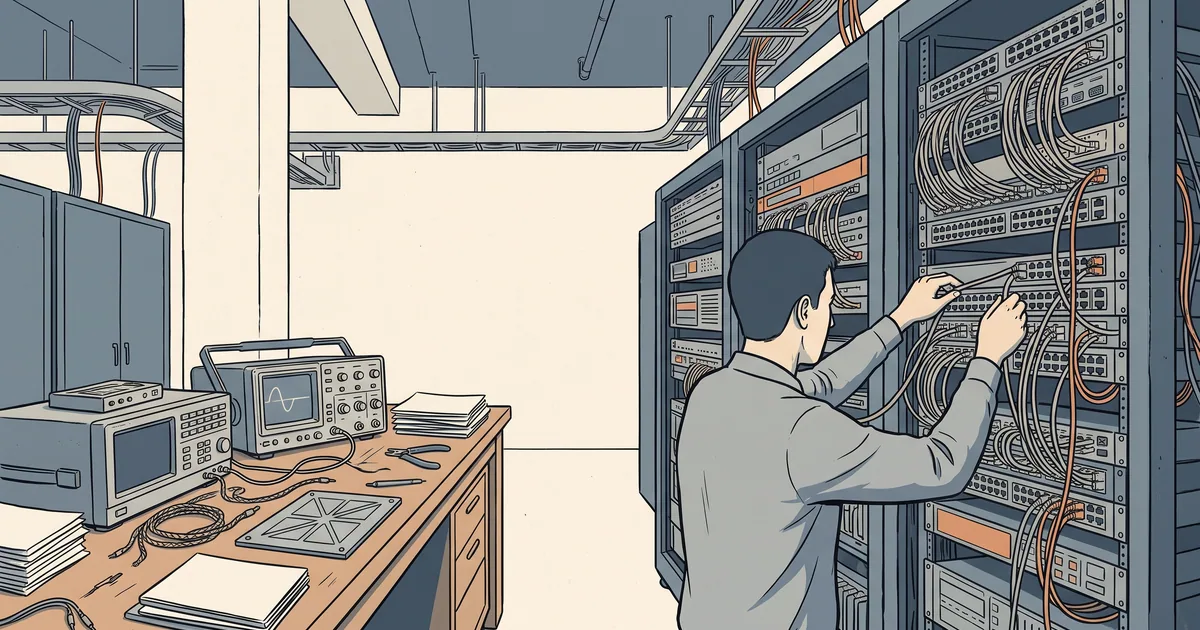
As of February 29, 2008, transport synchronization delays degrade pipelines because render nodes stall hardware swap buffers awaiting lock confirmations and frame-barrier tokens over Gigabit Ethernet or InfiniBand networks.
During February 2008, high-performance visual computing reached an inflection point as multi-tile projection walls and cave automatic virtual environments pushed commodity workstation clusters to their architectural limits. In a rigorous examination published by (Elsevier BV), systems researchers demonstrated that local rendering hardware is no longer the primary impediment to visual fidelity. Instead, network interconnects and state exchange barriers dictate runtime behavior. This empirical revelation highlights an urgent systems design question:
Why do transport synchronization delays degrade cluster visualization pipelines?
Evaluating performance bottlenecks in cluster-based architectures for immersive visualization establishes that transport synchronization delays, rather than local node rendering power, represent the critical operational constraint for multi-screen display environments (Elsevier BV). Adopting reservation-based transaction mechanisms in distributed environments is essential for preventing concurrent control operations from violating strict delivery deadlines in real-time networked architectures (Institute of Electrical and Electronics Engineers (IEEE)). Cluster-based immersive visualization systems experience frame-rate degradation when state coordination and transaction exchanges across cluster nodes fail to keep pace with individual graphics pipelines (IEEE). Self-adaptive and locality-aware peer-to-peer membership protocols organize heterogeneous distributed nodes according to network topology to minimize messaging overhead across wide-area node groupings (Elsevier BV). Scalable distributed QoS multicast routing protocols enforce quality-of-service parameters to provide bounded latency and resource reservations during multi-receiver data distribution (Elsevier BV). Applying locality-aware membership structures to cluster coordination reduces control-plane communication delays that cause visual tearing and pipeline stalls in multi-node visualization systems (Institute of Electrical and Electronics Engineers (IEEE)). When visual simulation engines distribute scene graphs across multiple display engines, software architects frequently design coordination mechanisms under the naive assumption that inter-node signaling behaves like local bus access. In operational deployments, however, cluster-based immersive visualization systems experience frame-rate degradation when state coordination and transaction exchanges across cluster nodes fail to keep pace with individual graphics pipelines (Elsevier BV; Institute of Electrical and Electronics Engineers (IEEE)). Local PCI Express graphics adapters process millions of polygons per second, but render nodes must continuously stall their hardware swap buffers while awaiting lock confirmations and frame-barrier tokens over Gigabit Ethernet or InfiniBand networks. This barrier synchronization failure magnifies when distributed transactions attempt to synchronize camera positions, object physics, and input events simultaneously. Without explicit reservation semantics, uncoordinated write requests trigger pipeline bubble propagation throughout the cluster fabric. As individual worker nodes wait on lagging peers to acknowledge geometry transformations, graphics queues empty out. The resulting jitter disrupts refresh cycles, converting high-throughput compute infrastructure into an idling, latency-bound topology where total throughput collapses to the speed of the slowest distributed state lock.
How can reservation-capable multicast routing trees prevent visual desynchronization?
Resolving these systemic deadlocks requires restructuring the communication boundary by separating bulk visual data handoffs from the low-latency control plane. To discipline the overlay networks that govern peer nodes, self-adaptive and locality-aware peer-to-peer membership protocols organize heterogeneous distributed nodes according to network topology to minimize messaging overhead across wide-area node groupings (IEEE). When control planes ignore physical topology, synchronization heartbeats cross redundant switch hops, saturating shared switches and introducing packet jitter into deterministic swap-barrier protocols. By grouping proximate visualization nodes into tightly coupled synchronization domains, architects confine tight lock-step barriers to localized network fabrics while delegating relaxed state updates to slower egress links. At the network layer, scalable distributed QoS multicast routing protocols enforce quality-of-service parameters to provide bounded latency and resource reservations during multi-receiver data distribution (Elsevier BV). Standard broadcast and basic IP multicast mechanisms fail under high-frequency control pressure because they offer no latency bounds or queuing guarantees when large geometry datasets contend with tiny sync tokens. By deploying reservation-capable multicast routing trees, the network infrastructure can guarantee path delay boundaries and bandwidth reservations for mission-critical frame barriers. Visualization engines can then establish rigid interface contracts, ensuring that camera-orientation broadcasts arrive at every display slave within a deterministic time window, thereby preventing visual desynchronization across adjoining display tiles. Structural resilience in this hybrid model depends on robust failure containment boundaries. When an individual visualization node experiences a transient socket timeout or memory bottleneck, naive lock-step protocols stall the entire display wall, jarring the human operator and causing perceptual disruption. contemporary control planes must therefore employ lease-based state models alongside distributed reservation channels. If a node fails to meet a presentation deadline, the remaining nodes proceed using predictive interpolation rather than blocking the master frame clock. By isolating payload rendering paths from control transactions and establishing deterministic routing trees, distributed systems maintain interactive performance without succumbing to the latency traps inherent in physical cluster networks.
Can adaptive protocols reconcile deterministic frame-barrier deadlines with fluctuating networks?
By late February 2008, cluster visualization has proved that raw workstation computational capacity cannot compensate for uncoordinated transport protocols. The field now recognizes that state synchronization must be engineered as a first-class networking constraint rather than an abstract programmatic assumption. As display resolutions scale and multi-node clusters govern increasingly complex virtual environments, systems architects must determine how to dynamically reconcile deterministic frame-barrier deadlines with non-deterministic wide-area network fabrics when physical topologies fluctuate.
Sources
- Elsevier BV: Analyzing the performance of a cluster-based architecture for immersive visualization systems, 2008-02-08
- Institute of Electrical and Electronics Engineers (IEEE): A Reservation-Based Extended Transaction Protocol, 2008-02-11
- IEEE: SAP2P: Self-adaptive and Locality-aware P2P Membership Protocol for Heterogeneous Systems, 2008-02-14
- Elsevier BV: SoMR: A scalable distributed QoS multicast routing protocol, 2008-02-17