Substation Automation Architectures and Grid Control Systems
Modernizing grid control systems requires strict alignment with underlying communication bounds to mitigate synchronization latency.
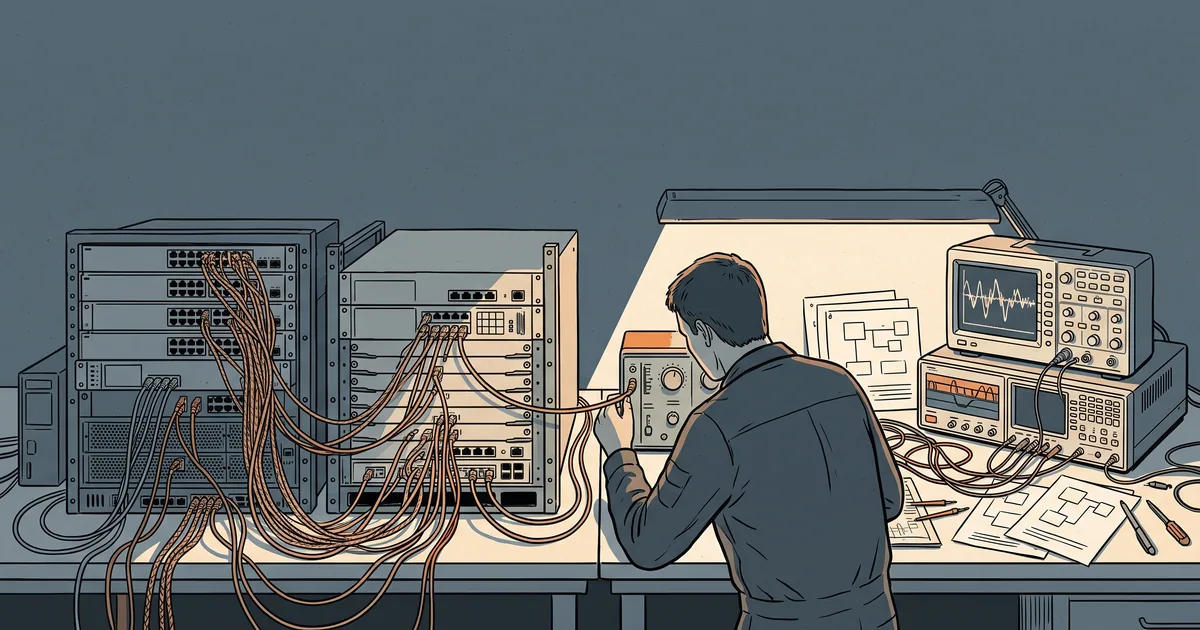
As of August 31, 2014, modernizing grid control systems requires strict alignment with underlying communication bounds, as synchronization latency directly impacts critical operational reliability.
During August 2014, the rapid distribution of real-time control frameworks exposed severe systemic vulnerabilities when designers treated low-level transport networks as transparent, instantaneous fabrics. contemporary industrial installations increasingly rely on decoupled management software, but evaluating substation automation architectures demonstrates that modernizing grid control systems requires strict alignment with underlying communication bounds, as synchronization latency directly impacts critical operational reliability (Advances in Electrical Engineering). When engineering specifications presuppose that distributed nodes share a unified operational state without propagation delay, protocol stalls and cascading failures emerge.
Why Do Substation Automation Architectures Face Synchronization Latency?
Evaluating substation automation architectures demonstrates that modernizing grid control systems requires strict alignment with underlying communication bounds, as synchronization latency directly impacts critical operational reliability (Advances in Electrical Engineering). Quantitative analysis of location-independent network architectures highlights that abstracting topological location introduces control overhead and latency penalties when physical transport limits are neglected (DOI Registry). Separating logical control mechanisms from physical transport topologies produces lookup overhead and queuing delays in both automated substations and location-independent network routing (Simulation Modelling Practice and Theory). Hierarchical cloudlet storage systems distribute intermediate state across tiered nodes to mitigate transmission latency between mobile devices and remote cloud infrastructures (International Journal of Computing). Large-scale computing environments require autonomous monitoring frameworks like MonALISA to maintain continuous telemetry and prevent blind spots across widely distributed nodes (Advances in Electrical Engineering). Distributed architectures in industrial automation and cloudlet networks require coordinated state updates across localized tiers to prevent transport bottlenecks from stalling control pipelines (DOI Registry). The core operational breakdown begins when control planes abstract state synchronization into an instantaneous primitive, ignoring the physical constraints of wide-area or multi-hop data paths. Recent quantitative analysis of location-independent network architectures highlights that abstracting topological location introduces control overhead and latency penalties when physical transport limits are neglected (DOI Registry). In distributed routing overlays, decoupling node identity from physical address schemes requires continuous resolution mechanisms. When network links experience packet loss, buffer bloat, or asymmetric routing delays, the coordination layer continues to execute commands under obsolete state assumptions. This divergence creates packet re-transmissions and synchronization deadlocks that rapidly consume link bandwidth. At the operational level, this breakdown manifests as a failure of mutual state convergence. If an automated controller issues an isolation directive based on stale topological views, neighboring actuators receive contradictory instructions. In high-voltage substations, protection relays must balance differential electrical currents within milliseconds; any delay introduced by control bus congestion induces improper circuit breaker tripping or prevents fault isolation. Similar dysfunctions emerge in edge-oriented mobile systems, where physical distance undermines control-loop timeliness. To prevent remote round-trip delays from breaking user-facing applications, hierarchical cloudlet storage systems distribute intermediate state across tiered nodes to mitigate transmission latency between mobile devices and remote cloud infrastructures (Simulation Modelling Practice and Theory). When intermediate tiers lack coordinated synchronization protocols, localized cached states drift, forcing aggressive reconciliation routines that overwhelm edge uplinks.
How Can Priority Queuing Mitigate Control Pipeline Stalls?
To govern the handoff between control logic and transport pipelines, system architects must enforce strict structural boundaries between signaling metadata and bulk payload traffic. When control messages compete for the same physical queues as bulk data payloads, transient traffic spikes can choke critical synchronization heartbeats. Preserving operational integrity requires strict priority queuing and bounded state validation intervals. As engineering studies illustrate, distributed architectures in industrial automation and cloudlet networks require coordinated state updates across localized tiers to prevent transport bottlenecks from stalling control pipelines (Advances in Electrical Engineering; Simulation Modelling Practice and Theory). Without localized validation boundaries, a solitary degraded link can propagate backpressure across the entire administrative domain, forcing central orchestrators to suspend processing while awaiting timeout acknowledgments. Maintaining visibility across these partitioned systems requires telemetry systems capable of dynamically decoupling observation from control overhead. Rather than imposing centralized polling loops that exhaust network buffers during periods of congestion, scalable telemetry architectures deploy self-organizing agent patterns that execute localized data reduction. These frameworks gather metric streams and calculate health indicators autonomously at each node. System operators face an inevitable trade-off: either they consume transmission capacity to deliver sub-second telemetry across every tier, or they rely on localized summaries that sacrifice granular visibility to preserve transport capacity for core control signals. Structural resilience ultimately rests upon explicit contract models that discard the illusion of instantaneous global consensus. Real-world physical networks cannot supply deterministic zero-delay guarantees across complex, multi-hop pathways. System designers must structure control planes to operate safely under bounded inconsistency, employing asynchronous handshakes, epoch-based state validation, and fallback mechanisms that execute safe-state fallbacks upon detecting anomalous transmission latencies. When network topologies partition or degrade, independent nodes must gracefully reduce their functional scope rather than freezing execution queues. System stability depends on acknowledging that propagation delays are inherent physical characteristics rather than minor transport abnormalities that can be hidden behind transparent abstractions.
Can Distributed Control Planes Negotiate State Reconciliation Under Delays?
By late August 2014, distributed systems across utility grids, overlay networks, and edge infrastructures demonstrate that control plane abstractions cannot outrun physical transport limits. When architects engineer software assuming zero-latency state synchronization across independent machines, uncoordinated queues and topological drift inevitably trigger cascade failures. Sustained reliability demands localized tiering, independent telemetry, and protocols designed for propagation latency. How can distributed control planes reliably negotiate rapid state reconciliation when underlying physical links experience unpredictable partitions and asymmetric delays?
Sources
- Advances in Electrical Engineering: Towards the Smart Grid: Substation Automation Architecture and Technologies, 2014-08-20
- DOI Registry: Towards a quantitative comparison of location-independent network architectures, 2014-08-12
- Simulation Modelling Practice and Theory: CoSMiC: A hierarchical cloudlet-based storage architecture for mobile clouds, 2014-08-11
- International Journal of Computing: MONALISA: A MONITORING FRAMEWORK FOR LARGE SCALE COMPUTING SYSTEMS, 2014-08-01