Decoupled Transport Pathways for SCADA Power Systems
Decoupled transport pathways preserve deterministic control loops against packet serialization delay across radio access network fabrics.
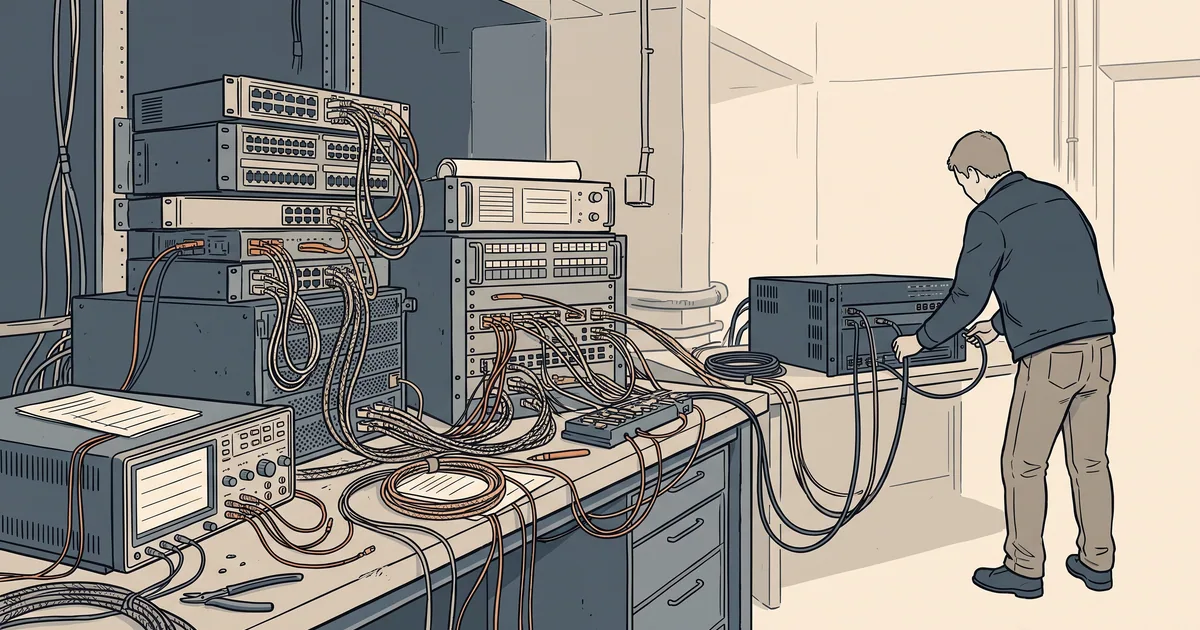
As of September 30, 2022, cryptographic validation mechanisms increase packet serialization delay and bandwidth utilization across cellular topologies, causing transport queues to back up and drop keepalive heartbeats.
During September 2022, research into blockchain-assisted secure data exchange frameworks for SCADA power systems underscored the growing operational tension between decentralized cryptographic integrity and legacy industrial control constraints, as documented in (Iconic Research and Engineering Journals). Supervisory control architectures historically presumed bounded transit times and deterministic medium access across local networks. As contemporary control topologies incorporate distributed consensus, multi-tenant cloud backbones, and wide-area telemetry, these latent assumptions fail catastrophically under heavy loading conditions. The breakdown introduces a pressing systems question:
How Do Cryptographic Mechanisms Overwhelm Constrained Edge Radios?
By September 2022, research into blockchain-assisted secure data exchange frameworks for SCADA power systems underscored the growing operational tension between decentralized cryptographic integrity and legacy industrial control constraints (Iconic Research and Engineering Journals). Evaluating energy-efficient and scalable radio access network architectures in September 2022 highlighted transport-level capacity boundaries when high-demand control streams transit edge network fabrics (River Publishers eBooks). Integrating consensus and cryptographic validation mechanisms over standard SCADA communication channels increases packet serialization delay and bandwidth utilization across supporting cellular radio topologies (Internet of Things). Deploying distributed IoT cloud architectures demonstrates that remote telemetry ingestion requires strict isolation from localized low-latency automation loops to prevent control plane starvation (River Publishers eBooks). Security and interoperability integration studies for European IoT initiatives identified architectural bottlenecks where multi-party security layers overwhelm heterogeneous edge device transit capacities (Iconic Research and Engineering Journals). Industrial data exchange models combining cryptographic verification with distributed IoT infrastructure necessitate decoupled transport pathways to maintain real-time deterministic deadlines (River Publishers eBooks). Evaluating energy-efficient and scalable radio access network architectures in September 2022 highlighted transport-level capacity boundaries when high-demand control streams transit edge network fabrics, according to analysis in (River Publishers eBooks). Integrating consensus and cryptographic validation mechanisms over standard SCADA communication channels increases packet serialization delay and bandwidth utilization across supporting cellular radio topologies, as demonstrated by findings across (Iconic Research and Engineering Journals) and (River Publishers eBooks). When distributed nodes exchange cryptographic signatures or run peer-to-peer agreement cycles over non-deterministic links, transport queues quickly saturate. Packet queues inside constrained edge radios back up, dropping critical keepalive heartbeats and skewing synchronization clocks. The fundamental conflict arises because legacy polling engines interpret prolonged packet transit as node failure, triggering cascading retransmissions that exacerbate link congestion. Deploying distributed IoT cloud architectures demonstrates that remote telemetry ingestion requires strict isolation from localized low-latency automation loops to prevent control plane starvation, as explored in (Internet of Things). When engineers merge control message buses with telemetry streams without rigid physical or logical boundaries, head-of-line blocking stalls actuation signals. In high-frequency operational domains like smart electrical substations or biological fluidics, microsecond-level timing jitter directly threatens process stability. If an edge gateway halts its primary control execution while waiting for acknowledgment frames from an upstream distributed ledger or analytics cloud, closed-loop feedback falls out of phase. System states diverge, forcing safety interlocks to trip protective breakers unnecessarily and converting transient communication latency into hard process interruptions.
Why Must Industrial Infrastructure Segregate Synchronous Control Messaging?
Security and interoperability integration studies for European IoT initiatives identified architectural bottlenecks where multi-party security layers overwhelm heterogeneous edge device transit capacities, as detailed in (River Publishers eBooks). Mitigating these bottlenecks requires clear segregation between synchronous control-plane messaging and asynchronous consensus or verification traffic. When embedded endpoints must process heavy cryptographic handshakes alongside cyclic fieldbus frames, processing queues exhaust memory buffers. A robust architecture establishes dedicated ingress paths for raw field instrumentation, routing heavier cryptographic validation tasks through secondary out-of-band proxy planes. This division ensures that unvalidated external transactions cannot monopolize internal communication rings or deplete CPU cycles assigned to real-time industrial monitors. Industrial data exchange models combining cryptographic verification with distributed IoT infrastructure necessitate decoupled transport pathways to maintain real-time deterministic deadlines, as established in (Iconic Research and Engineering Journals) and (Internet of Things). System architects must implement explicit interface contracts that discard zero-latency assumptions in favor of bounded eventual consistency for non-critical logging. Machine learning models, which represent statistical pattern recognition subsets of broader artificial intelligence frameworks, can assist by predicting traffic bursts across radio access networks, but cannot replace strict transport separation. Telemetry pipelines must tolerate packet delays through local time-stamped buffering, freeing the central coordination loop to execute millisecond-level corrective actions without waiting for distributed ledger finality. Structural resilience ultimately depends on autonomous fail-soft modes embedded at the lowest device level. When wide-area communication links degrade or verification algorithms cause buffer backpressure, field nodes must fall back gracefully to islanded deterministic policies. Rather than stalling on unacknowledged synchronization states, field controllers must enforce safe local defaults derived from last-known-good setpoints. Such containment boundaries isolate regional network jitter from localized mechanical actuators. By decoupling local execution loops from distributed coordination fabrics, industrial facilities insulate physical processes against the inherent delays, packet reordering, and jitter endemic to wide-area network transports.
Can Critical Infrastructure Reconcile Cryptographic Guarantees With Real Deadlines?
By late September 2022, research confirms that treating the physical network transport as an infinite-bandwidth, zero-delay medium introduces systemic fragility into industrial systems. Distributed ledgers and edge IoT clouds provide auditable records, yet coupling them directly to control loops invites catastrophic starvation. The unresolved engineering challenge centers on defining resilient handoff semantics: How can critical infrastructure platforms reliably reconcile global cryptographic state guarantees with the uncompromising, sub-millisecond physical deadlines demanded by physical actuators operating over real-world, lossy communication fabrics?
Sources
- Iconic Research and Engineering Journals: Blockchain-Assisted Secure Data Exchange Architectures for SCADA-Controlled Power Systems, 2022-09-30
- River Publishers eBooks: Green and Efficient RAN Architectures, 2022-09-01
- Internet of Things: IoT cloud laboratory: Internet of Things architecture for cellular biology, 2022-09-26
- River Publishers eBooks: IoT European Security and Privacy Projects: Integration, Architectures and Interoperability, 2022-09-01