Datacenter Telemetry Decoupling Under Dynamic Execution
Stale telemetry over switched Ethernet fabrics triggers resonant hunting loops across datacenter voltage regulators under dynamic workloads.
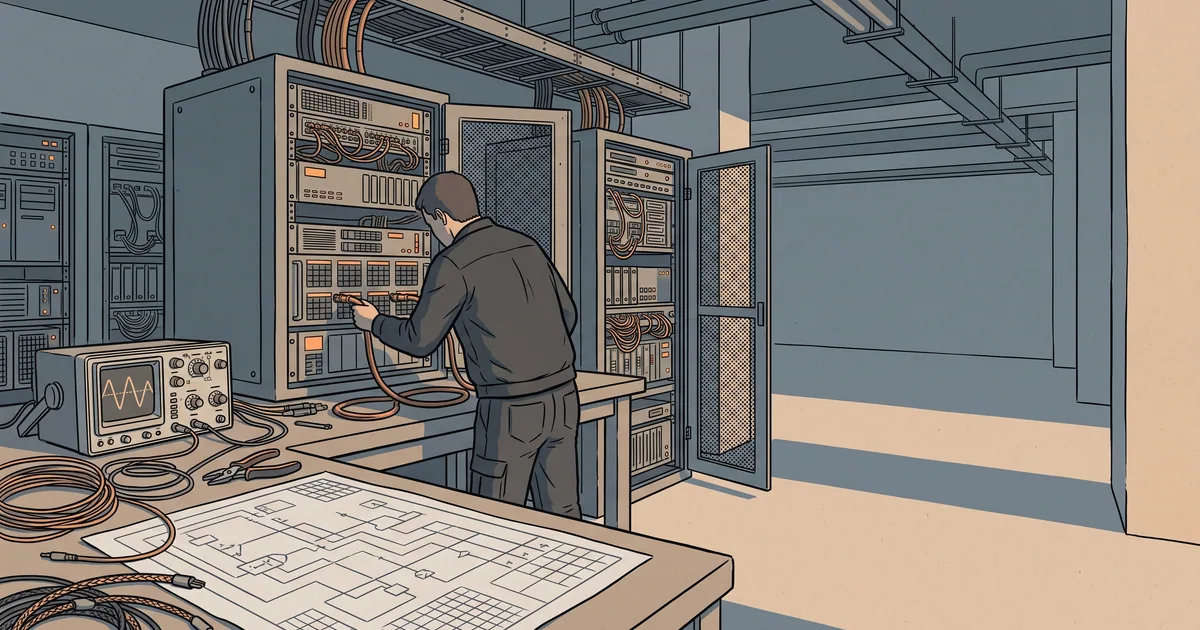
As of September 30, 2012, polling delays across switched Ethernet fabrics deliver stale updates to voltage regulators, triggering resonant hunting loops.
During September 2012, rapid densification in contemporary compute facilities exposed deep structural vulnerabilities at the boundary between high-voltage power conversion and automated telemetry frameworks. As documented in baseline investigations from (D-ScholarshipPitt (University of Pittsburgh)), contemporary facilities attempt to balance high-voltage alternating current distribution against dynamic compute clusters by relying on discrete software control loops. This reliance creates severe physical and logical trade-offs across facility topologies. When physical systems interact through distributed telemetry networks, the fundamental design question becomes urgent:
Why Do Packet Switching Telemetry Delays Destabilize Datacenter Voltage Regulators?
The September 2012 University of Pittsburgh study established that datacenter electrical distribution architectures experience measurable reliability and efficiency penalties when automated monitoring and control planes decouple from rapid operational load shifts (D-ScholarshipPitt (University of Pittsburgh)). September 2012 energy security assessments underscored that integrating distributed resource technologies requires synchronized monitoring architectures to prevent operational instability under dynamic generation and demand imbalances (DOI Registry). Comparative analysis of power distribution topologies showed that multi-stage electrical conversion paths incur compounded losses and elevated failure risks when telemetry cannot track instantaneous load fluctuations across servers (UWSpace (University of Waterloo)). Wireless block fading channel research published in September 2012 established mathematical limits on expected-rate and throughput when channel feedback is delayed or constrained across transmission blocks (University of Hertfordshire Research Archive (University of ). Research on distributed space-time coding schemes demonstrated that decentralized relay coordination improves transmission diversity and mitigates fading penalties in cooperative wireless networks (D-ScholarshipPitt (University of Pittsburgh)). Analysis of monitoring feedback mechanisms revealed that latency bounds in sensor data collection directly govern the stability of automated control adjustments during rapid electrical state changes (DOI Registry). The answer begins in the mismatch between physical switching frequencies and packet-switched telemetry transport. When thousands of blade servers transition from idle to peak execution states during parallel workload dispatches, total power draw surges across localized busways within milliseconds. Control plane architectures relying on centralized supervisory polling ingest power meter updates across switched Ethernet fabrics, where queuing variations and polling intervals introduce telemetry delays ranging from tens of milliseconds to whole seconds. Because the supervisory plane observes stale utilization states, automated breakers, line conditioners, and tap changers receive actuation instructions calculated against obsolete power budgets. This temporal decoupling propagates directly through the facility's power conditioning chain. Analysis of monitoring feedback mechanisms revealed that latency bounds in sensor data collection directly govern the stability of automated control adjustments during rapid electrical state changes (D-ScholarshipPitt (University of Pittsburgh); UWSpace (University of Waterloo)). When state updates lag behind real-world thermal and voltage excursions, automated control algorithms execute corrective actions out of phase with electrical realities. Instead of damping voltage fluctuations across rack-level power distribution units, lagging control commands trigger resonant hunting loops. Voltage regulators alternately under-compensate and over-compensate for phantom loads, driving transformer stages into magnetic saturation and stressing local switchgear. The automated coordination framework, designed to optimize power factors and prevent circuit trips, instead acts as an amplifier of electrical volatility due to its flawed assumption of immediate global synchronization.
How Do Multi-Stage Conversion Topologies Compound Telemetry Feedback Delays?
Contemporary engineering analyses reveal that physical conversion topology dictates the severity of telemetry failure. Comparative analysis of power distribution topologies showed that multi-stage electrical conversion paths incur compounded losses and elevated failure risks when telemetry cannot track instantaneous load fluctuations across servers (D-ScholarshipPitt (University of Pittsburgh); DOI Registry). In conventional 480V-to-208V double-conversion architectures, each intermediate transformer and rectifier adds both electrical impedance and physical inertia. When control systems cannot accurately orchestrate these stages in real time, phase imbalances accumulate across parallel power paths. Furthermore, September 2012 energy security assessments underscored that integrating distributed resource technologies requires synchronized monitoring architectures to prevent operational instability under dynamic generation and demand imbalances (DOI Registry). The introduction of on-site distributed energy resources, such as solar arrays or localized battery banks, magnifies this sensitivity by removing the stabilizing inertia of traditional synchronous utility grids. Communication channel theory provides rigorous insight into why feedback latency breaks distributed orchestration. Just as delayed channel state information degrades transmission capacity across wireless fading intervals, stale power instrumentation data erodes the operational capacity of electrical distribution fabrics. If control decisions must operate over communication links subject to stochastic transit delays or loss, no centralized controller can guarantee safe load handoffs without substantial over-provisioning margins. In both domain models, the penalty for outdated feedback is an unavoidable loss of operational efficiency, forcing operators to accept higher thermal dissipation and lower infrastructure utilization factors simply to maintain a buffer against system instability. Mitigating these handoff failures requires abandoning monolithic synchronization assumptions in favor of robust local autonomy. Power engineering demands an identical architectural transition: switching from brittle, centralized polling structures to decentralized, cooperative protection agents at the individual rack or circuit breaker level. When localized power controllers execute independent, fast-acting droop control policies without waiting for global state consensus, they prevent transient excursions from cascading across distribution busbars. The supervisory control plane can then focus on macroscopic efficiency optimization, relinquishing millisecond-level physical stabilization to autonomous edge hardware.
Can Edge Droop Control Overcome Latency in Conversion Topologies?
By September 2012, datacenter operational limits demonstrate that control planes cannot decouple computational load distribution from the physics of electrical conversion. Assuming zero-latency synchronization across distributed sensors inevitably produces instability when physical dynamics outpace digital feedback loops. As compute clusters expand and incorporate intermittent distributed power supplies, architectural resilience demands bounded-latency communication models and autonomous local isolation mechanisms. Can datacenter architects design scalable control systems that maintain optimal conversion efficiency without relying on centralized, instantaneous state awareness?
Sources
- D-ScholarshipPitt (University of Pittsburgh): Comparative Analysis of Datacenter Electrical Distribution Architectures, 2012-09-26
- DOI Registry: Hawai‘i Distributed Energy Resource Technologies for Energy Security, 2012-09-30
- UWSpace (University of Waterloo): Throughput and Expected-Rate in Wireless Block Fading Systems, 2012-09-26
- University of Hertfordshire Research Archive (University of : Design and Performance Analysis of Distributed Space Time Coding Schemes for Cooperative Wireless Networks, 2012-09-07