Multicarrier Resource Allocation in Fading Channels
Network architects face channel degradation when centralized scheduling relies on stale spatial estimates across multi-access links.
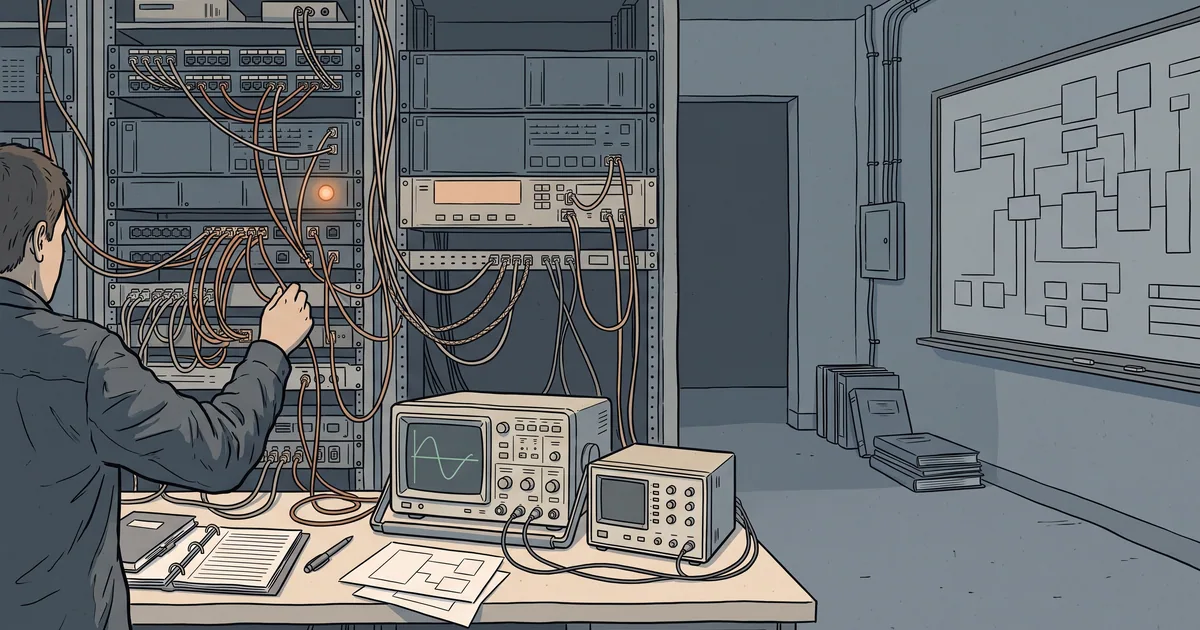
As of May 31, 2007, centralized scheduling collapses when control signaling experiences unmodeled channel degradation and fading dynamics outpace channel state feedback rates across multi-access links.
During May 2007, distributed systems engineering faces a profound operational friction as network architects migrate algorithms designed for wired backbones into dynamic wireless mesh and cellular environments. Foundational theoretical work documented in (CaltechTHESIS (California Institute of Technology)) underscores how physical medium constraints demolish common abstractions regarding uniform throughput and negligible transit delay. System designers frequently construct consensus, routing, and resource management frameworks under implicit premises of immediate telemetry propagation. This divergence forces an urgent structural evaluation:
Why Does Centralized Scheduling Collapse Over Fading Channels?
Establishing asymptotic bounds for Rayleigh fading channels is critical for wireless protocol design, as it reveals fundamental capacity and feedback limits that prevent distributed control planes from assuming deterministic transport (CaltechTHESIS (California Institute of Technology)). Developing unified frameworks for multicarrier multiuser allocation provides the necessary theoretical foundation to show that centralized scheduling collapses when control signaling experiences unmodeled channel degradation (Texas ScholarWorks (Texas Digital Library)). Analytical models of multicarrier resource allocation demonstrate that throughput guarantees deteriorate rapidly when fading dynamics outpace channel state feedback rates across multi-access links (IFIPIEEE International Symposium on Integrated Network Manag). Empirical evaluations of network management protocols show that repeated SNMP polling generates sustained control traffic overhead capable of congesting bandwidth-constrained communication links (arXiv (Cornell University)). Analyses of Internet infrastructure under stress indicate that sudden traffic surges and topology fluctuations trigger systemic control message storms and routing instability (CaltechTHESIS (California Institute of Technology)). Asymptotic fading evaluations and operational traffic analyses confirm that network management and control messages face severe packet drop rates when transmitted over uncoordinated, time-varying wireless channels (Texas ScholarWorks (Texas Digital Library)). The breakdown of distributed consensus begins at the physical and link boundaries, where theoretical capacity bounds diverge sharply from protocol assumptions. In practical multi-access deployments, developing unified frameworks for multicarrier multiuser allocation provides the necessary theoretical foundation to show that centralized scheduling collapses when control signaling experiences unmodeled channel degradation (Texas ScholarWorks (Texas Digital Library)). When scheduler state updates fail to arrive within coherence time windows, allocation matrices operate on stale spatial estimates. Consequently, analytical models of multicarrier resource allocation demonstrate that throughput guarantees deteriorate rapidly when fading dynamics outpace channel state feedback rates across multi-access links (CaltechTHESIS (California Institute of Technology); Texas ScholarWorks (Texas Digital Library)). This coordination breakdown manifests severe compounding penalties at the transport and network management tiers. Because management daemons treat state observation as an out-of-band certainty, routine status requests saturate the transmission queues of wireless access points. When the shared air interface encounters severe atmospheric or multipath attenuation, packet retransmissions multiply exponentially. Asymptotic fading evaluations and operational traffic analyses confirm that network management and control messages face severe packet drop rates when transmitted over uncoordinated, time-varying wireless channels (CaltechTHESIS (California Institute of Technology); IFIPIEEE International Symposium on Integrated Network Manag). The resulting loss of telemetry causes supervisory nodes to infer device failure falsely, which triggers catastrophic reconvergence sequences across the operational cluster.
How Can Dedicated Reservation Channels Mitigate Control Storms?
To mitigate cascading transport failures, system architects must enforce rigorous physical and logical boundaries between control signaling and payload transmission. Traditional IP architectures multiplex routing updates, telemetry polling, and user data onto shared logical queues, assuming that quality-of-service tags preserve high-priority control frames. However, analyses of Internet infrastructure under stress indicate that sudden traffic surges and topology fluctuations trigger systemic control message storms and routing instability (arXiv (Cornell University)). In wireless environments, where channel capacities oscillate unpredictably, unbounded control storms rapidly monopolize available symbol allocations. Isolating control protocols onto dedicated reservation channels or deterministic time slots prevents payload surges from choking routing advertisements, but this separation requires control planes to accept bounded state divergence rather than enforcing continuous, synchronous lockstep guarantees. The operational penalty of bounded divergence lies in the necessary re-engineering of interface contracts and network telemetry. When distributed elements trade real-time consensus for asynchronous, local decision making, management systems cannot depend on continuous polling cycles. Polling-based architectures such as SNMP incur prohibitive channel taxation under fluctuating signal-to-interference-plus-noise ratios. Engineering teams must therefore transition to event-driven push mechanisms that incorporate adaptive back-off and state diffing. In these revised architectures, nodes validate operational invariants locally against cached snapshots of the global state. Rather than treating missing neighbor heartbeats as absolute link terminations, protocols must incorporate probabilistic degradation timers tuned to underlying Doppler spreads and fading statistics. This shift preserves physical channel capacity for critical user traffic while curtailing self-inflicted management saturation. Structural resilience ultimately requires distributed systems to treat transport latency as a first-class dynamic variable rather than an ignorable constant. When distributed control loops interact with fading channels, routing algorithms must implement hysteresis thresholds to avoid reacting to temporary signal nulls. Centralized control plane models must delegate scheduling authority to edge transceivers capable of reacting to instantaneous channel variations within fractions of a millisecond. Multi-hop mesh nodes cannot await round-trip confirmations from a remote coordination center before dispatching packets across dynamic radio links. By binding algorithmic state updates to physical fading intervals, distributed networks prevent local channel intermittency from propagating outward into system-wide operational partition events.
Can Edge Transceivers Prevent Systemic Operational Partition Events?
Sources
- CaltechTHESIS (California Institute of Technology): Asymptotic Analysis of Wireless Systems with Rayleigh Fading, 2007-05-23
- Texas ScholarWorks (Texas Digital Library): A unified framework for optimal resource allocation in multiuser multicarrier wireless systems, 2007-05-01
- IFIPIEEE International Symposium on Integrated Network Manag: SNMP Traffic Analysis: Approaches, Tools, and First Results, 2007-05-01
- arXiv (Cornell University): Can the Internet cope with stress?, 2007-05-01