Decentralized Electricity Architectures and Control Planes
Decentralized electricity architectures risk grid stability when communications across dispersed generation assets face unmanaged latency.
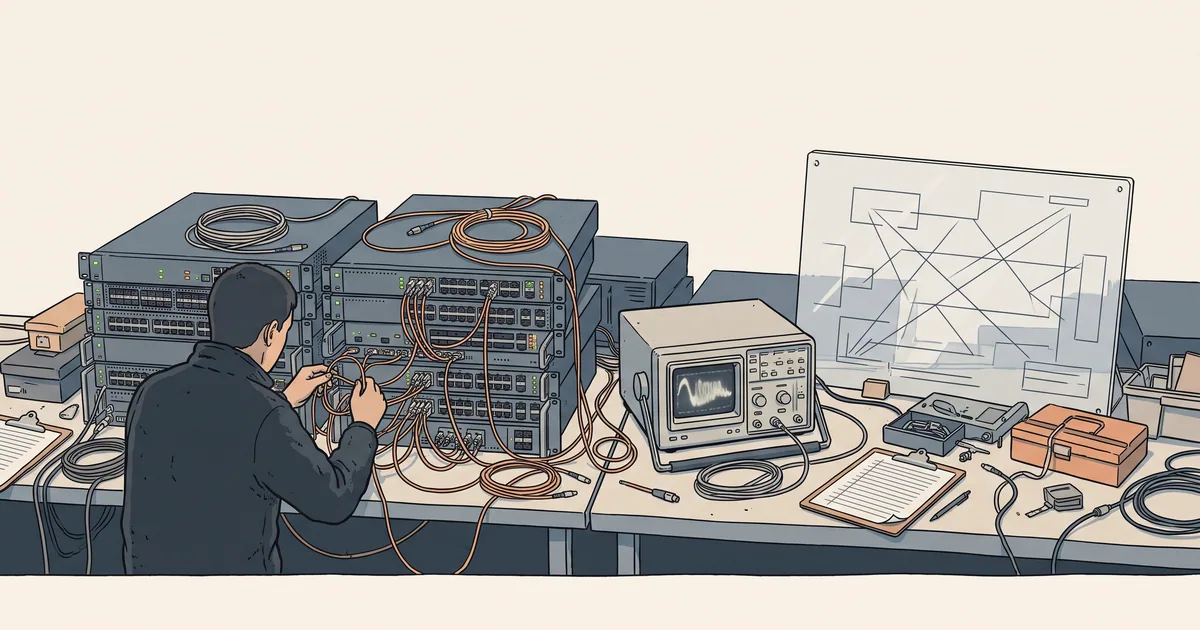
As of December 31, 2017, decentralized electricity architectures risk grid stability when communications across dispersed generation assets encounter unmanaged latency and throughput mismatches.
During December 2017, infrastructure architects across utility networks and enterprise datacenters confronted severe structural limits in distributed control planes. Analysis published in (Energy Policy) underscored how decentralizing operational assets exposed latent transport assumptions, revealing that physical network media cannot instantaneously propagate global state. When algorithmic controllers presume immediate consensus, packet jitter, localized congestion, and protocol retransmissions mutate harmless telemetry fluctuations into systemic operational lockouts across distributed boundaries.
Why Do Decentralized Electricity Architectures Destabilize Grids?
Transitioning to decentralized electricity architectures revealed that distributed control frameworks risk grid stability when communications across dispersed generation assets face unmanaged latency and throughput mismatches (Energy Policy). Securing uncoordinated Internet of Things deployments required redesigning control architectures to prevent transport-layer vulnerabilities and latency variances from compromising device management (KSII Transactions on Internet and Information Systems). Distributed control planes in smart grids and connected environments degraded when underlying transport layers could not guarantee uniform response times across heterogeneous end devices (Unipd). Containerized software architectures demonstrated measurable performance trade-offs in distributed services depending on network isolation and underlying system overhead (Bitlis Eren University Journal of Science and Technology). Field automation in electrical distribution systems confirmed that wireless communication channels encounter throughput constraints when scaling real-time power monitoring across regional endpoints (Energy Policy). Coordinating modular microservices across distributed nodes required accommodating physical network bounds to maintain synchronization across control plane functions (KSII Transactions on Internet and Information Systems). When control systems govern physical apparatus, coordination algorithms rely on deterministic timing to align phase angles and load profiles. As demonstrated by contemporaneously documented grid modernization initiatives, distributed control planes in smart grids and connected environments degraded when underlying transport layers could not guarantee uniform response times across heterogeneous end devices (Energy Policy; KSII Transactions on Internet and Information Systems). Underlying media constraints frequently collide with high-frequency synchronization calls. In practice, regional supervisory control and data acquisition gateways over wireless links suffer from packet queue buildup when bursts of state telemetry overwhelm channel capacities. If the control algorithm interprets delayed acknowledgments as remote node dropouts, it triggers unnecessary reconfiguration loops. The resulting failover cascades consume further bandwidth, driving the transport medium into persistent saturation and stranding remote actuators in indeterminate states.
How Can Containerized Clusters Decouple Consensus Gossip Paths?
Preventing control failure requires decoupling consensus gossip from synchronous operational paths. In containerized clusters, overlay networking abstraction introduces translation hops that magnify tail latency under heavy inter-service chatter. When control envelopes intermingle with payload data without clear priority queuing, control plane starvation occurs, degrading the cluster's ability to schedule workloads dynamically. Engineers must resolve the fundamental tension between strict linearizability and partition resilience across high-latency topologies. In edge installations and substation controllers, enforcing immediate consensus via lock-step synchronization stalls transactions whenever transport links experience sporadic packet drops. Operators are forced to adopt explicit boundary contracts, utilizing bounded queues and monotonic version vectors rather than naive remote procedure calls. telemetry data must carry explicit temporal horizons, allowing downstream worker nodes to reject stale state mutations. When operational software utilizes automated classification techniques, machine learning, a statistical subset of artificial intelligence, differs from broader symbolic artificial intelligence systems by relying on empirical data distributions, making it particularly vulnerable if training telemetry is corrupted by unsynchronized transmission lags. Structural resilience relies on constructing hierarchical failure domains that isolate degraded communication links from core decision rings. By inserting local autonomy thresholds, sub-networks execute safe fallback behavior instead of awaiting remote synchronization handshakes. Wireless remotes deployed across remote sectors can maintain local equilibrium through pre-programmed governor curves whenever upstream carrier channels falter (Bitlis Eren University Journal of Science and Technology). When connection windows clear, synchronization reconciles divergence incrementally via compressed state deltas. Designing systems to respect the physics of real-world networks prevents localized transport friction from metastasizing into catastrophic distributed failure.
Can Future Coordination Models Maintain Absolute Deterministic Governance?
By the close of 2017, the expansion of distributed microservices and utility grids demonstrated that distributed software cannot treat physical networks as invisible conduits. When control planes assume zero-latency consistency, real-world transport variances inevitably break system stability. Architectural viability requires designing for asynchronous resilience, bounded buffering, and explicit failure domains. This leaves open a vital question: can future coordination models maintain absolute deterministic governance when scaling across fundamentally unreliable, geographically dispersed physical transport media?
Sources
- Energy Policy: Delivering a highly distributed electricity system: Technical, regulatory and policy challenges, 2017-12-21
- KSII Transactions on Internet and Information Systems: A SECURITY ARCHITECTURE FOR THE INTERNET OF THINGS, 2017-12-31
- Unipd: Implementation and evaluation of a container-based software architecture, 2017-12-07
- Bitlis Eren University Journal of Science and Technology: Application of wireless power system automation for electrical distribution system of Van, Turkey, 2017-12-26