Wideband Distributed Beamforming and Network Latency
Network transport delays and jitter disrupt wideband distributed beamforming and consensus state across distributed nodes.
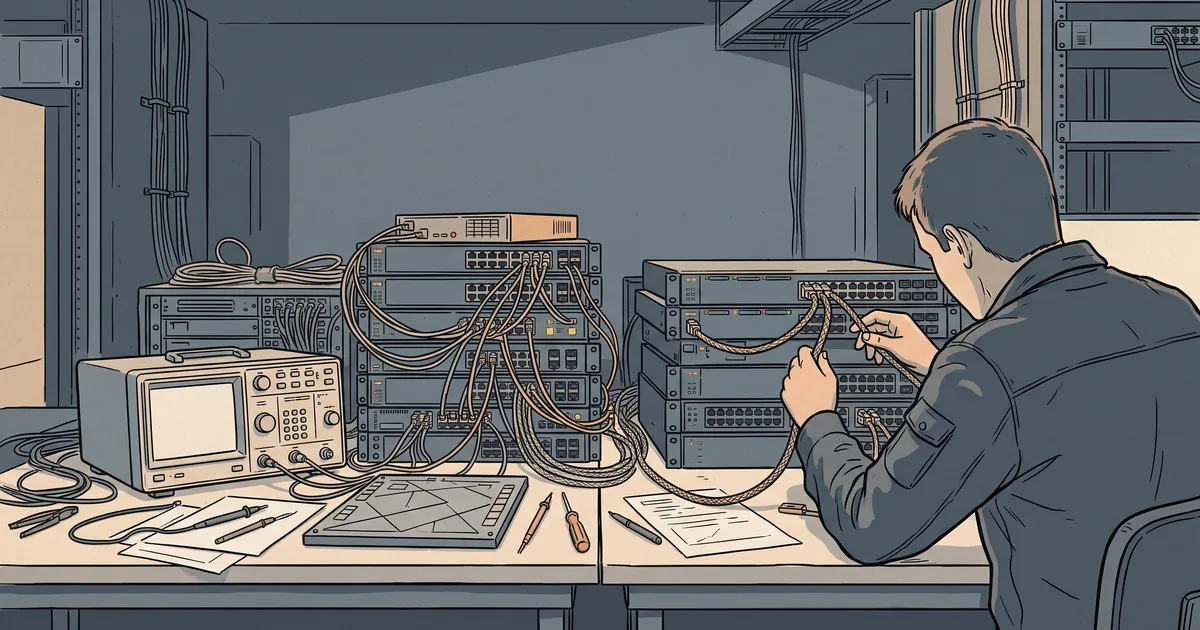
As of January 31, 2018, distributed coordination algorithms fail to sustain synchronization when network transport delays and jitter are abstracted away, causing destructive interference across distributed antenna nodes.
During January 2018, distributed computing practitioners encountered mounting evidence that abstracting away physical infrastructure dynamics introduces severe systemic instability. Research on physical-layer coordination published in (eScholarship (California Digital Library)) underscored that mathematical models treating packet propagation as instantaneous yield catastrophic degradation when deployed over realistic topologies. In concurrent systems, ignoring wire latency, buffering variance, and serialization overhead produces fatal misalignment between local consensus logic and true operational state. This critical friction motivates an essential inquiry:
How does network transport jitter disrupt distributed coordination algorithms?
The January 2018 study on wideband distributed beamforming demonstrated that distributed coordination algorithms fail to sustain synchronization when network transport delays and jitter are abstracted away (eScholarship (California Digital Library)). Formalizing a system-of-systems architectural viewpoint provided critical operational models to prevent cross-boundary failures caused by unaligned network transport assumptions in complex architectures (arXiv (Cornell University)). Algorithms governing wideband distributed beamforming require strict end-to-end transport latency bounds to maintain phase alignment and coherent signal transmission across distributed antenna nodes (eScholarship (California Digital Library)). Analysis of interactive background radiation traffic indicated that anomalous transport-level flows introduce measurement artifacts that distort distributed outage detection protocols (eScholarship (California Digital Library)). The Alluxio virtual distributed file system architecture mitigates remote transport overhead by colocating data caching alongside compute layers across distributed storage tiers (eScholarship (California Digital Library)). Network transport anomalies and propagation jitter disrupt timing-sensitive distributed control loops, requiring active physical and transport-layer modeling in telemetry pipelines (arXiv (Cornell University)). Distributed consensus layers routinely rely on logical clocks or heartbeat cadences to enforce ordering and maintain membership. When software components assume that consensus state propagates uniformly without temporal degradation, transient queueing delays in switches or physical propagation shifts cause desynchronization across independent participants. As demonstrated in architectural research documented by Cornell University, formalizing a system-of-systems architectural viewpoint provided critical operational models to prevent cross-boundary failures caused by unaligned network transport assumptions in complex architectures (arXiv (Cornell University)). Without these rigorous architectural viewpoints, distributed components misinterpret late state announcements as split-brain scenarios, triggering unnecessary leader elections, stale read executions, or degraded operational capabilities across node boundaries. The tangible impact of this abstraction deficit becomes acute in physical and radio coordination. Algorithms governing wideband distributed beamforming require strict end-to-end transport latency bounds to maintain phase alignment and coherent signal transmission across distributed antenna nodes (eScholarship (California Digital Library); arXiv (Cornell University)). When distributed nodes share high-frequency coordination payloads over standard packet-switched links, variable transport latency corrupts signal phase synchrony. If individual transmitters transmit slightly out of phase due to unmeasured transport latency jitter, constructive interference collapses into destructive interference. Rather than amplifying the intended transmission, the system inadvertently degrades overall throughput and produces transmission nulls. The software layer believes it has executed lockstep consensus based on idealized protocol state machines, yet physical reality diverges sharply because the control plane did not incorporate the non-deterministic transit characteristics of the underlying network fabric.
Why do telemetry path anomalies trigger false partition recovery?
Separating the control plane from raw payload dissemination exposes severe architectural vulnerabilities when lower-layer anomalies masquerade as application failures. In global monitoring and edge-sensing topologies, distributed health checks measure reachability and node liveness using continuous probe exchanges. When non-standard traffic anomalies, network noise, or microbursts introduce jitter into telemetry paths, coordination layers miscalculate failure thresholds. The coordination engine concludes that remote worker nodes have halted, when in truth the nodes remain healthy while intermediate network queues experience bursty contention. These false positives cause rapid, destabilizing churn, forcing clusters into expensive state rebalancing and partition recovery routines that saturate the transport fabric even further. Architectures seeking high operational throughput must explicitly account for transport boundaries by altering how data and state interact. Rather than pretending that underlying network calls to remote object stores or distant physical clusters operate with uniform zero-latency semantics, this virtual distributed file system bridges storage and compute by maintaining memory-speed access patterns locally. This design enforces strict interface contracts between hot working sets and remote underlying persistent stores. Compute jobs access localized data directly, reducing the impact of cross-rack transport bottlenecks. The architecture explicitly isolates time-sensitive analytics workloads from unpredictable network transport latencies, acknowledging that relying on instantaneous remote fetches invites queue buildup, worker starvation, and cascading backpressure across the processing cluster. Mitigating these systemic handoff failures requires rigorous telemetry integration across protocol tiers. Network transport anomalies and propagation jitter disrupt timing-sensitive distributed control loops, requiring active physical and transport-layer modeling in telemetry pipelines (eScholarship (California Digital Library); eScholarship (California Digital Library)). Telemetry cannot treat the communication channel as an impenetrable black box. contemporary distributed system operators must instrument transport metrics, including TCP retransmissions, socket queue depths, and buffer utilization, directly into distributed state machines. If a coordination protocol detects elevated jitter or buffer saturation, it must adaptively expand timing budgets or throttle mutation rates before catastrophic partition declarations occur. By acknowledging that state synchronization requires measurable physical transit time, systems can construct defensive recovery paths that degrade gracefully under network contention rather than collapsing under brittle, zero-latency assumptions.
Can active transport modeling prevent catastrophic partition declarations?
Sources
- eScholarship (California Digital Library): Algorithms and Protocols for Wideband Distributed Beamforming, 2018-01-01
- arXiv (Cornell University): System-of-Systems Viewpoint for System Architecture Documentation, 2018-01-21
- eScholarship (California Digital Library): Identifying Traffic Anomalies Interfering with IBR Based Outage Detection, 2018-01-01
- eScholarship (California Digital Library): Alluxio: A Virtual Distributed File System, 2018-01-01