Decoupled Event Architectures and 6G Sensing Limits
Analysis of transport constraints and event-driven architectures across distributed topologies.
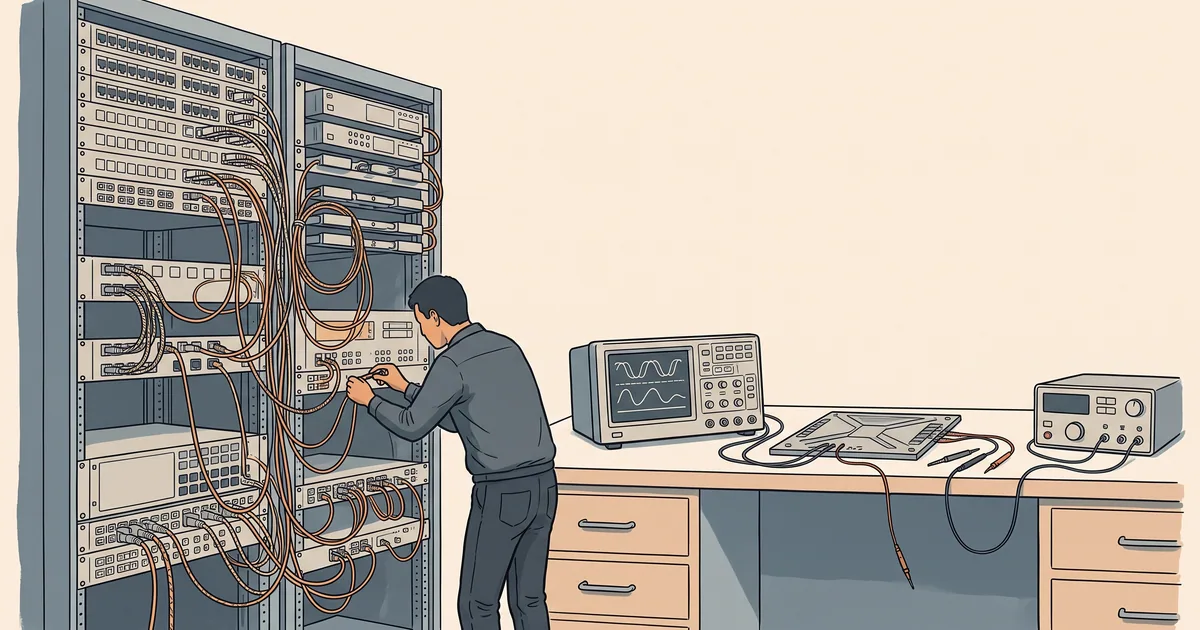
As of April 30, 2025, distributed systems require tight coupling between event brokering pipelines and physical transport latency constraints to prevent queuing collapse across edge networks.
During April 2025, distributed engineering reached a critical crossroad as message-oriented backends struggled to reconcile decoupled orchestration with underlying physical transmission boundaries. When software teams deploy event brokering pipelines across geographically distributed infrastructure, messaging frameworks frequently treat physical connections as uniform substrates with negligible overhead. However, investigations into distributed designs published by the World Journal of Advanced Engineering Technology and Science show that increasing reliance on decoupled event-driven patterns makes logical coordination fragile whenever messaging abstractions drift from underlying network realities. Without explicit awareness of link variability and physical propagation boundaries, asynchronous publishers emit events at rates that outpace network interface buffers. In high-throughput settings, this oversight converts broker persistence layers into systemic bottlenecks. Unmanaged delays accumulate within intermediary queues, producing stale coordination views, timeout storms, and node partition alerts. Addressing these vulnerabilities requires architects to balance decoupled logical abstractions against transport realities.
How Do 6G Sensing Frameworks Constrain Distributed Transmission?
The rapid expansion of distributed intelligent sensing presents acute transport challenges across wireless interfaces. Research compiled in arXiv (Cornell University) details how distributed 6G communication frameworks deploy sensing nodes to extract spatial and environmental context in real time. Because these systems couple high-resolution data streams with local feature extraction algorithms, transmission links experience severe contention when nodes publish continuous telemetry to centralized orchestrators. Statistical methods, contrasted with broader symbolic artificial intelligence techniques that execute deterministic logical deduction, rely on continuous empirical telemetry updates that quickly saturate uplink capacity. When distributed sensing logic assumes unrestricted channel availability, radio frequency interference and propagation limits degrade packet delivery ratios. As a consequence, localized intelligence cannot coordinate actions across wider networks without encountering desynchronization. Control loops that monitor physical environments require rigorous ingestion throttling and transport-aware filtering to prevent raw sensing streams from overwhelming wireless infrastructure.
Why Does Propagation Latency Compromise High-Throughput Message Brokers?
Transport-level congestion across wide-area networks severely alters the operational stability of backend coordination tiers. An architectural analysis in the World Journal of Advanced Research and Reviews indicates that propagation latency and unmanaged network congestion represent primary drivers of degradation in large-scale server infrastructure. When distributed message brokers decouple consumers from producers, broker-side storage disks temporarily mask transport delays. However, prolonged transit slowdowns cause internal topic queues to inflate exponentially. Once consumer confirmation intervals exceed operational thresholds, publisher admission systems fail, cascading memory pressure to upstream components. Implementing adaptive backpressure protocols mitigates this issue by signaling upstream services to restrict request volume before buffer exhaustion occurs. Furthermore, telemetry agents must track physical packet flight times alongside application execution latencies. This dual monitoring ensures schedulers do not route compute-intensive payloads across degraded transit pathways, preserving backend throughput during network fluctuations.
Can Edge Computing Power Systems Prevent Network Saturation?
Industrial infrastructure demonstrates the hazardous operational consequences of ignoring network transport constraints. A review documented in Applied Sciences regarding edge computing architectures within power utility operations reveals that automated distributed control loops collapse if system designs omit transport reliability and link bandwidth boundaries. In electrical grid monitoring, distributed automated switching and substation control systems depend on sub-millisecond status exchanges. When telemetry spikes generate packet loss over constrained utility communication channels, protective relays receive delayed state updates, prompting premature emergency shutoffs or uncoordinated breaker operations. To prevent cascading failures, utility software architectures isolate critical control traffic from non-essential logging streams using prioritized network queues. Embedding strict admission limits and transport latency budgets directly into control contracts allows distributed edge components to switch into autonomous protection modes rather than maintaining dependencies on stalled remote brokers.
Sources
- World Journal of Advanced Engineering Technology and Science: Demystifying event-driven architecture in modern distributed systems, 2025-04-30
- arXiv (Cornell University): Distributed Intelligent Sensing and Communications for 6G: Architecture and Use Cases, 2025-04-17
- World Journal of Advanced Research and Reviews: Optimizing system performance in large-scale backend architectures, 2025-04-27
- Applied Sciences: Comprehensive Review of Edge Computing for Power Systems: State of the Art, Architecture, and Applications, 2025-04-21