Smart Grid Communication Networks Face Latency
Evaluations show distributed control architectures face severe operational bottlenecks when transport-level assumptions fail across networks.
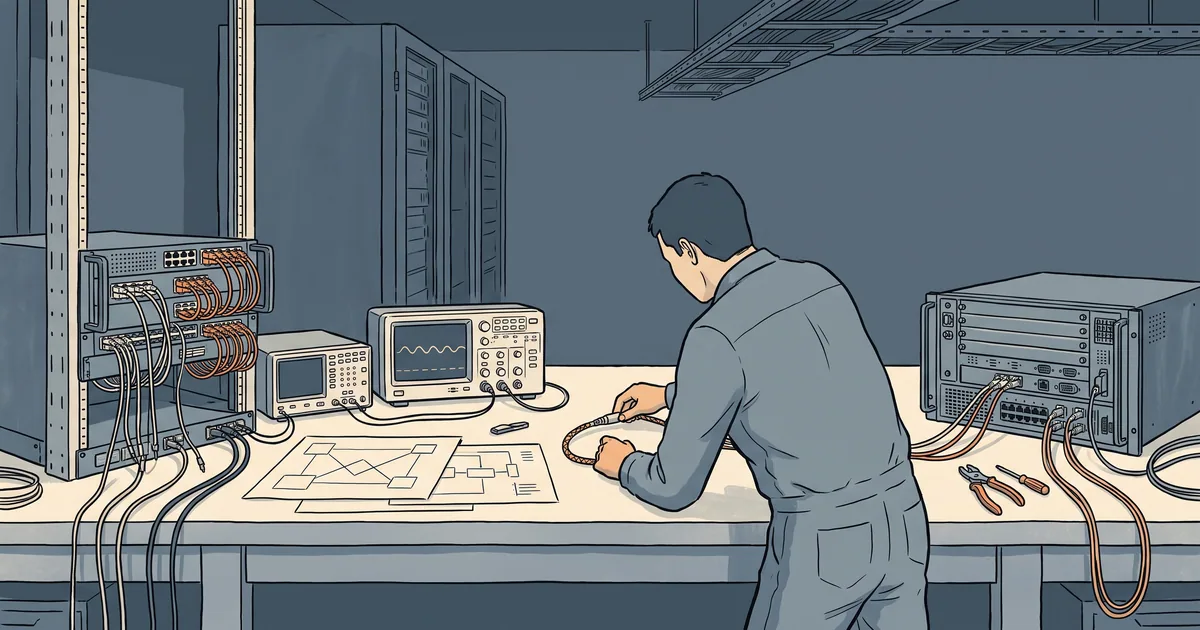
As of May 31, 2024, decentralized grid assets experience misaligned localized control decisions when coordination messages suffer transport delays, causing delayed synchronization and severe operational bottlenecks.
During May 2024, software and infrastructure engineering communities encountered a critical re-examination of distributed systems assumptions. Evaluations published in (arXiv (Cornell University)) demonstrated that distributed control architectures face severe operational bottlenecks when transport-level assumptions regarding low latency and reliable state synchronization fail, prompting a reassessment of monolithic versus distributed architectural trade-offs. As computing frameworks and physical control topologies decentralize, engineers increasingly encounter a fundamental design dilemma: Resolving this dilemma requires examining how protocol latency dismantles state coherence across contemporary networks.
How Do Transport Delays Disrupt Decentralized Grid Assets?
Evaluations published in May 2024 demonstrate that distributed control architectures face severe operational bottlenecks when transport-level assumptions regarding low latency and reliable state synchronization fail, prompting a reassessment of monolithic versus distributed architectural trade-offs (arXiv (Cornell University)). The operational reliability of decentralized infrastructure systems, including smart grids and distributed energy resource networks, depends fundamentally on whether transport protocols can sustain control plane coherence under dynamic physical conditions (Heliyon). Comparative assessments of monolithic versus distributed architectures indicate that inter-service communication overhead and network serialization introduce latency penalties that undermine performance benefits when components are decomposed across network boundaries (Scientific Reports). Agent-based modeling of decentralized grid assets reveals that localized control decisions become misaligned when coordination messages suffer transport delays during acute outage scenarios (Cybersecurity). Analyses of distributed energy islanding detection show that remote detection mechanisms experience reduced accuracy and slower response times when communications infrastructure encounters latency or transmission degradation (arXiv (Cornell University)). Surveys of smart grid communication networks highlight that protocol vulnerabilities and synchronization gaps across distributed telemetry layers expose control systems to operational failure and network-level disruption (Heliyon). When engineers split monolithic domains into distributed microservices or decoupled control planes, they frequently presuppose that the underlying network mimics the deterministic latency of in-memory procedure calls. In reality, socket buffers, packet retransmissions, thread context switches, and transport layer handshakes accumulate non-deterministic delays. When transactions span multiple decoupled nodes, each hop multiplies the variance of wall-clock response times. Distributed consensus protocols and state coordination layers then stall while waiting for acknowledgments, causing internal request queues to saturate and cascading backpressure throughout the ingress pipeline. This dynamic translates directly into cyber-physical operational spheres where software commands trigger physical actions. When electric vehicle battery reserves or localized generation units dispatch balancing commands based on stale telemetry snapshots, conflicting load schedules emerge. Rather than stabilizing regional electrical phases, the delayed synchronization induces oscillation, demonstrating how transport latency degrades the supervisory plane into competing, unsynchronized decision engines.
How Can Protocol Contracts Formalize Transport Assumptions Reliably?
Architecting resilient systems requires drawing strict boundaries between control plane state propagation and payload data transport. When telemetry routing overlaps with operational message buses, transient bandwidth contention instantly inflates control loop latency. If an edge islanding sensor cannot differentiate between a legitimate grid disconnect and transport network delay, protection relays either trip prematurely or fail to isolate hazardous line segments. Engineers must therefore implement strict failure containment zones, preventing transport layer degradation from being misread by application logic as physical state transitions. Network boundaries must enforce explicit validation checkpoints that reject timed-out state assertions rather than allowing stale consensus vectors to propagate silently. Operators must balance synchronization guarantees against operational survivability when configuring distributed interface contracts. For instance, standard telemetry protocols that lack cryptographic authentication or deterministic time stamps allow latency-induced packet reordering to corrupt state registries. When software systems deploy distributed data pipelines, relying on loose eventual consistency introduces severe operational risks for mission-critical actuation. Designers face a trade-off: either accept synchronization stalls through strict distributed locking, or permit temporary state divergence through asynchronous messaging with the burden of complex reconciliation logic. Where high throughput is favored, stale state windows frequently violate domain invariants, proving that network abstractions cannot magically eliminate physical distance. The structural path toward resilience lies in formalizing transport assumptions within protocol contracts instead of treating the network as an invisible transport medium. Architectural patterns must decouple rapid local reflex loops from slower global optimization planes. Local controllers must possess autonomous decision boundaries capable of maintaining baseline stability without continuous remote heartbeat confirmation. Concurrently, global coordination layers must explicitly measure transport round-trip times and degrade operational fidelity gracefully when packet arrival jitter breaches pre-established thresholds. Instead of reflexively distributing application components across networked fabrics, software architects must weigh whether the operational maintenance of distributed consensus justifies the unavoidable serialization, marshalling, and latency penalties that accompany network decomposition.
Can Localized Autonomy Preserve Cohesion Across Physical Networks?
As physical utilities and digital enterprise platforms continue to intertwine in May 2024, the boundary between software architecture and network physics remains unforgiving. Systems designed on the assumption of friction-free transport inevitably fracture under real-world degradation, turning distributed coordination into an operational liability. If decomposed services and edge agents cannot reliably guarantee instantaneous state awareness across physical networks, how far must engineering teams scale back distributed control planes in favor of hardened, localized autonomy before overall operational cohesion is lost?
Sources
- arXiv (Cornell University): The trade-offs between Monolithic vs. Distributed Architectures, 2024-05-06
- Heliyon: Using electric vehicles to enhance power outage resilience – An agent-based modeling approach, 2024-05-29
- Scientific Reports: Enhancing grid resiliency in distributed energy systems through a comprehensive review and comparative analysis of islanding detection methods, 2024-05-27
- Cybersecurity: Study of smart grid cyber-security, examining architectures, communication networks, cyber-attacks, countermeasure techniques, and challenges, 2024-05-01