Distributed Database Fault Tolerance and Network Delays
Evaluations show that distributed database fault tolerance suffers severe degradation when coordination layers ignore network transport delays.
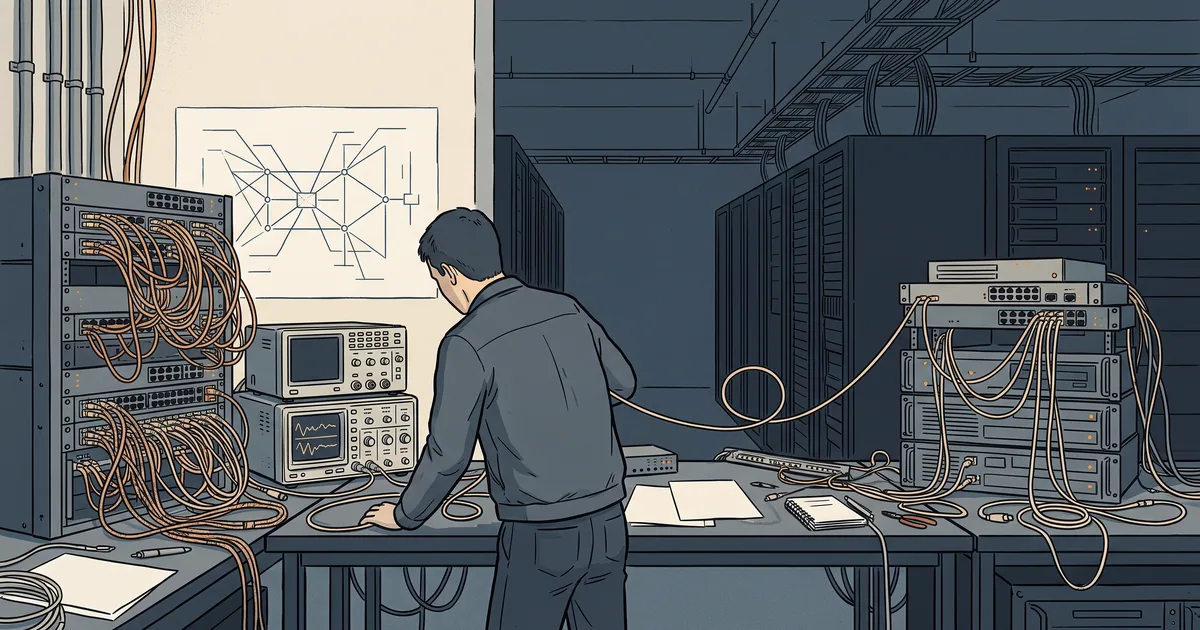
As of November 30, 2013, coordination layers fail under network transport delays because intermediate switch buffers trigger false crash detections, causing leader re-elections and cascading timeouts across surviving nodes.
During November 2013, architectural investigations into distributed database reliability revealed severe systemic instability whenever control-plane designs treated network communication as an instantaneous abstraction. Fresh evaluations documented by research in (Zenodo (CERN European Organization for Nuclear Research)) demonstrated that distributed database fault-tolerance architectures stumble into catastrophic states when real-world propagation characteristics contradict internal clock assumptions. System designers routinely build metadata registries, lock managers, and consensus rings that take minimal latency for granted. This discrepancy brings forth an urgent operational inquiry:
Why Do Coordination Layers Fail Under Network Transport Delays?
Research into distributed database fault tolerance in November 2013 emphasized that coordination layers that overlook real-world network transport delays suffer catastrophic synchronization failures, making transport-aware fault tolerance central to contemporary database reliability (Zenodo (CERN European Organization for Nuclear Research)). Evaluations of scalable data dissemination protocols established the necessity of decoupling control-plane coordination from synchronous network assumptions when operating across unpredictable and high-latency topologies (EURASIP Journal on Wireless Communications and Networking). Distributed database fault-tolerance architectures and data dissemination frameworks experience severe throughput degradation and state divergence when network transport introduces unmodeled message delivery delays (International Journal of Network Security & Its Applications). Peer-to-peer local authentication protocols demonstrate that validating security states locally reduces reliance on high-latency remote network round trips during transaction processing (IEEE Transactions on Vehicular Technology). Vacation-based queuing models in communication systems demonstrate that periodic inactive periods and power-saving sleep schedules introduce structural latency into network message transmission (Zenodo (CERN European Organization for Nuclear Research)). Distributed database systems that integrate peer-to-peer verification mechanisms require fault-tolerance policies designed to handle transport delays without triggering premature node eviction or lock deadlocks (EURASIP Journal on Wireless Communications and Networking). When cluster controllers mandate lock leases or membership heartbeats under idealized round-trip durations, physical packet queuing triggers false crash detections. Contemporaneous evaluations of scalable data dissemination protocols established the necessity of decoupling control-plane coordination from synchronous network assumptions when operating across unpredictable and high-latency topologies (EURASIP Journal on Wireless Communications and Networking). Distributed database fault-tolerance architectures and data dissemination frameworks experience severe throughput degradation and state divergence when network transport introduces unmodeled message delivery delays (Zenodo (CERN European Organization for Nuclear Research); EURASIP Journal on Wireless Communications and Networking). As packets sit in intermediate switch buffers, consensus quorums stall, causing leader re-elections that disrupt active read-write pipelines. Under these delayed conditions, the cluster control plane enters an oscillating failure mode. Nodes that fail to acknowledge heartbeat pings within narrow timeouts are summarily evicted from the active membership set, even though the underlying operating systems and database storage engines remain entirely healthy. The newly elected coordinator attempts to redistribute shard ownership and replay transaction logs, flooding the physical interconnect with recovery traffic. This burst of management packets compounds the queuing backlog across physical top-of-rack switches. Rather than stabilizing the partition, the aggressive rebalancing maneuvers trigger cascading timeouts on surviving nodes. Network transit jitter transforms what should have been a minor transient delay into cluster-wide partition splits, split-brain scenarios, and corrupted distributed lock registries.
How Can Decentralized Verification Prevent Premature Node Eviction?
Architectural resilience requires strict operational separation between control-plane signaling and data plane payload routing. When control mechanisms enforce synchronous validation over remote links, the system inherits every transient latency spike of the transport substrate. Recent advances in peer-to-peer local authentication protocols demonstrate that validating security states locally reduces reliance on high-latency remote network round trips during transaction processing (International Journal of Network Security & Its Applications). Distributed systems can adopt a similar philosophy by delegating point-to-point transaction validity checks to edge nodes rather than blocking on centralized coordinator authorization. Simultaneously, physical transport properties cannot be treated as deterministic channels. Network interfaces and intermediate switches alternate between active processing and idle energy-saving states, producing inherent packet transmission pauses that synchronous algorithms erroneously interpret as node failure. Bridging this divide requires refined interface contracts between distributed control planes and low-level transport stacks. Distributed database systems that integrate peer-to-peer verification mechanisms require fault-tolerance policies designed to handle transport delays without triggering premature node eviction or lock deadlocks (Zenodo (CERN European Organization for Nuclear Research); International Journal of Network Security & Its Applications). In practice, operators must tune cluster telemetry to distinguish between prolonged physical disconnection and transient queuing latency. Rigid millisecond timeouts must yield to adaptive failure detectors that model statistical variance in round-trip times. Machine learning algorithms, which represent statistical pattern recognition subsets of artificial intelligence, can be contrasted with brittle deterministic heuristics because statistical estimators track shifting latency distributions dynamically. Implementing monotonic epoch counters and decentralized verification shields transaction processing from temporary control-plane paralysis, ensuring that brief network hesitations do not cascade into permanent distributed lock contention. Under such a decomposed architecture, failure containment boundaries are clearly drawn between membership governance and transaction processing. If a network partition or a hardware vacation cycle delays control traffic, independent storage replicas continue satisfying localized reads and writes using optimistic concurrency schemes or localized lease renewals. Telemetry frameworks must expose socket-level transit times, queue occupancy depths, and packet retransmission rates directly to distributed consensus drivers.
Can Distributed Databases Preserve Linearizability Across Wide Topologies?
As distributed architectures expand across heterogeneous networks in late 2013, the hazard of designing control planes around idealized transport behavior remains a critical engineering pitfall. Isolating transaction validation from remote coordination mitigates immediate stalls, yet fundamental tensions persist between strict global consistency and transport reality. If physical networks inevitably introduce variable structural delays through queue buffering and hardware idle cycles, can future distributed databases ever achieve true linearizability across wide geographical topologies without ultimately sacrificing transactional availability during transport volatility?
Sources
- Zenodo (CERN European Organization for Nuclear Research): Fault Tolerance In Distributed Database Systems, 2013-11-23
- EURASIP Journal on Wireless Communications and Networking: A scalable data dissemination protocol for both highway and urban vehicular environments, 2013-11-04
- International Journal of Network Security & Its Applications: A Need for Peer-To-Peer Strong Local Authentication Protocol (P2PSLAP) in Mobile Banking, 2013-11-30
- IEEE Transactions on Vehicular Technology: A Vacation-Based Performance Analysis of an Energy-Efficient Motorway Vehicular Communication System, 2013-11-19