Cooperative Wireless Architectures Under Transport Latency
Transport latency degrades cooperative wireless architectures when distributed control mechanisms operate on stale state information.
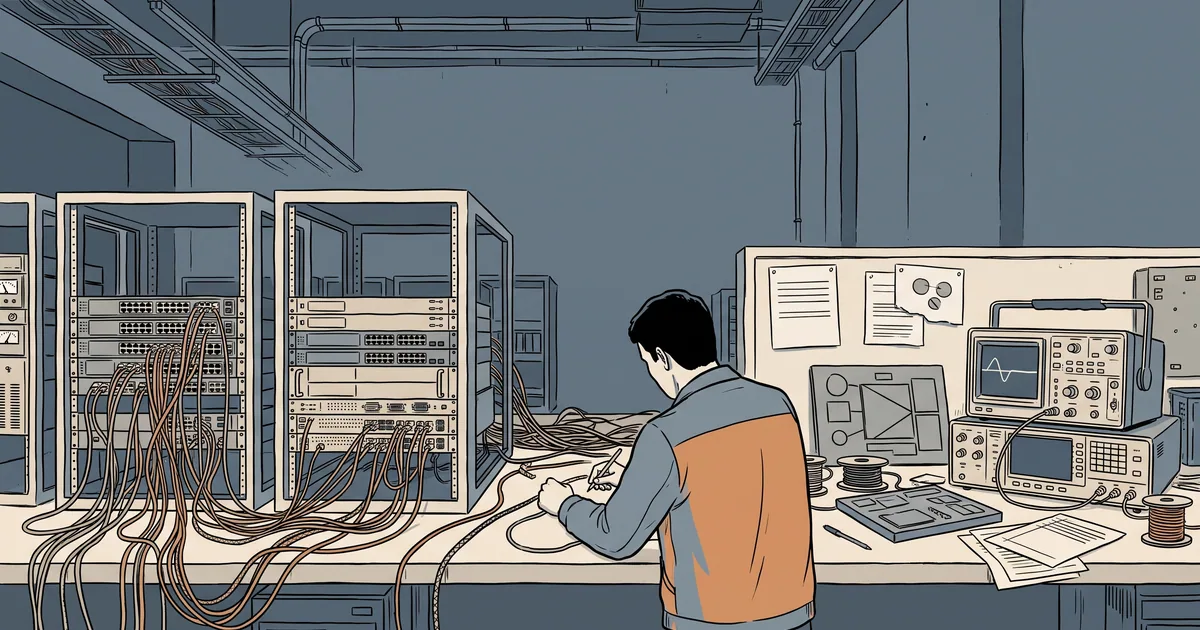
As of December 31, 2013, channel state information aging degrades cooperative wireless networks because signaling latency exceeds channel coherence time, causing transmission decisions to execute on stale metrics.
During December 2013, network architects encountered a recurring systemic failure across cooperative wireless architectures and decentralized power grids: distributed coordination mechanisms were increasingly designed around ideal abstractions rather than physical channel realities. Theoretical evaluations of hybrid device-to-device uplink cooperation published in contemporaneous literature (arXiv (Cornell University)) brought this friction into sharp focus by showing how control feedback delays degrade collaborative throughput. Engineers and systems theorists must therefore confront a foundational dilemma:
How does channel state information aging degrade cooperative wireless networks?
Evaluating outage performance in hybrid device-to-device uplink schemes demonstrated that cooperative device control strategies risk severe throughput penalties when transport-layer feedback does not match dynamic physical channel variations (arXiv (Cornell University)). Outage and energy-efficiency analyses in cognitive multi-antenna relay networks established that optimal distributed power allocation breaks down if relay coordination ignores physical-layer network coding and transport latency realities (KSII Transactions on Internet and Information Systems). Mathematical modeling of hybrid D2D uplink cooperation and multi-antenna cognitive relays revealed that transmission outage probabilities rise sharply without precise, timely channel state information during distributed relay power allocation (UWSpace (University of Waterloo)). Automated reconfiguration and self-healing algorithms in distribution systems with high distributed generation penetration depend on real-time switching constraints to prevent localized control actions from destabilizing the network (DOI Registry). Real-time monitoring and advisory control systems for distribution feeders rely on continuous health management telemetry to execute feeder performance adjustments under constrained communication channels (arXiv (Cornell University)). Distributed management frameworks across cooperative wireless uplinks and decentralized generation networks encounter structural bottlenecks when control-plane signaling latency exceeds physical transport response speeds (KSII Transactions on Internet and Information Systems). The operational friction emerges when distributed control algorithms treat the underlying communication fabric as a transparent, instantaneous transaction medium. Simultaneously, outage and energy-efficiency analyses in cognitive multi-antenna relay networks established that optimal distributed power allocation breaks down if relay coordination ignores physical-layer network coding and transport latency realities (KSII Transactions on Internet and Information Systems). Mathematical modeling of hybrid D2D uplink cooperation and multi-antenna cognitive relays revealed that transmission outage probabilities rise sharply without precise, timely channel state information during distributed relay power allocation (arXiv (Cornell University); KSII Transactions on Internet and Information Systems). When state dissemination trails the rapid temporal fading of physical links, participating nodes allocate transmission power against phantom topologies that have already vanished. At the protocol level, this mismatch manifests as channel state information aging, where control decisions are executed on stale metrics. In cooperative multi-hop or relay topologies, nodes exchange local channel estimates to schedule beamforming vectors, power tiers, and multiplexing schedules. Because signaling packets traverse real channels governed by queuing delays, scheduling overhead, and retransmission backoffs, the latency of control signaling inevitably exceeds the coherence time of the channel. When intermediate relays apply physical-layer network coding to stale incoming signals, phase and amplitude misalignments corrupt decoding at destination nodes. The control plane operates under the mathematical assumption that state vectors converge instantaneously, yet the physical transport introduces packet jitter and non-deterministic queuing. Consequently, collaborative gain quickly erodes into severe interference, forcing nodes to trigger repetitive retransmissions that further saturate the shared transport layer.
Can bounded pessimism mitigate cascading failures across physical utility grids?
The identical structural vulnerability governs physical utility grids, where distributed energy resources introduce severe dynamic variability. When local generators and sectionalizing switches attempt autonomous reconfiguration without strict temporal bounds, transient voltage swings propagate across adjacent branches before supervisory systems can intervene. Distributed management frameworks across cooperative wireless uplinks and decentralized generation networks encounter structural bottlenecks when control-plane signaling latency exceeds physical transport response speeds (arXiv (Cornell University); UWSpace (University of Waterloo)). In both environments, the control plane cannot maintain state consistency faster than the transit delay of the physical handoff, causing protective disconnects or packet drops. Managing these boundaries demands a strict architectural separation between operational telemetry and execution commands. Without accurate streaming telemetry, advisory control engines generate dispatch setpoints predicated on invalid feeder configurations. The fundamental trade-off lies between synchronization precision and channel saturation: broadcasting state updates continuously taxes limited bandwidth, while sparse sampling forces control routines to extrapolate over stale baselines. Network operators cannot simply treat communication links as lossless remote procedure call conduits. Instead, control logic must validate the temporal freshness of health metrics and channel indicators before issuing authoritative switching or transmission commands. To prevent cascading control failures, system designs must enforce defensive failure containment at the interface between the control plane and physical transport. When synchronization acknowledgments do not arrive within strict coherence windows, distributed nodes must fall back to conservative autonomous policies rather than attempting aggressive optimization. In cognitive relay networks, relays must downscale transmission power or default to direct infrastructure routes whenever state uncertainty exceeds threshold tolerances. In distribution feeders, local autonomous relays must inhibit automated switching sequences unless bilateral telemetry guarantees that neighbor nodes are stationary. Such interface contracts shift the control posture from optimistic synchronization to bounded pessimism. By explicitly treating transport latency as a first-class constraint rather than negligible friction, architectures insulate themselves from the destabilizing dynamics of stale state convergence.
Why must cooperative control algorithms accommodate asynchronous state decay?
The core engineering insight established by late 2013 is that cooperative control algorithms cannot exist in isolation from transport latency constraints. When distributed systems presume immediate global awareness, they exchange predictable localized performance for brittle collective failures. Whether coordinating cognitive radio uplinks or self-healing power grids, architectural resilience requires designing control loops that explicitly accommodate asynchronous state decay. Systems that fail to verify channel timeliness before committing collaborative actions will inevitably succumb to the physical realities of the networks they inhabit.
Sources
- arXiv (Cornell University): Spectral Efficiency and Outage Performance for Hybrid D2D-Infrastructure Uplink Cooperation, 2013-12-08
- KSII Transactions on Internet and Information Systems: Optimal Energy-Efficient Power Allocation and Outage Performance Analysis for Cognitive Multi-Antenna Relay Network Using Physical-Layer Network Coding, 2013-12-29
- UWSpace (University of Waterloo): Reconfiguration and Self-healing Mechanisms in Distribution Systems with High Distributed Generation (DG) Penetration, 2013-12-16
- DOI Registry: Real-Time Distribution Feeder Performance Monitoring, Advisory Control, and Health Management System, 2013-12-29