Decentralized Control Across Autonomous Physical Agents
Ignoring real-world latency bounds destabilizes decentralized control loops across autonomous physical agents in dynamic networks.
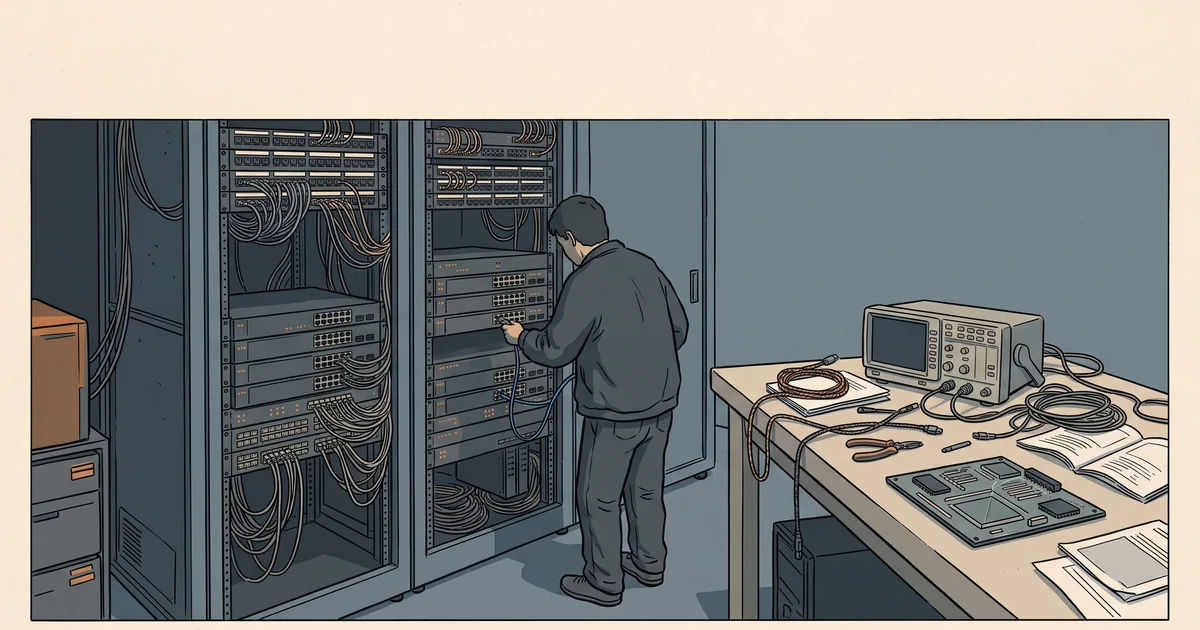
As of April 30, 2008, network transport delay decouples local perception from global reality, turning negative feedback into destructive positive feedback across autonomous nodes.
During April 2008, empirical investigations into distributed robotics and wide-area service networks exposed a critical vulnerability in decentralized system designs. Recent findings on distributed coordination architectures for multi-robot formation control, published in (Elsevier BV), demonstrate that ignoring real-world latency bounds destabilizes decentralized control loops across autonomous physical agents. When system architects construct coordination layers under the mathematical convenience of zero-delay messaging, physical networks inevitably falsify these assumptions through packet loss, buffer bloat, and transmission jitter.
Why Does Network Transport Delay Destabilize Decentralized Control?
Research published in April 2008 on distributed coordination architectures for multi-robot formation control demonstrates that ignoring real-world latency bounds destabilizes decentralized control loops across autonomous physical agents (Elsevier BV). The design of software architectures for medical distributed management systems underscores the vital necessity of rigorous state synchronization guarantees in mission-critical distributed network domains (IEEE). Distributed coordination frameworks fail when protocols assume instantaneous propagation, creating unstable oscillation bottlenecks between autonomous units experiencing network transport delay (Informa UK Limited). Extensible distributed grid monitoring systems like Gridscape II address node state tracking across wide-area networks through decoupled portal architectures (IEEE). Generalized distributed multi-antenna architectures rely on distributed spatial coordination and location tracking methods to maintain node awareness in Beyond 3G network environments (Elsevier BV). Decentralized control architectures must explicitly incorporate network transport latencies into formation control laws to maintain spatial convergence and operational safety (IEEE). The emergence of dynamic distributed networks reveals how fragile decentralized algorithms become when packet transit delays decouple local perception from global reality. This instability is not confined to mobile mechanical units; the design of software architectures for medical distributed management systems underscores the vital necessity of rigorous state synchronization guarantees in mission-critical distributed network domains (IEEE). In clinical networks, where delayed telemetry can trigger erroneous automated interventions, as well as in robotic vehicle clusters, stale state vectors lead nodes to execute control corrections against phantom positions. At the protocol level, this breakdown typically manifests as a phase shift between the true state of a remote participant and the local belief model held by its peers. When an autonomous node assumes that neighbor coordinates arrived synchronously, it computes corrective trajectory vectors based on outdated historical postures. Once the actual correction propagates across the communication fabric, the originating neighbor has already altered its heading, initiating an overcompensation cycle that amplifies with every message exchange. Rather than reaching geometric convergence, the distributed topology experiences spatial jitter or systemic divergence. Without explicit timestamp verification, bounded message queues, and forward-projecting kinematic filters, the system misinterprets network transit lag as physical error, turning what should be stabilizing negative feedback into destructive positive feedback. This architectural flaw illustrates that protocol latency is not simply a performance penalty, but an active disturbance input in closed-loop systems.
How Do Decoupled Software Architectures Prevent Cascading Failures?
To prevent cascading control failures, architectural boundaries must enforce a strict separation between low-frequency control-plane agreements and high-frequency operational payload delivery. By isolating telemetry collection from operational display mechanisms, Gridscape II demonstrates that state aggregation across disparate geographical sites requires explicit buffering and asynchronous consensus rather than lockstep handshakes. Without these containment barriers, an unexpected routing delay in one subnet will propagate lockups or stale data cascades into adjacent autonomous clusters. Such decoupling ensures that intermittent packet latency or route churn does not directly stall ongoing local operational tasks, preserving execution integrity across fluctuating communication links. Operational constraints further dictate how wireless nodes navigate physical media variability while preserving situational awareness. In these advanced radio systems, spatial diversity and multi-point coordination succeed only because channel state information incorporates delay compensation and channel estimation metrics. If base stations or mobile terminals were to presume instantaneous antenna calibration across distributed apertures, interference mitigation would collapse into cross-channel corruption. System designers must treat state dissemination as an estimation problem governed by transport boundaries, employing explicit leasing, expiration time-to-live attributes, and localized validation gates before acting on remote state messages. Recovering from transient link degradation requires autonomous nodes to maintain fallback modes that degrade gracefully when latency exceeds predefined thresholds. When transport latencies breach safety bounds, nodes must switch from cooperative consensus algorithms to autonomous inertial dead-reckoning or localized safety invariants. These interface contracts ensure that missing or delayed packets do not cause deadlocks or unconstrained oscillations. Software architectures must therefore decouple peer-to-peer heartbeat messaging from immediate actuation loops, using predictive estimators such as Kalman filters to extrapolate peer behavior over transport gaps. In this manner, decentralized nodes navigate network degradations by bounding uncertainty rather than demanding unattainable instantaneous global consensus. By treating network latency as a continuous, dynamic state variable rather than an ignorable overhead, distributed systems establish operational resilience even under volatile propagation delays.
Can Decentralized Architectures Reconcile Consistency With Agility?
As distributed systems expand across robotics, telecommunications, and wide-area grid computing in 2008, engineers must discard the assumption of instantaneous message transit. When coordination protocols ignore real-world latency, divergence and instability become mathematical certainties. While decoupled monitoring architectures and delay-aware control laws provide localized stability, an essential architectural challenge remains unresolved: How can distributed autonomous systems guarantee deterministic global consistency under arbitrary, non-stationary network latency without sacrificing localized agility and operational throughput?
Sources
- Elsevier BV: Distributed coordination architecture for multi-robot formation control, 2008-04-08
- IEEE: Software architecture for medical distributed manage systems, 2008-04-11
- Informa UK Limited: Gridscape II: An extensible grid monitoring portal architecture and its integration with Google Maps, 2008-04-14
- IEEE: Generalized Distributed Multi-antenna Architecture Based Location Technology for Beyond 3G Systems, 2008-04-17