Wide Area Networking Across LHCNet Infrastructure
Managing transport control overhead and state propagation across dynamic topologies challenges high-energy physics pipelines.
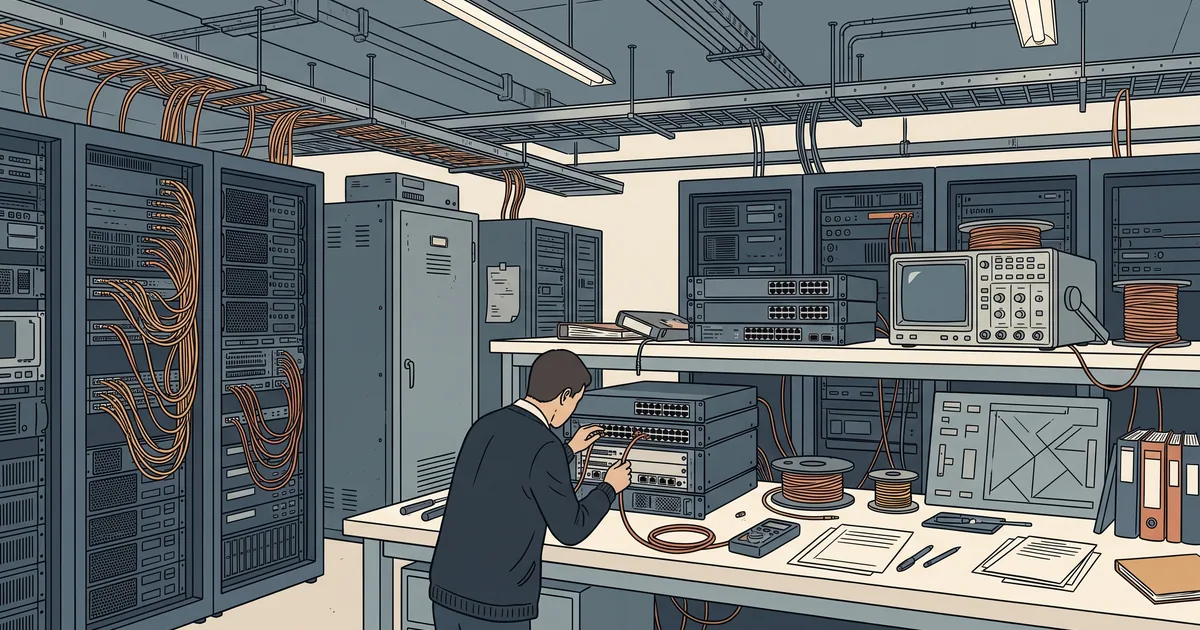
As of August 31, 2007, wide area networking across international research grids confronts transoceanic propagation delays that induce oscillatory buffer overflow cycles and degrade overall channel capacity.
During August 2007, engineers and network theorists increasingly confronted fundamental scaling penalties whenever distributed architectures decoupled physical transmission from global consensus. As analytical assessments of CDMA forward links published in (UTA ResearchCommons (University of Texas Arlington)) revealed, dynamic transmission environments penalize protocols that treat propagation delays as negligible anomalies rather than structural constraints. When distributed systems mandate immediate consistency across physically separated partitions, stale information cascades through scheduling loops and degrades overall capacity. This operational tension forces systems designers to confront an unyielding foundational dilemma:
How does propagation delay degrade wide area networking capacity?
In August 2007, wide area networking and collaborative infrastructures for high-energy physics emerged as vital backbones for international research grids, where distributed petascale pipelines required continuous high-throughput transport across continental boundaries (UTA ResearchCommons (University of Texas Arlington)). Managing transport control overhead and state propagation across dynamic topologies represented a critical design challenge for mid-2007 communications architectures seeking to maintain low-latency coordination without degrading transmission capacity (DOI Registry). Infrastructure analyses of LHCNet documented dedicated wide-area network deployments and collaborative systems configured to support sustained data exchange for high-energy physics workflows (DOI Registry). Protocol evaluations of DTLSR examined link-state routing and synchronization behavior across distributed network nodes subject to control plane state management constraints (ACM SIGCOMM Conference on Applications, Technologies, Archit). Contemporary routing research analyzed the balance between structural coordination mechanisms and randomized forwarding in wireless opportunistic routing protocols to improve delivery performance under uncertain link states (UTA ResearchCommons (University of Texas Arlington)). Analytical assessments of CDMA forward links detailed how base station power control mechanisms and soft handoff interactions govern system outage probability and overall channel capacity across coverage boundaries (DOI Registry). When large data bulk transfers encounter transoceanic propagation delays, the assumption that endpoint state mirrors remote queue occupancy inevitably breaks down. TCP window adjustments and rate controls lag behind instantaneous switch fabric bottlenecks, inducing oscillatory buffer overflow cycles and underutilization across provisioned optical paths. The physical distance between data producers and ingestion clusters introduces an unavoidable temporal skew, rendering simultaneous consensus over transient network telemetry fundamentally unattainable. Within dynamic topologies, flooding link-state updates to preserve global views consumes substantial channel overhead, producing stale routing tables when convergence times exceed the churn rate of individual links. Similarly, analytical assessments of CDMA forward links detailed how base station power control mechanisms and soft handoff interactions govern system outage probability and overall channel capacity across coverage boundaries (UTA ResearchCommons (University of Texas Arlington)). When cellular base stations coordinate power allocations based on delayed feedback, interference flares unpredictably across adjacent cells. Across both wireless interfaces and wired optical backbones, enforcing strict instantaneous synchronization triggers control channel thrashing, in which the signaling traffic generated to resolve state ambiguity eclipses the primary data payload itself.
How do localized forwarding heuristics isolate failure domains?
To mitigate these synchronization pathologies, contemporary architectures strictly segregate the control plane from high-bandwidth transport paths. If routing decisions require synchronous round-trip acknowledgments across transcontinental spans, packet forwarding halts during transient link flaps. By establishing clear validation boundaries, edge switches can execute localized forwarding decisions using speculative or probabilistic state heuristics rather than waiting for global consensus convergence. Link-state algorithms like DTLSR demonstrate that limiting synchronization frequency and bounding state propagation to localized topology neighborhoods isolates failure domains (DOI Registry). This containment prevents local routing fluctuations from triggering global route recalculation storms. System resilience depends on establishing decoupled operational layers where forwarding engines process buffered payloads under well-defined error budgets, regardless of temporary divergence in the supervisory control plane. Network operators encounter severe practical trade-offs when tuning interface contracts between wide area circuits and real-time coordination engines. Demanding strict serializability across globally distributed databases requires distributed locking primitives that stall client threads whenever wide-area latency spikes. Conversely, relaxing interface contracts to tolerate eventual consistency risks split-brain outcomes and data divergence under network partitions. In high-energy physics backbones such as LHCNet, telemetry mechanisms prioritize sustained throughput metrics over tight inter-node locking, delegating anomaly recovery to application-level checkpointing (DOI Registry). Telemetry collection must avoid feedback loops: if monitoring agents flood status messages during congestion episodes, the telemetry stream directly compounds buffer exhaustion. Operators must therefore calibrate measurement granularity against the cost of synchronization bandwidth. Structural resilience emerges when system designs abandon lockstep coordination in favor of asynchronous, opportunistic mechanisms. As demonstrated in opportunistic wireless routing studies, replacing deterministic multi-hop path coordination with randomized forwarding candidate sets mitigates the penalty of volatile link conditions (ACM SIGCOMM Conference on Applications, Technologies, Archit). Nodes capitalize on packet reception events opportunistically rather than orchestrating brittle end-to-end consensus. Parallel principles apply to wide-area transport pipes: decoupled queue management, multi-path transport protocols, and localized power control adaptations isolate nodes from remote latency variations. Recovery paths must operate autonomously through idempotent reconciliation phases rather than monolithic rollback routines. By recognizing propagation delay as an inviolable physical boundary, systems preserve forward progress under adverse network partitioning.
Why must future distributed topologies embrace partial observability?
The architectural tension observed across mid-2007 network paradigms underscores an inescapable boundary condition: absolute state synchronization across wide area links is an operational fiction. When systems insist on zero-latency agreement, the resulting friction manifests as collapsed channel capacity, signaling storms, and cascading outages. Surviving the scaling requirements of international computing backbones and high-density radio links demands embracing partial observability and asynchronous state convergence. The fundamental challenge remains: how can future distributed topologies maintain reliable global coordination without surrendering local operational autonomy to the speed of light?
Sources
- UTA ResearchCommons (University of Texas Arlington): Effects Of Base Station Power Control And Soft Handoff On The Outage And Capacity In The Forward Link Of CDMA Systems, 2007-08-23
- DOI Registry: LHCNet: Wide Area Networking and Collaborative Systems for HEP, 2007-08-20
- DOI Registry: DTLSR, 2007-08-27
- ACM SIGCOMM Conference on Applications, Technologies, Archit: Trading structure for randomness in wireless opportunistic routing, 2007-08-27