Edge Computing and 5G Network Elasticity Limits
analysis of how physical transport delays constrain dynamic resource orchestration across 5G networks and edge computing systems.
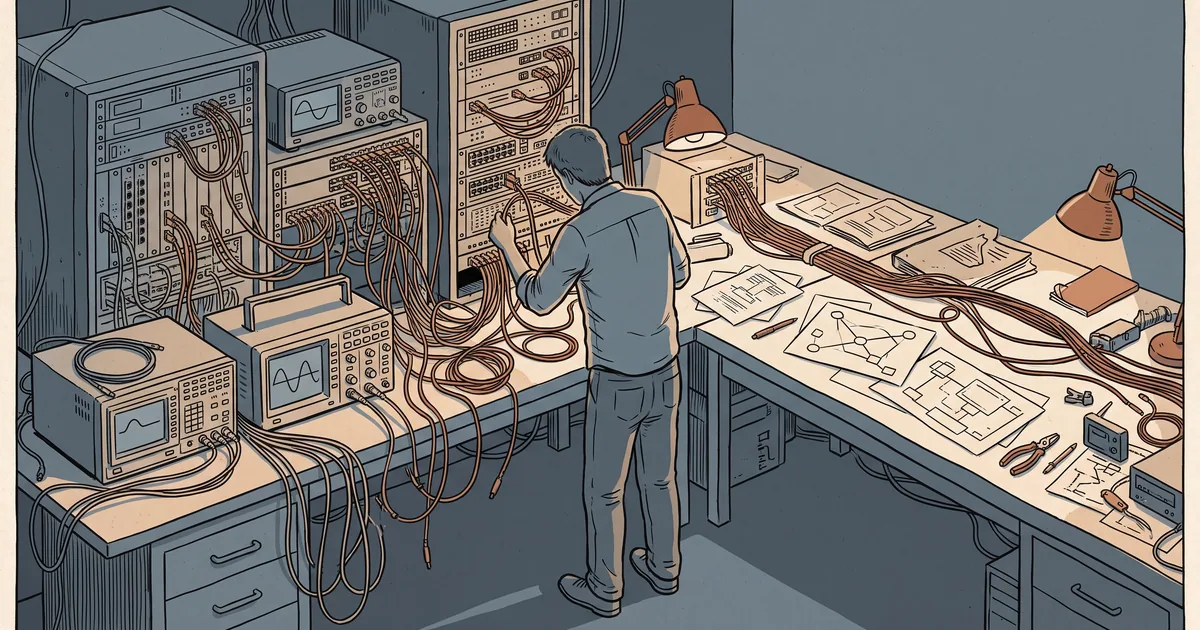
As of April 30, 2018, researchers demonstrate that dynamic 5G network elasticity and edge IoT control loops degrade when orchestration software abstracts away physical propagation delays and transport latency.
During April 2018, infrastructure researchers demonstrated that 5G network elasticity cannot function as an unconstrained software abstraction isolated from transport topology. When orchestration platforms scale compute instances across wide-area deployments, physical propagation delay imposes concrete boundaries on real-time control loops. As evaluated in the IEEE Wireless Communications and Networking Conference Works, dynamic resource allocation models experience severe synchronization penalties when management logic ignores underlying transport latency. Cloud-native virtualization strategies often assume instantaneous reconciliation between scheduling routines and remote base stations, but packet transit times introduce state discrepancies that compromise system stability. By treating backhaul links as transparent pipes, centralized hypervisors issue provisioning commands based on outdated telemetry metrics. This friction exposes an operational divide between high-level orchestration abstractions and physical network dynamics, revealing that elastic scaling mechanisms require direct integration with underlying channel profiles to sustain deterministic execution.
How Do Fog Computing Architectures Handle Stale Telemetry?
Decoupling control-plane coordination from transport-level transmission delays degrades responsiveness across distributed deployments. Investigations into fog computing architectures presented at the International Conference on Fog and Mobile Edge Computing (F confirm that dynamic IoT provisioning suffers latency penalties when control loops depend on remote telemetry synchronized across high-latency backhaul connections. When distributed nodes experience transmission lag, control instances receive telemetry out of order or after significant queuing delays. Orchestrators executing horizontal auto-scaling algorithms inadvertently induce control hunting: rapid cycles of resource over-provisioning followed by sudden deallocations. This oscillatory behavior consumes excessive network bandwidth and compute overhead, eroding the benefits of low-latency edge deployment. To mitigate state drift, system designers must integrate transport-aware feedback thresholds directly into edge coordination routines, ensuring that nodes discard obsolete telemetry packets before triggering resource migration.
Can Rural Smart Grid Distribution Tolerate Centralized Latency?
Empirical assessments of rural distribution smart grid networks demonstrate that physical distance and constrained communication links impose rigid latency boundaries on centralized management architectures. Field evaluations published in Energies reveal that electrical substations connected via constrained cellular or radio links cannot reliably stream continuous state telemetry back to central dispatch centers. Remote feeder lines experiencing intermittent communication blackouts destabilize centralized state estimation algorithms, resulting in uncoordinated tap-changer operations and voltage deviations. The physical layout of rural distribution topologies dictates that operational monitoring must execute close to the point of measurement. Because propagation delays and low-bandwidth channels create unavoidable communication bottlenecks, centralized supervisory control fails to provide real-time guarantees, requiring regional automation devices to filter and buffer data before transmitting summarized alerts to central utilities.
Do Self-Organizing Architectures Preserve Voltage Stability Under Disruption?
Self-organizing architectures in electrical distribution grids maintain stable voltage control by replacing centralized communication with localized coordination under transport disruption and denial-of-service conditions. Research documented in the IEEE Transactions on Smart Grid demonstrates that autonomous peer-to-peer equilibrium models allow distributed voltage regulators to reach consensus without upstream supervisory intervention. When adversary-induced denial-of-service attacks or transit link failures sever connection lines, voltage control schemes relying on localized coordination dynamically recalculate reactive power setpoints using adjacent node telemetry. This decentralized posture isolates disruptions to isolated feeder segments, preventing wide-area grid instability. By embedding physical network constraints and local boundary checks into autonomous control agents, cyber-physical infrastructures maintain operational reliability even when primary communication channels experience total throughput degradation.
Sources
- IEEE Wireless Communications and Networking Conference Works: The path towards resource elasticity for 5G network architecture, 2018-04-01
- International Conference on Fog and Mobile Edge Computing (F: On the development of IoT systems, 2018-04-01
- Energies: Smart Grid Architecture for Rural Distribution Networks: Application to a Spanish Pilot Network, 2018-04-04
- IEEE Transactions on Smart Grid: Using Self-Organizing Architectures to Mitigate the Impacts of Denial-of-Service Attacks on Voltage Control Schemes, 2018-04-03