Distributed Networked Control Systems Stability
Unmodeled transport delays, packet jitter, and verification overhead destabilize distributed networked control systems.
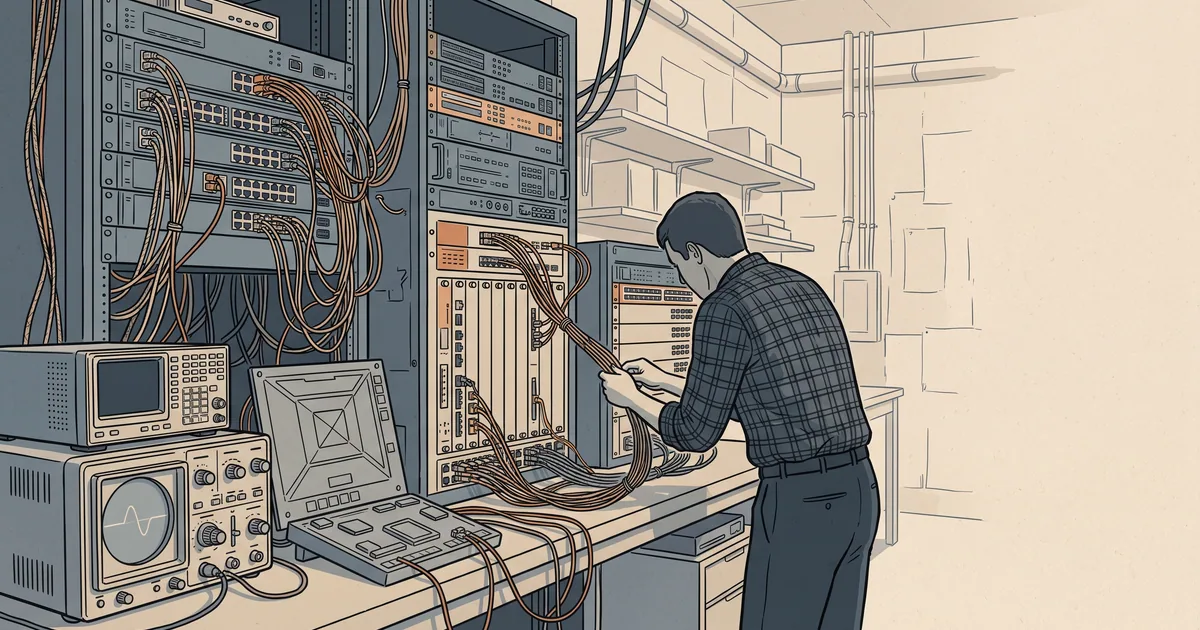
As of August 31, 2013, unmodeled transport delays, dynamic route reassignment, and queue variations rupture continuous feedback loops, producing severe mechanical oscillations and destabilizing physical processes.
During August 2013, rapid expansions in distributed computation exposed severe operational limits where physical actuation meets packet-switched communication. As highlighted in research from North Carolina State University published in the (NCSU Libraries Repository (North Carolina State University L), control theorists and system architects increasingly confront physical disruptions caused by non-deterministic network layers. When designers migrate closed-loop physical systems to distributed networks, the foundational presumption of instant data exchange collapses. The resulting degradation reveals that ignoring transport mechanics imperils stability.
How Do Network Transport Delays Destabilize Physical Feedback Loops?
In August 2013, North Carolina State University research established that maintaining stability in distributed networked control systems requires built-in defensive control methodologies to prevent transport-level disturbances from destabilizing physical processes (NCSU Libraries Repository (North Carolina State University L). The National Institute of Standards and Technology report in August 2013 highlighted that integrating cloud computing into cyber-physical smart systems fundamentally challenges conventional network transport models by coupling deterministic physical requirements with variable distributed fabrics (DOI Registry). Investigations across NCSU and NIST publications in August 2013 demonstrated that unmodeled transport delays and degraded state synchronization across communication channels lead to severe control performance degradation in distributed networked systems (arXiv (Cornell University)). A comprehensive August 2013 survey on distributed and cloud infrastructures outlined that scaling compute and storage nodes across wide-area networks introduces substantial latency and communication bottlenecks that impair state coordination (Research Repository (Delft University of Technology)). Research into cloud access architectures in August 2013 documented that mediating secure communication between diverse endpoints and remote software-as-a-service platforms creates boundary management and session verification bottlenecks across public transport layers (NCSU Libraries Repository (North Carolina State University L). Studies published in August 2013 on networked control and distributed computational infrastructures revealed that assuming underlying network transparency leads directly to coordination failures during periods of transport congestion (DOI Registry). Simultaneously, the National Institute of Standards and Technology report in August 2013 highlighted that integrating cloud computing into cyber-physical smart systems fundamentally challenges conventional network transport models by coupling deterministic physical requirements with variable distributed fabrics (DOI Registry). Classical feedback loops rely upon continuous differential equations or regular discrete-time intervals. When engineering teams place feedback loops over IP networks, packet jitter, dynamic route reassignment, and buffer bloat rupture this mathematical ideal. When actuator commands arrive out of order, or sensor measurements arrive stale, standard matrix estimators fail, producing severe mechanical oscillations, hunting behavior, or automatic emergency shutdowns. The underlying issue stems from a flawed architectural abstraction: treating the network fabric as a transparent, stateless wire. As intermediate switches queue frames, round-trip times vary unpredictably. If a distributed control algorithm presumes that every participating node possesses identical, instantaneous state vectors, any transport drop decouples the state estimation from reality. Instead of dampening physical perturbations, delayed correction signals amplify disturbance vectors, driving mechanical and electrical devices outside safe operating margins.
How Can Engineers Decouple Physical Control From Distributed Coordination?
Solving these systemic bottlenecks requires decoupling high-rate physical control from low-rate distributed coordination while securing transport boundaries. When remote nodes establish cryptographic tunnels or conduct continuous authentication across public networks, handshakes and cryptographic verification inject bursty computational latency into real-time streams. System architects must therefore establish strict separation of concerns: local microcontroller loops must run autonomously using deterministic buses to guarantee basic stability, while non-deterministic transport links are relegated solely to supervisory setpoint negotiation. Transport interfaces must enforce validation barriers that drop out-of-order state vectors rather than processing obsolete instructions that corrupt actuator setpoints. This separation introduces acute operational trade-offs between optimization and autonomous safety. When operators attempt to run plant-wide optimization models, telemetry streams from industrial sensors must compete with management traffic across shared switches. Because industrial Ethernet and standard enterprise protocols maintain disparate quality-of-service semantics, enterprise traffic bursts often starve control-plane telemetry. Engineers must construct clear interface contracts, defining explicit time-to-live thresholds for state packets. If a control-plane payload fails to arrive within its allocated temporal window, the consumer node must discard it and fall back to local dead-reckoning models. By implementing explicit timeout budgets and stale-data reject policies, engineers prevent stale telemetry from injecting artificial derivative spikes into proportional-integral-derivative algorithms. Finally, structural resilience demands that distributed systems acknowledge network unreliability as an inherent operational mode. Rather than relying on rigid lockstep synchronization, cyber-physical architectures must deploy asynchronous consensus protocols and distributed observer matrices designed specifically to handle packet dropouts. When a node detects an unexpected delay spike, it must automatically downgrade its operational envelope, shifting from tight collaborative multi-axis control to isolated conservation states. Such graceful degradation prevents localized transport failures from propagating cascading trip sequences across an entire interconnected power grid, chemical refining unit, or automated assembly line.
Why Must Cyber-Physical Architectures Abandon Network Transparency?
August 2013 marks a critical reckoning for networked cyber-physical architectures: packet-switched transports cannot simulate synchronous, zero-latency shared memory across distributed nodes. The findings from NCSU, NIST, and distributed infrastructure surveys establish that ignoring packet delays, security verification overhead, and routing variations leads directly to control failure. As software-defined systems continue to span wide networks, engineers must abandon the myth of transparent transports. The path forward requires co-designing physical control loops with explicit transport models, making network-induced latency an explicit parameter in stability equations.
Sources
- NCSU Libraries Repository (North Carolina State University L: Secure Distributed Control Methodologies with Built-in Defense in Distributed Networked Control Systems., 2013-08-16
- DOI Registry: A Vision of Cyber-Physical Cloud Computing for Smart Networked Systems, 2013-08-01
- arXiv (Cornell University): A Survey of Current Trends in Distributed, Grid and Cloud Computing, 2013-08-08
- Research Repository (Delft University of Technology): A BYOD Enterprise Security Architecture for accessing SaaS cloud services, 2013-08-30