Distributed Systems & Coordination
Consensus, synchronization, failure detection and the coordination protocols that hold distributed software together.
The Distributed Systems & Coordination topic collects 69 articles on consensus, synchronization, failure detection and the coordination protocols that hold distributed software together. Each article opens with a short summary and ends with links to related reading.
 Model Context Protocol Architectures and Network Hopsdeploying model context protocol architectures across distributed nodes exposes acute bottlenecks when coordination planes ignore transport jitter.
 Adaptive Runtime Control Systems in GPU ClustersAdaptive runtime control systems like SADDLE mitigate transport synchronization bottlenecks in heterogeneous GPU clusters.
 Adaptive Microservice Frameworks and Algorithmic AssuranceAlgorithmic assurance architectures and adaptive microservice frameworks address transport network delays and lock contention.
 Cooperative Relay Nodes and Channel ConstraintsEngineering teams address structural friction when synchronous consensus protocols encounter transport channel constraints and latency.
 Decoupling Control Plane Coordination SignalsEvaluations show that cloud-native distributed platforms require architectural decoupling to prevent catastrophic cluster partition cascades.
 Byzantine Fault-Tolerant Database ArchitecturesByzantine fault-tolerant database architectures encounter severe synchronization bottlenecks when transport layers fail latency assumptions.
 Evaluating Communication Reliability in Distributed EnergyEvaluating communication reliability in Distributed Energy Resource Management Systems prevents cascading state divergence across endpoints.
 Mitigating Transport Latency in Distributed Control ArchitecturesSoftware abstractions clash with physical transport constraints, causing quorum thrashing and catastrophic state divergence in backends.
 Open RAN Encounters Transport Latency BoundariesTransport latency boundaries degrade distributed systems when consensus layers decouple state synchronization from physical transit channels.
 Coordinating Microservices Across Transport ConstraintsDecoupling orchestration logic from physical transport constraints destabilizes quorum consensus and degrades cluster throughput.
 Microservices Resource Allocation Across Heterogeneous SystemsHeterogeneous distributed infrastructure requires unified microservices resource allocation frameworks to resolve synchronization bottlenecks.
 Networked Microgrids and Public Safety NetworksNetworked microgrids and public safety networks require tailored protocol stacks to withstand transport delays.
 Lease-Based Latency Architectures in Distributed SystemsLease-based latency architectures face severe synchronization bottlenecks when underlying transport networks introduce packet jitter.
 Transport Resilience in Distributed IoT MonitoringEvaluating transport resilience in distributed IoT monitoring systems is critical for preventing distributed denial of service conditions.
 Decentralized Ledger Mechanisms and Transport ConstraintsDecentralized ledger mechanisms face systemic stalls when consensus protocols ignore physical propagation delays and packet drops.
 Coordinated Transmission Schemes Fail Across Wide DomainsTransport delay and link dynamics trigger cascading desynchronization across distributed control architectures.
 Transport Delays Challenge Distributed Consensus SystemsNeglecting transport delays inside decoupled operational fabrics destabilizes downstream physical actuators across distributed networks.
 Cloud Systems Architecture and Latency LimitsDuring September 2021, evaluations demonstrated that control plane coordination layers face critical scalability bottlenecks across subnets.
 Revelio Uncovers State Divergence Across Distributed NodesAutomated query synthesis frameworks like Revelio isolate state divergence when control models ignore physical transport constraints.
 Decentralized Orchestration and DISCO Edge FrameworksDecentralized orchestration frameworks like DISCO face synchronization backpressure and queue delays across heterogeneous mobile edge clouds.
 Passivity Bilateral Teleoperation Architecture DynamicsPassivity frameworks and predictive control horizons decouple robotic stability from network timing characteristics.
 HyNTP Protocol Resolves Variable Transit LatencyAdaptive hybrid protocol coordination mitigates transport layer queueing delays across distributed clusters.
 Contention-Aware Scheduling Across Physical NetworksDistributed schedulers fail when ignoring link contention, demanding contention-aware scheduling and hardware offload protocols.
 Protocol Boundary Analysis In Distributed ComputingDuring January 2020, protocol boundary analysis showed physical buffering delays trigger unintended control plane partitioning.
 Active Data Technology and Physical NetworksActive data technology reveals how finite packet transit times across physical networks degrade distributed software control planes.
 Tuning Minimum Route Advertisement Interval TimersTuning control-plane timers dampens route flapping and prevents severe convergence lag across wide-area communication networks.
 Time-Triggered CAN FD Protocols in Cyber-Physical SystemsDeterministic timing schedules resolve physical delivery constraints and message contention across real-time cyber-physical infrastructure.
 Suzuki-Kasami Mutual Exclusion and Transport SkewEvaluating how variable network transport delays destabilize mutual exclusion, consensus metadata, and distributed cluster membership.
 Edge Topologies Confront Physical Latency LimitsSystems architects adopt formal decomposition methods and explicit delay modeling to prevent state divergence across distributed control layers.
 Evaluating Raft Consensus Inside KubernetesEvaluating consensus protocols like Raft inside Kubernetes exposes bottlenecks when virtualization overlays hide network transport latency.
 Decoupling Control Logic in Distributed RoboticsDecoupling control logic from transport mechanisms maintains consensus across modular distributed robotics under network constraints.
 Distributed Observer Protocols Counter Network DelaysDistributed observer frameworks and adaptive relative output feedback counter transit latency and phase lag across asymmetric directed graphs.
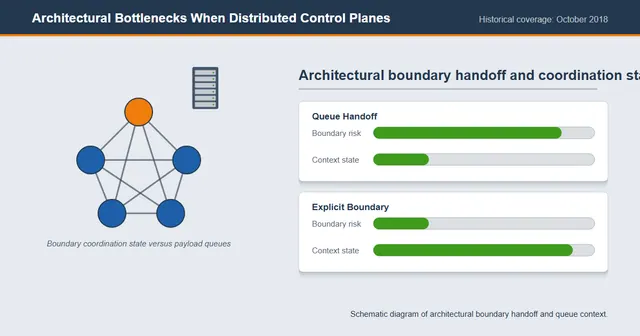 Dynamic Checkpoint Architectures Face Latency DivergenceDynamic checkpoint architectures preserve reliability across distributed frameworks as transport latency divergence disrupts consensus control.
 Software Coordination Planes Encounter Transport LatencyNetwork engineers confront operational bottlenecks when software coordination planes outpace underlying packet networks.
 Adaptive Fault-Tolerant Systems and Consensus ProtocolsDistributed coordination layers face cascading failures when naive consensus protocols presume deterministic transport behavior across nodes.
 Evaluating Multi-Agent Control CoordinationPhysical transport constraints introduce phase lag and hunting behavior into multi-agent control schemes across dense microgrid clusters.
 Evaluating Multi-Agent Distributed ArchitecturesEvaluating multi-agent distributed architectures proves critical when ignoring transport latency compromises distributed educational platforms.
 Semantic-Aware Software Architectures Face LatencySoftware reference architectures for semantic-aware distributed systems reveal how transport queue congestion triggers cascading cloud outages.
 Distributed Ledger Technology Across Transport LimitsDistributed ledger technology confronts wide-area transport trade-offs, node synchronization limits, and settlement finality requirements.
 Scaling Distributed Architectures Beyond Homogeneous BoundariesDistributed computing architectures mitigate localized transport latency and constrained bandwidth across heterogeneous systems.
 Dynamic Communication Channel Reconstruction ProtocolsDynamic communication channel reconstruction protocols resolve protection maloperation across physical transport interfaces.
 Distributed Computing Architectures Face Transport LatencyEngineers observe that neglecting physical link characteristics introduces severe vulnerabilities into distributed consensus systems.
 Industrial Control Architectures and Physical ChannelsEvaluations of industrial control architectures reveal state divergence and oscillatory behavior when supervisory loops face transport latency.
 Distributed Fault Tolerance Protocols Under LatencyBenchmarking distributed fault tolerance protocols reveals how transport bottlenecks degrade state consistency across heterogeneous clusters.
 Holistic Schedulability Analysis Under Network LatencyIterative schedulability tests diverge across distributed nodes when transmission latency breaks zero-latency synchronization bounds.
 Verdi Proves Distributed Software VerificationThe introduction of Verdi in June 2015 bridges distributed algorithmic proofs and runnable system code using the Coq proof assistant.
 Decentralized Scheduling Architectures and TransportDecentralized scheduling architectures face operational hazards when orchestration software decouples state transitions from transport latency.
 Distributed Telemetry Deployments and Transport LimitsDistributed telemetry deployments face operational overhead when coordination frameworks ignore underlying physical transport limits.
 Grid Middleware Across Heterogeneous InfrastructurePhysical network latency induces desynchronization windows when distributed systems ignore dynamic transport routing and packet transit delays.
 High Performance Computing Schedulers Across TransportResource allocation overlays face synchronization bottlenecks when physical transport latency disrupts control layers.
 Distributed Networked Control Systems StabilityUnmodeled transport delays, packet jitter, and verification overhead destabilize distributed networked control systems.
 Scaling Distributed Control Across Physical TransportUnoptimized state transfer and transport delays create acute throughput degradation across distributed database replication clusters.
 Distributed Storage Systems and Network QueuingNetwork queuing and transport latency undermine distributed consensus algorithms across storage clusters and hybrid power systems.
 Distributed Protocol Implementations and Physical TransportDistributed protocol implementations face severe latency overhead and throughput bottlenecks across heterogeneous physical network transport.
 Categorical Logic and Outage Bounds in Control SystemsApplying categorical logic bounds state divergence when transport delays decouple logical consensus from underlying physical channel conditions.
 Hybrid Time Group Communication ProtocolsArchitecture description languages formalize component interfaces and configurational constraints to decouple control plane coordination.
 Agent Architectures for Distributed Power GridsAutonomous software agents in power systems risk consensus stalls and failure detector thrashing when transport networks enforce relay limits.
 Split Verification of Internet Protocol StacksSplit verification of internet protocol stacks enables decoupled nodes to preserve stability against transport latency and packet drops.
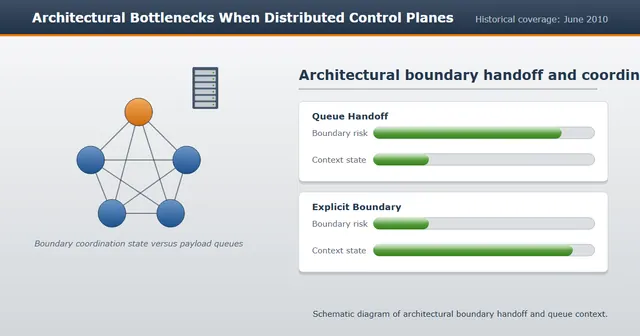 Scaling User-Controlled Access Management ArchitecturesScaling user-controlled access management architectures requires decoupling consensus signaling from high-volume application payload transport.
 Protocol Frameworks and Physical Wire BehaviorTreating network latency as negligible leads to systemic instability in distributed control planes across large network topologies.
 Consensus Protocols for Distributed Control TopologiesAccelerated consensus protocols and hybrid network architectures maintain agreement across distributed control topologies.
 Lightweight Delegation and Consistency Protocols in File Systemsanalysis of lightweight delegation architectures and data consistency schemes in distributed nodes.
 Distributed Software Architectures and Transport VariancesPhysical transport variances break synchronous semantics across collaborating nodes in distributed software architectures.
 Private SIP Extensions and Nonblocking Atomic Commitmentsanalysis of SIP proxy-to-proxy extensions and formal verification for dependable asynchronous coordination.
 Preventing Cascading Rollbacks in Distributed NetworksUncoordinated checkpoints and transmission latency trigger cascading rollbacks and split-brain failures in distributed networks.
 Arbitrary Failure Detector Methodologies Across NetworksFormal arbitrary failure detector methodologies and location-aware models mitigate transport latency bottlenecks across distributed protocol networks.
 Distributed Mutual Exclusion Across Dynamic Overlay NetworksEvaluating distributed mutual exclusion and multi-routing protocols reveals why dynamic ad hoc topologies trigger cascading consensus failures.
 Scaling QuickSilver Scalable Multicast in ClustersDecoupling control layers from rigid transport protocols prevents buffer exhaustion and acknowledgment implosion in distributed clusters.
 Service Oriented Architectures Across Network ProtocolsUnderstanding network protocols, messaging middleware, and communication latency prevents enterprise integration failures across topologies.