Categorical Logic and Outage Bounds in Control Systems
Applying categorical logic bounds state divergence when transport delays decouple logical consensus from underlying physical channel conditions.
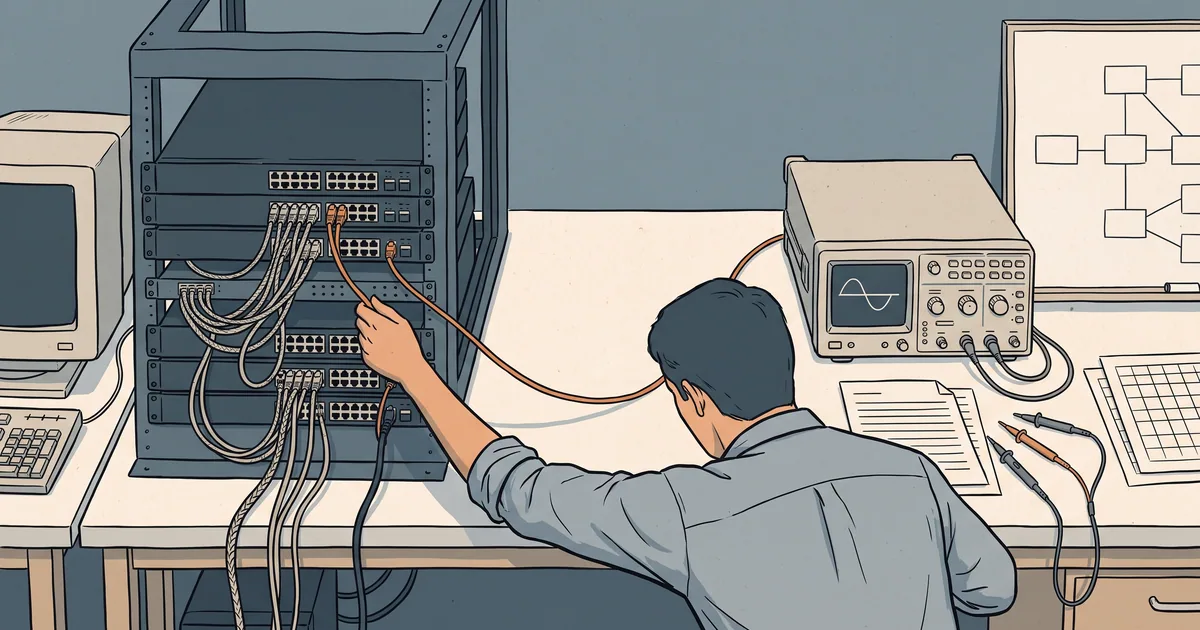
As of September 30, 2011, outdated transport signals trigger cascading failovers because orchestrators act on obsolete views when physical propagation latency exceeds the coherence time of the communication medium.
During September 2011, network architects confronted an increasingly acute divergence between software control logic and the physical realities of data dissemination. contemporary distributed software often relies on high-level abstractions that treat message propagation across remote clusters as instantaneous and uniform. However, investigations into formal structural verification published through (IEEE) demonstrate that ignoring transport delays inevitably compromises overall system behavior. This friction raises an essential inquiry for contemporary systems design:
Why Do Outdated Transport Signals Trigger Control Cascades?
Formalizing distributed control security through categorical logic establishes mathematical bounds for multi-node integrity when transport delays decouple logical state from real-time network conditions (IEEE). Quantifying outage performance under constrained channel state information reveals critical failure thresholds where distributed relaying schemes collapse due to outdated transport feedback (Institute of Electrical and Electronics Engineers (IEEE)). Research published in September 2011 evaluates outage probabilities in opportunistic relay networks where distributed nodes must coordinate without full channel state information (Institution of Engineering and Technology (IET)). Power-efficient coded architectures for distributed wireless sensing address transport constraints by structuring message passing across power-constrained nodes (Defense Technical Information Center). Distributed middleware architectures implement fault-tolerant computing abstractions over distributed repositories to maintain execution guarantees despite underlying node and transport failures (IEEE). Applying categorical logic provides a formal modeling framework for security architectures spanning heterogeneous distributed systems (Institute of Electrical and Electronics Engineers (IEEE)). When distributed control planes operate under the fiction of instantaneous state consensus, divergence begins at the boundary between logical expectations and physical packet transit. In practice, control planes exchange membership heartbeats, routing updates, and lease renewals via packet-switched links subject to jitter, queueing, and transient packet loss. When an orchestrator presumes instantaneous knowledge of peer availability, delayed acknowledgments trigger spurious failovers, split-brain partitioning, or redundant master elections. The failure does not originate from software bugs in the algorithm itself, but from an ontological mismatch: the mathematical model assumes synchronous state convergence, while physical channels introduce stochastic delays. Consequently, distributed components act on obsolete views of the topology, causing cascading control-plane thrashing. This breakdown becomes catastrophic in networks where feedback signals decay rapidly over degraded or contested physical media. In these dynamic wireless environments, coordinating entities select routing paths based on periodic channel estimations. When the propagation latency of the control signal exceeds the coherence time of the transport medium, nodes make forwarding decisions using stale measurements. Relays attempt cooperative transmissions for channels that have already faded, resulting in severe packet drops and mutual interference. The control loop falls out of phase with the actual transport topology, turning what was designed as an opportunistic optimization into an amplifier of network congestion.
How Can Distributed Middleware Prevent Synchronization Storms?
To prevent catastrophic control plane collapse, system designers must rigorously decouple control metadata from bulk payload transport while establishing explicit handoff boundaries. In sensor fields and distributed data acquisition pipelines, transmitting complete state snapshots across every hop exhausts energy reserves and floods narrow radio links. By adopting structured coding and local message-passing rules, control protocols can restrict the scope of routing assertions to localized neighborhoods. Enforcing strict payload and control separation ensures that transient bottlenecks in data transmission do not impede critical supervision signals. Furthermore, control planes must establish explicit boundary validation contracts where incoming assertions carry timestamped epochs or logical version vectors, enabling recipient nodes to reject updates that reflect past network states rather than current physical conditions. At the middleware level, distributed systems require protective abstractions that actively buffer the control layer against physical transport volatility. These middleware platforms intermediate between high-level transactional software and distributed repositories, converting strict synchronization requests into asynchronous, partition-tolerant protocols. When underlying transport links suffer degradation, the middleware isolates stateful services through lease expirations, quorum checks, and localized retries. Operators face a fundamental trade-off: they can enforce linearizable global consistency at the cost of high latency and decreased availability, or tolerate bounded staleness to maintain operational throughput. Rich telemetry, including continuous round-trip latency tracking and heartbeat jitter histograms, allows middleware components to adapt quorum timeouts dynamically rather than enforcing brittle, static thresholds that fail under load. Structural resilience ultimately depends on designing control protocols that degrade gracefully when synchronization assumptions fail. Rather than treating transport delay as an exceptional error condition, resilient distributed architectures treat latency as a dynamic, continuous parameter. When message delivery slows, control planes must contract their coordination horizons, shedding non-essential coordination tasks and falling back to conservative, autonomous decision-making. For example, distributed storage repositories can temporarily halt asynchronous cross-site replication while maintaining local read-write serving, preventing transport-induced queue buildup from starving local operations. Recovery protocols must also prevent synchronization storms, where hundreds of disconnected nodes attempt simultaneous state reconciliation upon link restoration. By introducing exponential backoff, jittered reconciliation intervals, and hierarchical summarization of state differentials, systems can restore global coherence without triggering secondary transport collapses.
Can Formal Verification Reconcile Variable Transport Delays?
The architectural lesson across distributed systems in late 2011 is unequivocal: no software abstraction can completely erase the physics of the transport medium. When coordination layers decouple from physical latency realities, operational collapse is an inevitable mathematical outcome. As distributed systems scale across geographically dispersed data centers and heterogeneous wireless networks, can formal verification techniques provide automated synthesis of coordination protocols that dynamically preserve correctness across unbounded, variable-delay transport fabrics?
Sources
- IEEE: Applying Categorical Logic on a Holistic Security Architecture across Distributed Systems, 2011-09-08
- Institute of Electrical and Electronics Engineers (IEEE): Outage Analysis of Distributed Scheme on Opportunistic Relaying with Limited CSI, 2011-09-11
- Institution of Engineering and Technology (IET): Power-efficient-coded architecture for distributed wireless sensing, 2011-09-09
- Defense Technical Information Center: A Distributed Middleware-Based Architecture for Fault-Tolerant Computing over Distributed Repositories, 2011-09-01