Cooperative Relay Nodes and Channel Constraints
Engineering teams address structural friction when synchronous consensus protocols encounter transport channel constraints and latency.
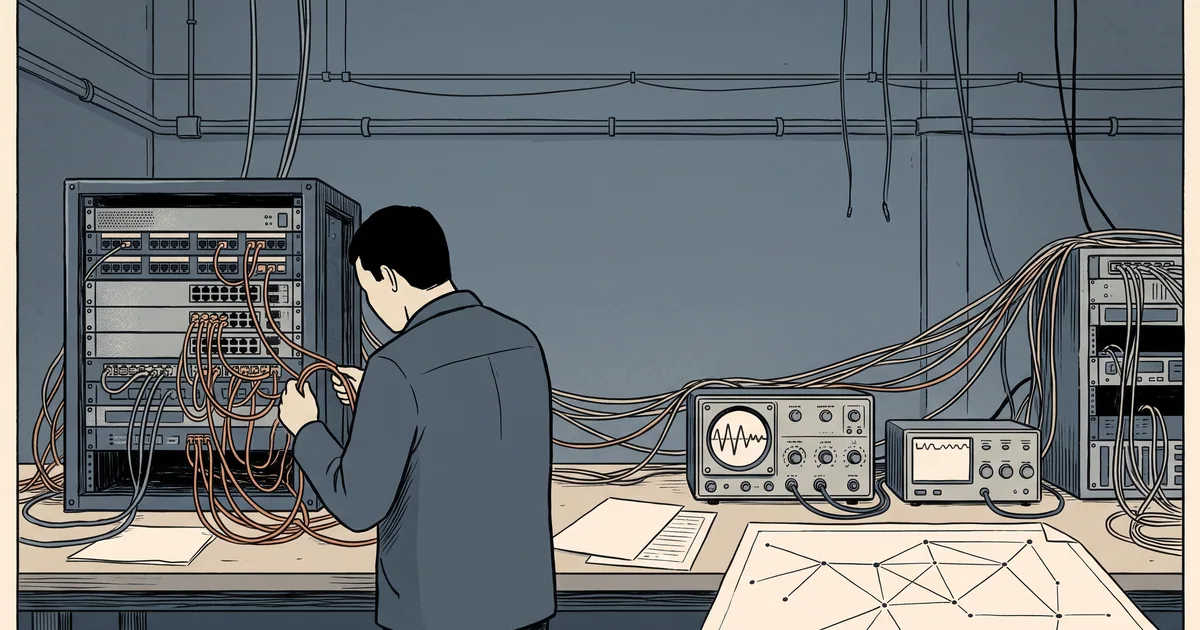
As of July 31, 2025, coordinating dispersed nodes over physical transport channels with round-trip latency leads consensus algorithms to misinterpret transport delay as complete node failure, triggering uncoordinated failovers.
During July 2025, distributed systems engineering faced an escalating crisis as control plane architectures continually outpaced the physical realities of contemporary packet networks. As documented in (Journal of King Saud University - Computer and Information S), engineering teams repeatedly encounter structural breakdowns when coordinating dispersed nodes over real-world channels subject to non-negligible propagation delays and packet loss. This mismatch exposes a fundamental vulnerability in contemporary enterprise and infrastructure software:
Why Do Physical Network Transports Trigger Uncoordinated Failovers?
Evaluating outage dynamics in cooperative energy-harvesting networks demonstrated the critical need to align relay coordination policies with underlying transport channel constraints to prevent unexpected communication degradation (Journal of King Saud University - Computer and Information S). Technical reviews of financial distributed systems demonstrated that failing to account for transport latency and synchronization overhead creates severe systemic risks for distributed transaction processing (Journal of Information Systems Engineering & Management). Analysis of energy-harvesting cooperative NOMA topologies showed that direct link availability and power-allocation ratios govern outage probability across coordinating relay nodes (Journal of Computer Science and Technology Studies). Financial distributed infrastructure implementations encountered throughput bottlenecks when transactional consistency mechanisms imposed higher coordination overhead than underlying network transports could sustain (Journal of Robotics and Control (JRC)). Decomposing public licensing platforms into modular microservice components identified inter-service latency and distributed state synchronization as primary drivers of operational service delays (Journal of King Saud University - Computer and Information S). Autonomous 5G-VANET architectures utilized intelligent routing control layers to handle rapid topology fluctuations and mitigate vehicle-to-infrastructure latency penalties (Journal of Information Systems Engineering & Management). Technical reviews of financial distributed systems demonstrated that failing to account for transport latency and synchronization overhead creates severe systemic risks for distributed transaction processing, as detailed in (Journal of Information Systems Engineering & Management). In enterprise platforms, software architects frequently design consensus and coordination protocols around abstract synchronous semantics, presuming that remote procedure calls complete near instantaneously. When physical round-trip times increase under bursty cross-datacenter traffic, locking durations expand exponentially. This structural friction extends beyond high-frequency ledgers; decomposing public licensing platforms into modular microservice components identified inter-service latency and distributed state synchronization as primary drivers of operational service delays (Journal of Computer Science and Technology Studies). Each additional service boundary magnifies serialization costs and state-drift risks across administrative boundaries. The physical mechanics of propagation failure mirror observations in wireless telecommunications. Specifically, analysis of energy-harvesting cooperative NOMA topologies showed that direct link availability and power-allocation ratios govern outage probability across coordinating relay nodes (Journal of King Saud University - Computer and Information S). In digital control planes, equivalent transmission realities manifest when intermediate routing hops or congestion windows starve control heartbeats. If a coordinator assumes immediate state convergence while physical transport channels experience fading, bufferbloat, or queue saturation, the consensus algorithm misinterprets transport delay as complete node failure. This misinterpretation triggers uncoordinated failovers, split-brain conditions, and cascade-style recovery storms that saturate the remaining network bandwidth.
How Can Dynamic Systems Isolate Telemetry Payloads From Consensus?
To isolate control planes from transport degradation, contemporary system topologies mandate rigid boundaries between telemetry payloads and consensus directives. In dynamic mobile environments, autonomous 5G-VANET architectures utilized intelligent routing control layers to handle rapid topology fluctuations and mitigate vehicle-to-infrastructure latency penalties (Journal of Robotics and Control (JRC)). These transport environments employ machine learning, a statistical subset of AI that differs from broader symbolic AI systems, to forecast path degradation and adapt packet routing before link disconnection occurs. When control protocols enforce strict separation between high-priority synchronization pulses and bulk application payload data, edge gateways prevent traffic surges from starving critical state metadata. Strict admission boundaries validate that state changes are committed only when local invariants can be maintained without synchronous remote validation, thus insulating the cluster from transient network partitioning. Designing sustainable coordination interfaces forces engineers to confront inescapable trade-offs between consistency guarantees and operational availability. Traditional two-phase commits and linearizable consensus frameworks depend on tight timing bounds that production networks cannot reliably deliver. When network jitter introduces variance into synchronization heartbeats, distributed systems must trade immediate global consistency for bounded staleness or monotonic read guarantees. Operator telemetry must actively monitor transport metrics, such as socket buffer occupancy and round-trip time standard deviations, rather than relying exclusively on application-level success codes. Interface contracts that decouple execution from synchronization allow worker nodes to acknowledge local state changes provisionally, applying conflict-free replicated data structures or compensating transactions when transport channels re-establish reliable delivery. Resilience under persistent transport divergence depends on failure-containment boundaries and monotonic reconciliation workflows. When transport assumptions crumble, distributed nodes must avoid cascading retries that compound congestion across degraded links. Backoff mechanisms equipped with decorrelated jitter suppress synchronized broadcast storms, ensuring that nodes do not overwhelm intermediary switches during partial recoveries. Furthermore, partition-tolerant control planes delegate authority to localized sub-clusters, enabling continuous operation within isolated segments. Rather than demanding exhaustive state equivalence across the entire topology before resuming processing, recovery pathways prioritize lightweight epoch markers and state checkpoints. This selective catch-up strategy ensures that distributed applications preserve operational integrity while the transport fabric works through transient bottlenecks.
Can Distributed Consensus Protocols Evolve Beyond Channel Latency Boundaries?
As distributed architectures expand across disparate physical environments in July 2025, software systems cannot treat transport fabrics as frictionless abstractions. When coordination protocols assume instant synchronization, physical network dynamics inevitably degrade platform reliability and throughput. Control planes must be architected with explicit awareness of channel latency, buffer constraints, and partition probabilities. What question does this leave open for future systems design: Can distributed consensus protocols evolve to treat physical transport variance as an intrinsic state parameter rather than an exceptional operational failure?
Sources
- Journal of King Saud University - Computer and Information S: Outage probability of energy harvesting cooperative NOMA network with direct link, 2025-07-01
- Journal of Information Systems Engineering & Management: Distributed Systems and Financial Product Offerings - Transforming the Industry: A Technical Review, 2025-07-19
- Journal of Computer Science and Technology Studies: Microservices Architecture in Government Digital Service Platform: Driver's License and Firearm Licensing System Components, 2025-07-07
- Journal of Robotics and Control (JRC): Artificial Intelligence-Driven and Secure 5G-VANET Architectures for Future Transportation Systems, 2025-07-13