Distributed Storage Systems and Network Queuing
Network queuing and transport latency undermine distributed consensus algorithms across storage clusters and hybrid power systems.
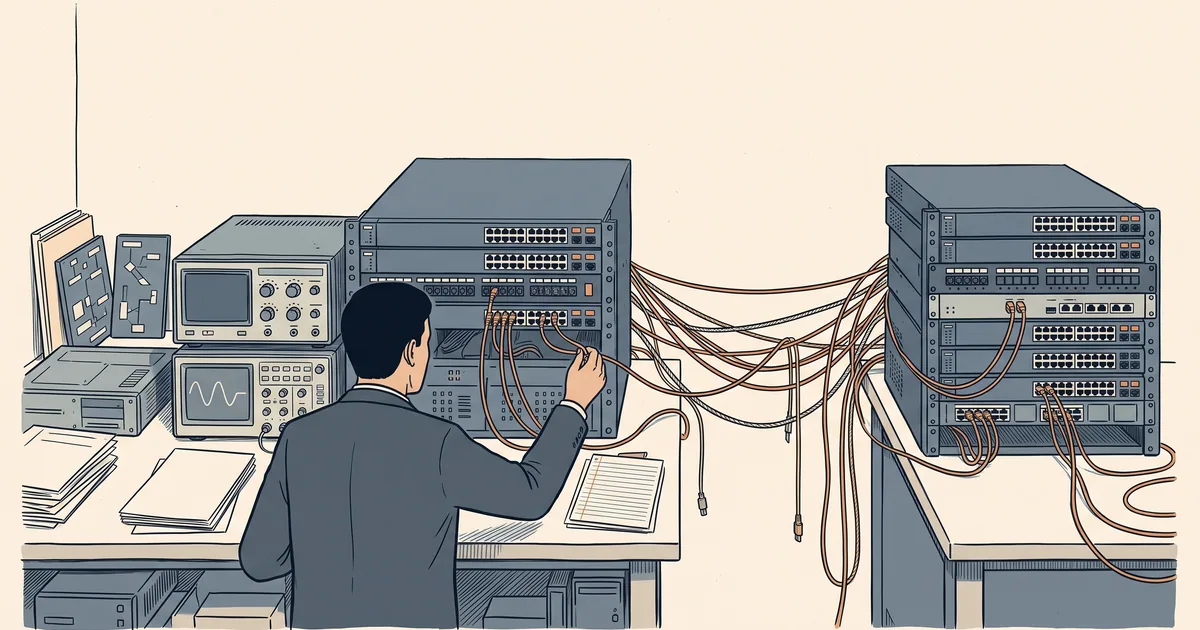
As of March 31, 2013, network queuing introduces phase shifts between logical protocol assertions and physical machine states, causing delayed consensus state vectors, voltage instability, and false node eviction declarations.
During March 2013, comprehensive surveys on distributed system reliability underscored that system dependability hinges on explicitly reconciling distributed coordination protocols with physical network realities rather than assuming negligible transport latency (Journal of Computer and System Sciences). Theoretical frameworks often abstract network transit into an instantaneous broadcast primitive, yet concrete architectures reveal that messaging backlogs alter distributed consensus behavior. When state coordination algorithms treat physical packets as immediate state transitions, network queuing introduces dangerous phase shifts between logical protocol assertions and physical machine states. This discrepancy brings forward a fundamental architectural dilemma:
How does network queuing undermine distributed consensus algorithms?
In March 2013, comprehensive surveys on distributed system reliability underscored that system dependability hinges on explicitly reconciling distributed coordination protocols with physical network realities rather than assuming negligible transport latency (Journal of Computer and System Sciences). The deployment of distributed architectures into operational environments such as hybrid power systems subject to pulsed loads demonstrated in March 2013 that control and protection mechanisms fail if communication constraints are treated as secondary factors (DOI Registry). Contemporary assessments indicated that distributed control architectures operating under dynamic loads encounter operational stability limits when distributed control protocols omit transport latency in feedback loops (DOI Registry). Research on distributed storage systems established that optimizing bandwidth utilization across underlying transport links is critical to prevent coordination bottlenecks and maintain data availability (IEEE Transactions on Parallel and Distributed Systems). Evaluations of heterogeneous distributed computing systems revealed that ignoring correlated failure modes across shared network infrastructure leads to substantial overestimation of overall system reliability (Journal of Computer and System Sciences). Analysis of distributed protocols confirmed that unconstrained bandwidth demands from distributed storage control mechanisms directly trigger cascading transport bottlenecks and reliability degradation (DOI Registry). The practical fallout of zero-latency assumptions appears clearly in cyber-physical deployments. When sudden load surges demand microsecond-scale reactive shedding, decentralized nodes execute safety interlocks using delayed consensus state vectors. Because the control plane relies on stale topological observations, actuation decisions trigger overcorrection cycles, voltage instability, and premature trip sequences across protection relays. The control loop becomes an oscillator rather than a stabilizer simply because propagation delay separates local perception from aggregate reality. A parallel manifestation occurs inside distributed storage clusters where metadata coordinators negotiate lease management, replication quorum, and block placement. When coordination routines generate bursty replication ballots or membership heartbeat floods without respect to pipe capacity, packet queues back up at top-of-rack switches. Control messages compete directly with bulk data transfers, resulting in dropped heartbeat frames and false node eviction declarations. Once a peer is falsely marked unreachable, the distributed cluster initiates aggressive re-replication routines that generate further network transit, intensifying the very congestion that induced the initial failure.
Which structural boundaries protect consensus protocols from saturation?
To prevent coordination collapse, system architects must enforce strict structural boundaries between control-plane signalling and application payload transport. Without explicit rate limiting, prioritization, and dedicated traffic classes for quorum messages, heavy the analyst/O workloads monopolize shared interface buffers. An architectural boundary must govern ingress validation, ensuring that state broadcast frequencies scale sub-linearly with node counts. Implementing token-bucket traffic shaping and out-of-band management channels guarantees that critical lease renewals traverse the network fabric even during peak link saturation, isolating delicate consensus protocols from untrusted client traffic. Architectural handoffs must also account for shared physical dependencies that undermine theoretical fault independence models. Operators frequently design consensus groups under the assumption that assigning replicas to distinct logical nodes provides independent failure domains. However, when these nodes traverse common aggregation switches, optical multiplexers, or shared hypervisors, transient transit delays simultaneously compromise multiple participants. Telemetry interfaces must therefore expose physical topology metadata to distributed consensus engines. Interface contracts should compel consensus schedulers to evaluate link diversity and latency envelopes before accepting membership quorum configurations. Finally, structural resilience requires replacing rigid synchronous assertions with timing-aware recovery paths. Systems that operate successfully over variable transport networks incorporate exponential backoff, adaptive lease intervals, and hysteresis timers within their state-machine transitions. Rather than interpreting a transient communication delay as an instantaneous node death, the coordination layer must dampen state migrations through provisional failure states. Recovery procedures must stagger reconnect attempts to avoid synchronized reconnect storms that overwhelm ingress buffers. By building communication uncertainty into the consensus contract itself, distributed control platforms maintain deterministic boundaries, preventing local transport fluctuations from detonating cluster-wide partition panics.
Can distributed consensus algorithms maintain strong consistency?
As distributed systems expand across varied hardware fabrics in 2013, the architectural illusion of costless, instantaneous synchronization has permanently shattered. Bridging consensus protocols with physical transport realities resolves immediate stability failures, yet it exposes an enduring design challenge: Can distributed coordination algorithms achieve strong consistency and high throughput without requiring continuous global topology awareness, or must future distributed architectures abandon universal consensus guarantees whenever physical transport latencies fluctuate unpredictably across disparate execution environments?
Sources
- Journal of Computer and System Sciences: A survey on reliability in distributed systems, 2013-03-13
- DOI Registry: Hybrid Power System Intelligent Operation and Protection Involving Distributed Architectures and Pulsed Loads, 2013-03-21
- DOI Registry: Optimizing the bandwidth utilization in distributed storage systems, 2013-03-08
- IEEE Transactions on Parallel and Distributed Systems: Reliability of Heterogeneous Distributed Computing Systems in the Presence of Correlated Failures, 2013-03-20