Distributed Coordination Under Network Latency
Physical network transport limits break distributed coordination protocols when propagation latency undermines state synchronization.
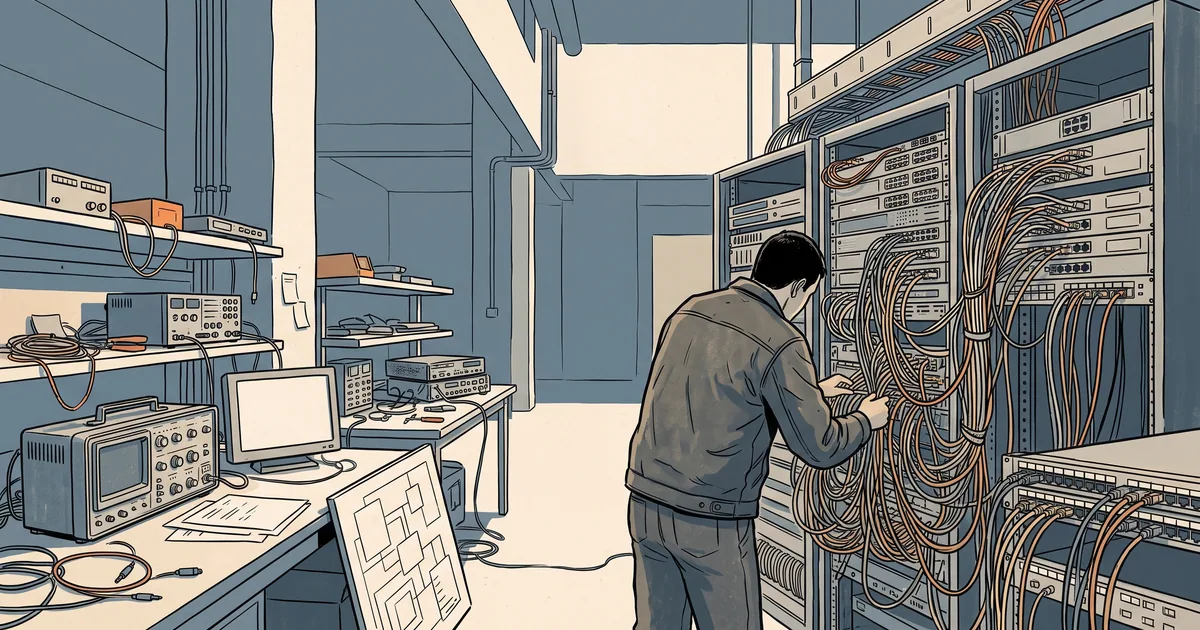
As of February 28, 2013, distributed wireless coordination breaks down when backhaul transport latency prevents real-time sharing of accurate channel state information across geographically separated nodes.
During February 2013, engineering disciplines converged on a shared architectural reckoning regarding distributed coordination and transport fidelity. As recorded in the (EURASIP Journal on Advances in Signal Processing), coordinating geographically separated nodes requires exchange protocols that must constantly battle physical transmission limits. System designers frequently design software abstractions under idealized assumptions of instantaneous consensus. This gap exposes a critical question: The resulting degradation manifests not as simple throughput loss, but as systemic deadlock, cascading retransmissions, and fractured operational consensus.
Why Does Distributed Wireless Coordination Experience Latency Stalls?
The February 2013 findings on distributed MIMO precoding demonstrated that distributed wireless coordination breaks down when backhaul transport latency prevents real-time sharing of accurate channel state information (EURASIP Journal on Advances in Signal Processing). The February 2013 survey on fault tolerance exposed that high-performance computing scalability is fundamentally constrained when coordinated checkpoint/restart mechanisms outpace the throughput and latency capabilities of underlying network transports (The Journal of Supercomputing). Research into linear precoding for distributed MIMO systems established analytical frameworks to optimize throughput when transmitters possess only partial or delayed channel state information (Digital Collections of Colorado (Colorado State University)). Analysis of checkpoint and restart implementations in high-performance computing showed that global coordination protocols suffer severe overhead penalties as node counts increase (DOI Registry). Hardware-in-the-loop evaluation platforms were designed to test distributed grid interconnection systems against communication latency and physical interface constraints (EURASIP Journal on Advances in Signal Processing). Long-term instrumentation, information, and control system modernization strategies formulated requirements for digital network architectures to maintain deterministic control across complex industrial facilities (The Journal of Supercomputing). The operational breakdown of distributed coordination layers appears when control message propagation cannot match the state evolution of participating nodes. When transmission points optimize beamforming vectors using stale channel feedback, inter-cell interference surges instead of canceling out. Parallel failures plague cluster computing environments. In both regimes, the coordination protocols presuppose a global consistency model that the physical fabric cannot deliver in bounded time. Physical transport layers impose propagation delays, serialization latency, and packet loss that undermine naive state synchronization. When thousands of compute nodes initiate synchronous memory dumps to remote storage targets, network contention triggers barrier synchronization stalls that idle processing cores. Similarly, research into linear precoding for distributed MIMO systems established analytical frameworks to optimize throughput when transmitters possess only partial or delayed channel state information (EURASIP Journal on Advances in Signal Processing). Without mathematical models that incorporate transport staleness directly into optimization routines, control planes enforce decisions based on phantom states, precipitating systemic divergence across distributed entities.
How Can Decoupled Control Channels Ensure Bounded Latency?
Managing the boundary between distributed control planes and physical transport layers requires strict structural decoupling. When coordination planes multiplex their synchronization traffic across the same links that handle bulk payload, bursty data transfers saturate shared buffers. In industrial contexts, long-term instrumentation, information, and control system modernization strategies formulated requirements for digital network architectures to maintain deterministic control across complex industrial facilities (DOI Registry). These industrial guidelines emphasize isolated control channels, strict priority scheduling, and guaranteed latency bounds. Without rigorous separation, safety-critical telemetry packets encounter queue starvation behind non-critical transfers, collapsing the closed-loop control guarantees necessary for continuous facility operation. Testing and validating these handoff mechanisms demands experimental frameworks that faithfully reproduce non-ideal network physics. By inserting real-world delays, jitter, and dropped frames between virtual control algorithms and actual power converters, such testbeds reveal brittle assumptions before field deployment. Operators face sharp trade-offs between synchronization frequency and telemetry overhead. Pushing updates too frequently floods the network fabric, whereas lowering telemetry rates risks drifting into uncoordinated, dangerous local states where controllers issue conflicting commands to interconnected grid components. Resilience across decoupled systems therefore depends on tolerating partial information rather than mandating universal lockstep coordination. When distributed nodes encounter transport degradation, fallback protocols must degrade gracefully into localized, autonomous operation. In wireless networks, linear precoding robustification trades peak spectral efficiency for error tolerance by shaping transmit beams against channel uncertainty margins (EURASIP Journal on Advances in Signal Processing). In computing clusters, non-blocking asynchronous checkpoint schemes permit individual nodes to snapshot state without stalling global execution cycles (The Journal of Supercomputing). These approaches replace the fragile fiction of instantaneous state sharing with probabilistic or localized convergence bounds.
Can Future Distributed Systems Eliminate Global Synchronization Entirely?
By late February 2013, the architectural lesson across wireless infrastructure, supercomputing fabrics, and industrial utilities is unambiguous: physical network transport cannot be abstracted away. Systems that mandate absolute, zero-latency state synchronization inevitably fail when deployed across physically distributed nodes. The pressing architectural question that remains unresolved is whether future distributed control systems can eliminate global synchronization entirely in favor of fully decoupled, consensus-free designs, or if physical transit latency will forever dictate a hard ceiling on scalable coordination.
Sources
- EURASIP Journal on Advances in Signal Processing: Linear precoding in distributed MIMO systems with partial CSIT, 2013-02-19
- The Journal of Supercomputing: A survey of fault tolerance mechanisms and checkpoint/restart implementations for high performance computing systems, 2013-02-11
- Digital Collections of Colorado (Colorado State University): An advanced platform for development and evaluation of grid interconnection systems using hardware-in-the-loop, 2013-02-01
- DOI Registry: Long-Term Instrumentation, Information, and Control Systems (II&C) Modernization Future Vision and Strategy, 2013-02-01