Industrial Control Architectures and Physical Channels
Evaluations of industrial control architectures reveal state divergence and oscillatory behavior when supervisory loops face transport latency.
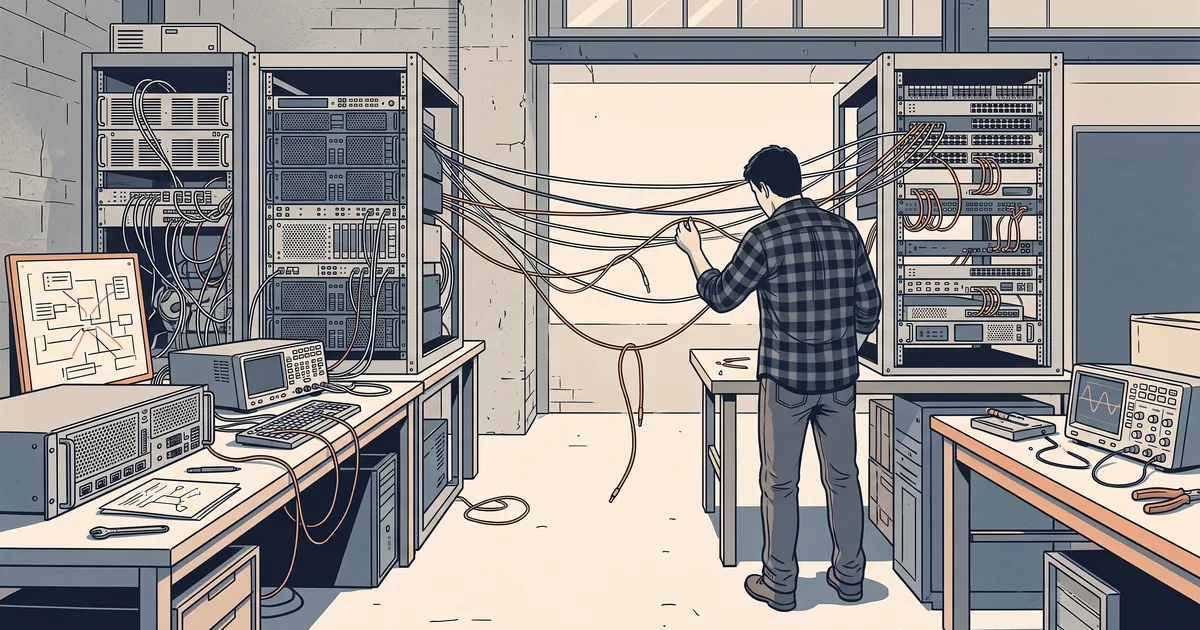
As of June 30, 2016, distributed automation systems suffer state divergence when decoupling control plane supervisory loops from underlying transmission latency introduces jitter-induced phase drift across nodes.
During June 2016, emerging evaluations of industrial control architectures revealed deep structural vulnerabilities when theoretical distributed state machines encountered physical communication channels. As demonstrated by contemporaneously documented investigations in (New University of Lisbons Repository (New University of Lisb), software architectures frequently presume transparent data dissemination between autonomous actors and centralized telemetry aggregators. When traffic bursts or transport layer bottlenecks emerge, however, these idealistic models rapidly decompose into cascading delays and degraded control topologies. This operational breakdown forces engineers to address a fundamental architectural dilemma:
Why Do Distributed Automation Systems Suffer State Divergence?
In June 2016, research into hybrid distributed automation systems demonstrated that assuming frictionless state synchronization between local control units and supervisory layers exposes automated operations to severe instability when physical transport limits are reached (New University of Lisbons Repository (New University of Lisb). The emergence of multi-agent and intelligent building energy management architectures highlighted the critical operational need to account for network transport constraints rather than treating underlying communication channels as idealized control conduits (Iris (Roma Tre University)). Studies evaluating distributed automation and intelligent energy management architectures showed that decoupling control plane supervisory loops from underlying transmission latency leads to state divergence and delayed actuation across distributed nodes (University of Minnesota Digital Conservancy (University of M). Research into the availability of routing infrastructures demonstrated that adversarial transport degradation systematically exploits the mismatch between distributed control protocols and vulnerable underlying packet routing mechanisms (International Journal of Security and Its Applications). Analysis modeling architectures for wireless networks under physical hardware impairments established that physical layer distortions disrupt the reliable link assumptions required by distributed coordination frameworks (New University of Lisbons Repository (New University of Lisb). Cross-system analyses of distributed automation frameworks and wide-area routing infrastructures confirmed that localized transport failures propagate upward into distributed control layers, causing widespread synchronization stalls across supervisory systems (Iris (Roma Tre University)). When software engineers structure supervisory loops around instant peer-to-peer telemetry, any unpredicted jitter introduces jitter-induced phase drift between node-level decision processes. The operational consequences of this divergence manifest rapidly within physical environments where mechanical valves, power distribution switches, and environmental regulators depend upon timely status updates. When a local controller executes actions against stale state representations received from a congested channel, actuation commands arrive out of phase with physical conditions. Supervisory software then issues corrective interventions based on obsolete feedback, inducing oscillatory behavior that strains mechanical actuators and destabilizes overall infrastructure. In systems relying on machine learning algorithms for localized predictive tuning, which operate as statistical optimization subsets of broader symbolic artificial intelligence control architectures, delayed observation vectors corrupt training matrices and inferential policies. Consequently, distributed units enter recursive recovery routines, generating extraneous telemetry packets that further choke the already congested transport buffers.
How Can Protocol Interfaces Mitigate Intermediate Buffer Backpressure?
At the transport interface, decoupling control plane supervisory loops from raw data payloads requires strict isolation boundaries to maintain service stability under packet degradation. When control signaling shares intermediate physical buffers with bulk payload flows, transient backpressure induces head-of-line blocking that halts state exchange mechanisms. Furthermore, analysis modeling architectures for wireless networks under physical hardware impairments established that physical layer distortions disrupt the reliable link assumptions required by distributed coordination frameworks (International Journal of Security and Its Applications). Hardware imperfections, including phase noise and non-linear power amplification, create bursty packet drops that supervisory layers misinterpret as remote node shutdowns or total network partitions. Because physical layer distortions directly degrade logical reachability, operators face severe telemetry compromises when evaluating runtime state validity. When distributed topologies treat communication sockets as flawless abstraction barriers, intermediate link saturation forces consensus protocols into continuous leader election cycles or quorum re-negotiations. To mitigate this cascade, architectural contracts must enforce explicit timeouts, rate-limited heartbeat intervals, and monotonic sequence validation at the protocol boundary. Without these defensive measures, intermittent route flapping at the routing fabric level continuously invalidates active routing tables, starving the upper management tier of actionable operational telemetry. Establishing structural resilience therefore demands that system architects abandon the assumption of synchronous coherence across distributed perimeters. Distributed control planes must be designed to execute gracefully degraded local fallback states whenever underlying latency exceeds bounded physical thresholds. Decoupling the high-frequency local safety loops from the lower-frequency supervisory optimization fabric prevents packet drops in the wide-area transit tier from paralyzing edge operations. Defensive engineering dictates that nodes maintain autonomous authority to throttle ingress commands, validate operational invariants locally, and reject stale supervisory updates. By converting brittle consensus requirements into loosely coupled, eventual-consistency state exchanges with explicit transport budgets, distributed architectures isolate transient network congestion from core mechanical operations.
Can Distributed Control Topologies Overcome Physical Channel Instability?
As distributed architectures expand across heterogeneous physical environments, the operational assumption of frictionless communication channels becomes fundamentally untenable. The documented instability in automation fabrics and wide-area routing topologies underscores that distributed control software cannot be abstracted cleanly from the physical realities of the transport layer. While contemporary engineering teams can implement localized safety fallbacks and relaxed synchronization boundaries, this reality poses an unresolved question: Can large-scale distributed control architectures achieve provable global optimization without reintroducing the fatal vulnerability of transport-induced state divergence?
Sources
- New University of Lisbons Repository (New University of Lisb: Hybrid System of Distributed Automation, 2016-06-01
- Iris (Roma Tre University): An innovative architecture for an intelligent building energy management system, 2016-06-20
- University of Minnesota Digital Conservancy (University of M: Adversarial Degradation of the Availability of Routing Infrastructures and Other Internet-Scale Distributed Systems, 2016-06-01
- International Journal of Security and Its Applications: An Analysis Modeling Architecture for Supporting Physical Layer Security of Wireless Networks under Hardware Impairments, 2016-06-30