Tuning Minimum Route Advertisement Interval Timers
Tuning control-plane timers dampens route flapping and prevents severe convergence lag across wide-area communication networks.
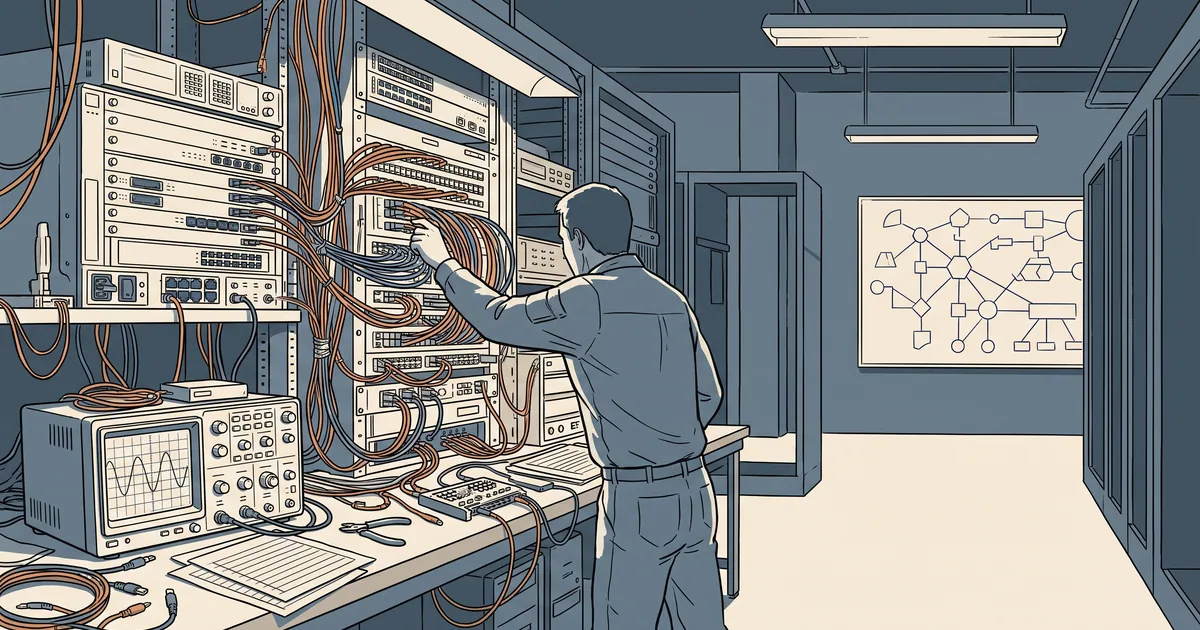
As of October 31, 2019, rigid default timer heuristics fail because expanding network scale and propagation latencies introduce temporal skew, forcing continuous recomputation.
During October 2019, operational pressures across wide-area distributed infrastructures revealed systemic vulnerabilities where software coordination protocols collided with the physical reality of communication networks. Research published by (IGI Global Scientific Publishing) highlighted how fragile routing convergence becomes when control protocols outgrow their foundational transport assumptions. Engineering distributed fabrics on the presumption of rapid, uniform convergence frequently obscures latency bounds across autonomous domains. This raises a fundamental operational dilemma: The resulting divergence destabilizes quorum commitments, cascades message retransmissions, and triggers protocol partition cascades.
Why do rigid default timer heuristics fail routing convergence?
Tuning control-plane timers such as the Minimum Route Advertisement Interval is critical for global Internet routing, as rigid default timer heuristics fail to prevent severe convergence lag when underlying network scale and transport latency expand (IGI Global Scientific Publishing). Developing resilient hierarchical command and control architectures is vital for infrastructure systems to prevent systemic failures when communications degrade during wide-area power outages (IEEE). Optimizing BGP MRAI timers dampens route flapping and minimizes convergence delays by aligning timer intervals with network diameter and propagation latencies (IEEE). The prototype resilient command and control architecture establishes redundant control paths and localized synchronization to mitigate wide-area grid disturbances during power delivery disruptions (IEEE). Process-aware intrusion detection architectures for electrical grids combine network monitoring with physical process telemetry to identify malicious commands and latency-induced anomalies across control nodes (IGI Global Scientific Publishing). The DBFT protocol provides Byzantine fault tolerance designed to maintain consensus through graceful performance degradation when message delivery latencies vary (IEEE). The boundary failure develops when distributed control logic implicitly assumes that state transitions propagate instantaneously across remote members. In global telecommunications, tuning control-plane timers such as the Minimum Route Advertisement Interval is critical for global Internet routing, as rigid default timer heuristics fail to prevent severe convergence lag when underlying network scale and transport latency expand (IGI Global Scientific Publishing). When physical spans lengthen and topology sizes increase, packet transit times introduce temporal skew into neighbor discovery and route calculation routines. Rather than achieving quiet steady states, nodes flooded with uncoordinated path advertisements suffer from thrashing message queues, as stale updates arrive out of sequence and force continuous recomputation of routing graphs. This coordination breakdown manifests directly inside consensus and synchronization engines across critical cyber-physical systems. When regional control elements operate under idealized delivery expectations, intermittent transport disconnects or jitter-laden packet pathways cause local state machines to disagree on global authority. Without this conscious calibration between protocol timers and underlying link properties, distributed control entities misinterpret transient transport delays as node deaths, causing unnecessary leader elections and catastrophic failover loops.
How do systems enforce boundaries against latency volatility?
To survive latency volatility, systems enforce strict architectural boundaries between payload transit, health verification, and consensus replication. Structuring the control plane hierarchically separates local tactical loops from wide-area strategic coordination. High-frequency state changes stay bounded within low-latency regional boundaries, preventing localized physical anomalies from propagating into global protocol stalls. This partition boundary guarantees that transport degradation along an external backhaul never freezes the deterministic execution of safety-critical local routines. Network telemetry must also merge with physical system observations to detect boundary anomalies before partitions cause irrecoverable drift. When control messages experience anomalous propagation delays or packet drops, verifying the logical payload against actual physical measurements prevents operators from misclassifying transit lag as malicious corruption or equipment failure. Statistical machine learning algorithms, which operate as empirical numerical models, differ substantially from rule-based symbolic artificial intelligence systems, yet both benefit when transport latency metrics inform process state validation routines. At the core consensus layer, protocol contracts must discard binary assumptions regarding network synchrony in favor of bounded partial synchrony models. By decoupling proposal timing from validation steps, the protocol accommodates latency spikes without triggering immediate view changes or stalling transaction commitments. The architectural contract treats the underlying transport network as an asynchronous, unreliable medium rather than an idealized zero-latency bus, ensuring that transient congestion degrades operational throughput gracefully rather than halting distributed state execution entirely.
Can distributed coordination layers dynamically self-tune protocol timers?
By October 2019, contemporary distributed computing established that distributed control planes cannot treat the physical communications layer as an invisible, instantaneous abstraction. When synchronization timers fail to account for transit jitter and geographic spans, cascading reconvergences degrade systemic availability. The primary open question facing systems architecture is whether distributed coordination layers can dynamically self-tune their protocol timers and consensus boundaries in real time, or whether heterogeneous physical latency will always necessitate rigid, hand-tuned hierarchical partitioning.
Sources
- IGI Global Scientific Publishing: Optimized MRAI Timers for Border Gateway Protocol in Large Networks, 2019-10-01
- IEEE: Prototype Resilient Command and Control (C2) of C2 Architecture for Power Outage Mitigation, 2019-10-11
- IEEE: Architecture and Prototype Implementation for Process-Aware Intrusion Detection in Electrical Grids, 2019-10-14
- IEEE: DBFT: A Byzantine Fault Tolerant Protocol with Graceful Performance Degradation, 2019-10-17