Distributed Antenna Systems Under Fading Channels
Evaluating outage probability in distributed antenna systems reveals how channel degradation disrupts control signaling loops.
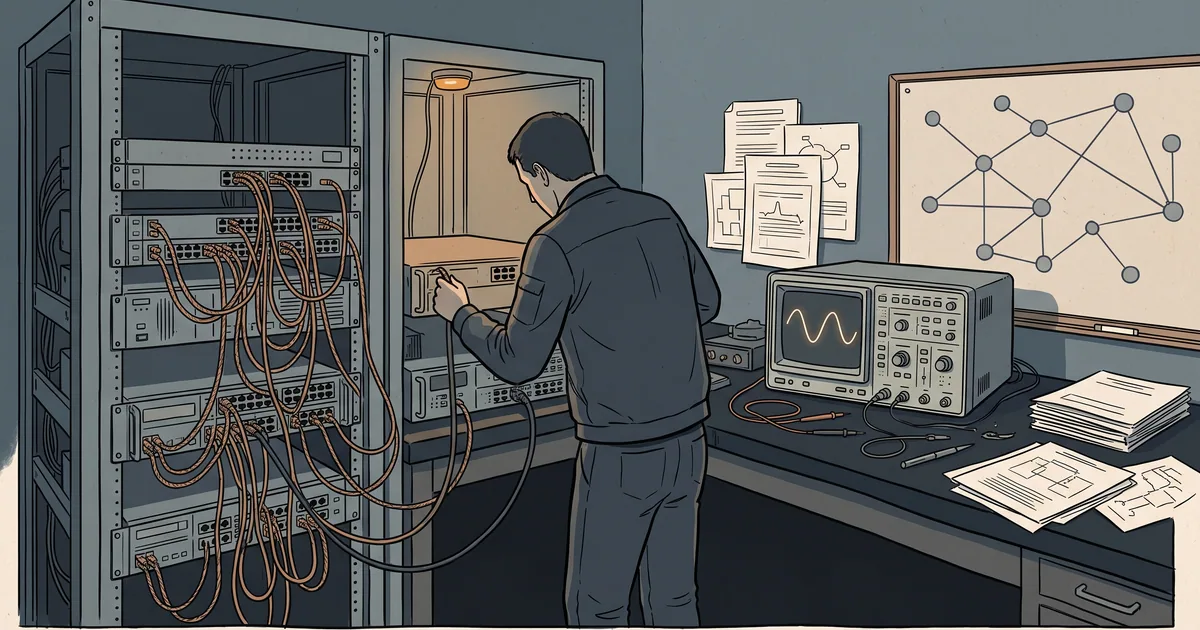
As of November 30, 2009, physical channel fading and queuing delays turn near-instantaneous control loops into sluggish operations, triggering retries that congest shared links and collapse system throughput.
During November 2009, distributed wireless system architectures are increasingly tasked with operating across non-ideal backhaul and fading radio channels, challenging classical coordination abstractions. Research published by (IEEE) reveals that signal degradation and propagation variability directly limit distributed antenna coordination in realistic environments. When radio frequency topologies fracture into autonomous clusters and mobile multi-hop groups, control plane mechanisms frequently break down if they treat communication channels as transparent and instantaneous pipelines. This dilemma raises a fundamental architectural question:
Why Do Fading Channels Trigger Control Loop Divergence?
Evaluating downlink outage probability in distributed antenna systems under shadowed Nakagami-m fading channels underscores the vulnerability of coordination schemes to physical layer channel degradation as distributed wireless deployments expand in late 2009 (IEEE). The development of distributed address auto-configuration protocols for mobile ad hoc networks represents an essential step toward sustaining autonomous network operations without centralized administrative servers (Springer Science and Business Media LLC). Distributed antenna selection models and ad hoc address auto-configuration protocols both face performance limits when underlying transport links experience fading, shadowing, and uncoordinated routing overhead (China Science Publishing & Media Ltd.). Distributed secure clustering protocols in wireless sensor networks establish localized cluster arrangements to manage peer trust and reduce message overhead across constrained sensor nodes (ACM). Epidemic protocols in pervasive computing systems leverage pairwise opportunistic interactions to disseminate data updates across distributed nodes without assuming continuous transport connectivity (IEEE). Both antenna selection schemes in distributed antenna architectures and secure clustering algorithms in sensor networks rely on exchange of local control state across imperfect wireless channels (Springer Science and Business Media LLC). At the same time, the development of distributed address auto-configuration protocols for mobile ad hoc networks represents an essential step toward sustaining autonomous network operations without centralized administrative servers (Springer Science and Business Media LLC). When physical conditions decay, control messages carrying channel state information or duplicate address detection probes undergo queuing delays, packet drops, and retransmissions. These transport impediments turn what protocol designers assumed to be atomic, near-instantaneous control loops into sluggish, non-deterministic operations. The divergence between mathematical control models and actual channel behavior triggers cascade retries that congest the shared medium. When a sensor cluster head must validate cryptographic credentials and collect neighborhood topology metrics across links buffeted by interference, state divergence inevitably occurs. If a node acts on stale topology or outdated link quality tables, routing loops and false partitioning errors emerge. The control plane attempts to resolve these discrepancies through further protocol chatter, multiplying signaling overhead precisely when link capacity is most degraded. Consequently, the coordination mechanism actively consumes the very spectral resources needed for payload delivery, causing system throughput to collapse under severe channel degradation.
How Can Protocol Architects Enforce Failure Containment Boundaries?
Architectural separation between control plane messaging and data plane payload is critical when transport integrity cannot be guaranteed. In centralized infrastructures, control logic assumes dedicated low-latency backhaul where signaling traffic takes absolute priority. Distributed mobile environments invert this reality because control transactions compete directly with payload streams over common, bandwidth-limited channels. Designers must establish strict routing and validation boundaries so that transient local link outages do not trigger global configuration re-elections. In ad hoc auto-configuration systems, unbounded broadcast queries for address uniqueness trigger broadcast storms if partition healing is attempted prematurely. To enforce failure containment, architects are forced to introduce dampening timers and localized state scopes, acknowledging that global consensus is physically unsustainable across lossy radio hops. Without clear boundaries, localized packet loss quickly escalates into cluster-wide protocol flapping. Balancing state freshness against messaging cost represents a classic operational trade-off for distributed wireless protocols. When operators tune protocols for high reactivity, telemetry gathering generates unsustainable network congestion. Conversely, over-dampening telemetry leads to obsolete state vectors that degrade transmission beamforming or multi-hop routing paths. As demonstrated in pervasive computing research, epidemic protocols in pervasive computing systems leverage pairwise opportunistic interactions to disseminate data updates across distributed nodes without assuming continuous transport connectivity (ACM). By trading strict instant consistency for progressive convergence, epidemic models avoid synchronous locking mechanisms. They replace fragile lock-step handshakes with gossip-based reconciliation, ensuring that temporary physical link disconnections do not paralyze application workflows or trigger cascade rollbacks across the peer population. Telemetry interfaces must therefore expose uncertainty metrics rather than binary reachability flags. Structural resilience in distributed wireless control planes demands explicit interface contracts that accommodate variable transport delays. Rather than treating transport as a synchronous bus, control layers must treat inter-node messaging as inherently asynchronous, lossy, and partitioned. In distributed antenna systems, antenna selection algorithms must degrade gracefully into single-cell autonomous modes when channel state reports fail to arrive within tight coherence intervals. Similarly, secure clustering structures in sensor topologies must incorporate lease expiration mechanisms and trust thresholds that withstand delayed beacon exchanges. Recovery paths must avoid synchronous global recovery phases; instead, nodes must employ monotonic state advances where late arrivals are discarded or integrated without rolling back verified transactions.
How Can Engineers Mathematically Bound State Inconsistency?
As wireless networks continue to distribute intelligence away from centralized controllers into autonomous nodes, the assumption of zero-latency synchronization proves to be a dangerous fiction. The divergence between idealistic control logic and physical radio realities forces engineers to rethink coordination primitives across distributed antennas, ad hoc routing, and sensor clusters. The central architectural challenge remaining on November 30, 2009, is determining how to mathematically bound state inconsistency so that distributed control loops remain provably stable without consuming excessive wireless channel capacity.
Sources
- IEEE: Downlink outage probability of distributed antenna systems over shadowed Nakagami-m fading channels with antenna selection, 2009-11-08
- Springer Science and Business Media LLC: Distributed address auto configuration protocol for Manet networks, 2009-11-05
- China Science Publishing & Media Ltd.: Distributed Secure Clustering Protocol in Wireless Sensor Networks, 2009-11-06
- ACM: Epidemic protocols for pervasive computing systems, 2009-11-30