Mitigating Outage Probability in STAR-RIS-NOMA Networks
Imperfect channel state information and telemetry delays degrade user outage probability and beamforming in wireless infrastructure.
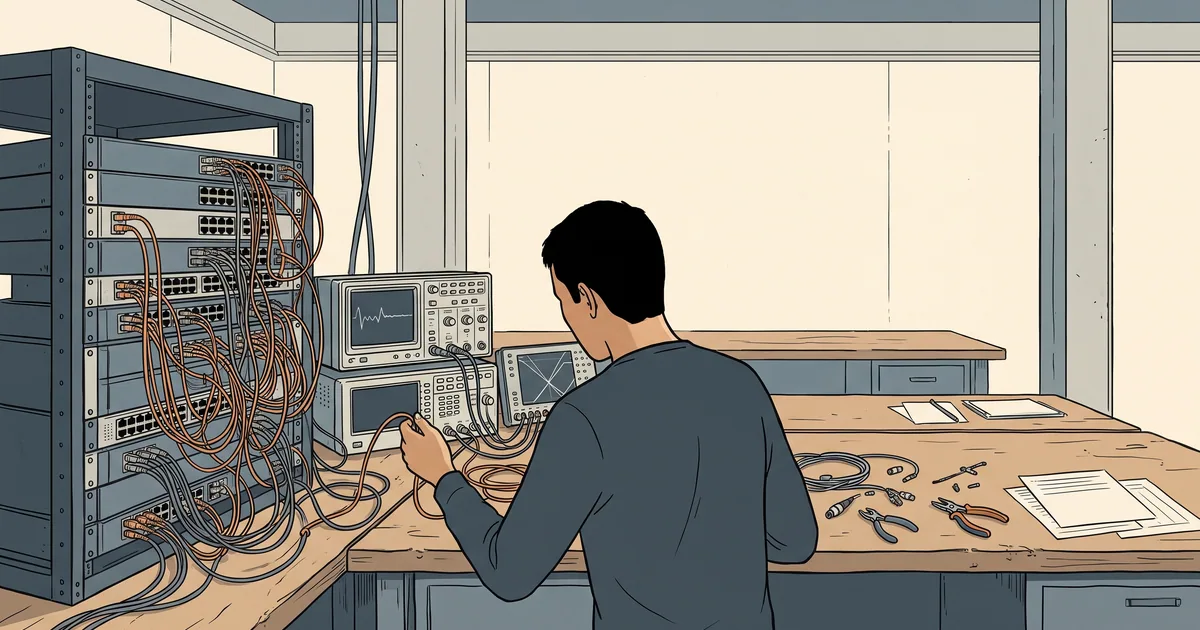
As of September 30, 2024, channel estimation inaccuracies and telemetry delays feed outdated phase shifts to reconfigurable surfaces, causing successive interference cancellation to fail and user outage probability to increase.
During September 2024, the structural fragility of high-density wireless infrastructure became starkly apparent as physical-layer coordination mechanisms confronted unbridgeable telemetry delays. Recent research documented by (Advances in Electrical and Electronic Engineering) highlighted how theoretical gains in simultaneous transmission and reflection surfaces disintegrate when channel state information departs from mathematical perfection. As base stations, distributed elements, and client devices interact under variable propagation conditions, architectural assumptions regarding instantaneous signaling collapse. This instability forces network engineers to confront a foundational problem:
Why Do Feedback Delays Degrade Interference Cancellation?
Quantifying outage performance under imperfect channel state information established critical operational boundaries for deploying STAR-RIS-NOMA networks where deterministic physical-layer feedback is unattainable (Advances in Electrical and Electronic Engineering). Investigating antenna behavior across multi-protocol environments is essential for preventing transmission failures during heterogeneous radio frequency coordination (National Journal Of Antennas And Propagation). Evaluations of STAR-RIS-NOMA network topologies show that channel estimation inaccuracies induce measurable increases in user outage probability (Journal of Electronics Computer Networking and Applied Mathe). Multi-protocol wireless designs incorporate dedicated antenna configurations to maintain concurrent connectivity across diverse wireless standards (DOI Registry). Intelligent control architectures utilize support vector machine classification to enhance resilience and mitigate cybersecurity vulnerabilities in networked systems (Advances in Electrical and Electronic Engineering). Edge-aware graph neural network implementations process distributed IoT sensor streams to enable automated predictive maintenance across infrastructure networks (National Journal Of Antennas And Propagation). When physical-layer controllers operate under real-world feedback constraints, propagation delays transform intended constructive interference into harmful signal distortion. Specifically, evaluations of STAR-RIS-NOMA network topologies show that channel estimation inaccuracies induce measurable increases in user outage probability (Advances in Electrical and Electronic Engineering). Non-orthogonal multiple access relies on exact power-domain multiplexing and successive interference cancellation. When control loops feed slightly aged phase shifts or outdated power coefficients to reconfigurable surfaces, the intended cancellation fails at receiver terminals. Instead of isolating concurrent user streams, the receiver processes residual power leakage as co-channel interference, degrading signal-to-interference-plus-noise ratios across the entire transmission sector. The operational challenge expands dramatically in heterogeneous spectrum allocations where radio frequency chains must arbitrate multiple concurrent transmission standards. In practical deployments, multi-protocol wireless designs incorporate dedicated antenna configurations to maintain concurrent connectivity across diverse wireless standards (National Journal Of Antennas And Propagation). However, spatial coupling, near-field impedance loading, and mismatched phase centers across adjacent radiators disrupt the stability of transmitted waveforms. When the coordinating scheduler treats each protocol stack as an isolated software abstraction, physical mutual coupling alters radiating patterns in real time. The resulting phase shifts invalidate the assumptions used by baseband beamforming engines, producing silent packet drops and unexpected frame retransmissions before higher layers detect the underlying RF misalignment.
How Can Local Inference Mitigate Telemetry Jitter?
To prevent cascading state collapses, network architectures enforce strict isolation between real-time data plane pipelines and slower control plane reconciliation loops. When channel state information transport is delayed, baseband hardware cannot execute synchronous beam updates without introducing pipeline stalls. Decoupling the control loop requires defining explicit degradation envelopes where the data plane defaults to conservative, robust modulation and coding schemes whenever telemetry latency exceeds strict thresholds. Routing boundaries must isolate control message serialization from payload delivery, ensuring that backpressure on signaling channels does not starve user data buffers. Without such bounded fallbacks, transient feedback latency causes scheduling buffers to bloat, which recursively amplifies the age of telemetry packets queued for transport across the control plane. Bridging this latency gap demands intelligent telemetry estimation algorithms embedded directly at network boundaries. In this operational layer, machine learning, a statistical subset of AI, differs from broader symbolic AI systems by learning empirical decision boundaries from non-stationary channel telemetry. In parallel, edge-aware graph neural network implementations process distributed IoT sensor streams to enable automated predictive maintenance across infrastructure networks (DOI Registry). By combining graph-structured spatial relationships with statistical classification, contemporary edge controllers infer physical link conditions and detect anomalous signaling behavior without waiting for centralized polling rounds. These edge models synthesize missing channel telemetry locally, shielding the immediate transmission window from transport-induced timing jitter. Operators continually balance feedback fidelity against transport overhead in these distributed topologies. Saturating the uplink with high-rate channel state telemetry exhausts spectrum that would otherwise carry user payload, while sparse reporting cycles induce phase divergence at the beamformer. Interface contracts between remote radio units and central orchestration entities must therefore transition from deterministic synchronous commands to probabilistic state machines. These contracts establish explicit survival times during which an antenna array may safely extrapolate beam vectors using historical gradient trajectories. If channel coherence expires before fresh telemetry arrives, local radio logic autonomously drops high-order spatial multiplexing in favor of isotropic, diversity-oriented transmission modes. This fail-safe transition preserves basic control link connectivity while preventing catastrophic interference across neighboring spatial cells.
Which Operational Boundaries Ensure Physical Layer Stability?
Sources
- Advances in Electrical and Electronic Engineering: Outage Performance Analysis of STAR-RIS-NOMA Networks under Imperfect CSI, 2024-09-30
- National Journal Of Antennas And Propagation: Exploring Antennas For Multi-Protocol Wireless Systems, 2024-09-01
- Journal of Electronics Computer Networking and Applied Mathe: Building a Resilient Architecture with an Intelligent System Based on Support Vector Machines Algorithm for Cybersecurity, 2024-09-27
- DOI Registry: Edge-Aware Graph Neural Network Architecture For Predictive Maintenance Of Railway Infrastructure Using Iot-Based Distributed Sensing, 2024-09-19