Limiting Logical Clock Exposure in Heterogeneous Networks
Characterizing transport delays and managing state under incomplete network information mitigates wide-area coordination stalls.
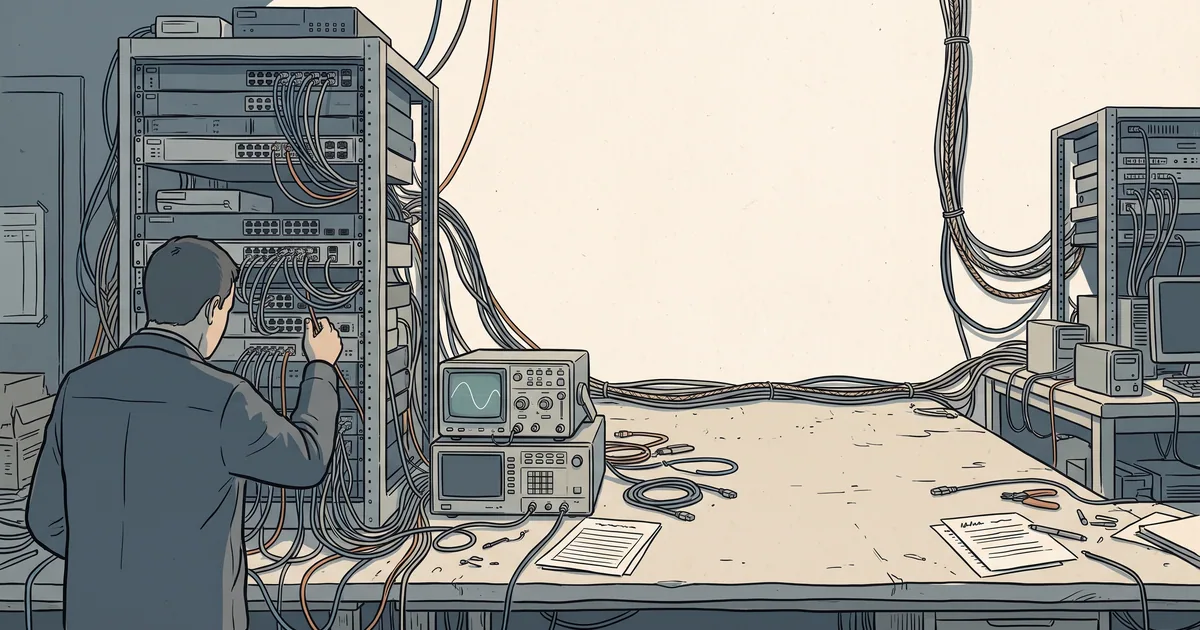
As of May 31, 2014, synchronous algorithmic abstractions fail across heterogeneous networks when unannounced network severance blocks lockstep agreement, depleting socket pools and connection buffers.
During May 2014, distributed systems engineering faces severe operational friction when wide-area architectures fail to account for non-negligible transport delays across heterogeneous networks. Research in telecommunications and physical sensor fabrics, such as evaluations in the (International Journal of Distributed Sensor Networks), demonstrates that hardware clusters and edge nodes encounter volatile latencies that disrupt simplistic consensus abstractions. When software designers construct operational state engines around idealized assumptions of instantaneous update propagation, network anomalies cascade into localized paralysis. This structural vulnerability forces systems engineers to confront a fundamental inquiry:
Why Do Synchronous Algorithmic Abstractions Fail Across Heterogeneous Networks?
Establishing architectural fault isolation against distant partition failures is vital for globally managed distributed systems to prevent wide-area coordination stalls (International Journal of Distributed Sensor Networks). Characterizing transport delays and managing state under incomplete network information is essential for maintaining dependable distributed operation across wireless and sensor infrastructures (arXiv (Cornell University)). Techniques introduced in May 2014 limit Lamport logical clock exposure to remote site failures within globally managed distributed coordination layers (HAL (Le Centre pour la Communication Scientifique Directe)). Distributed network resource utilization schemes can coordinate allocations effectively despite operating with limited local state visibility (DOI Registry). Network transit delays and jitter in wireless mesh networks degrade real-time transport protocols when underlying hop counts and routing latencies fluctuate (International Journal of Distributed Sensor Networks). Wireless sensor network architectures for healthcare decouple localized sensor acquisition from higher-tier management to mitigate transport instability (arXiv (Cornell University)). The breakdown of distributed consensus begins at the boundary between synchronous algorithmic abstractions and physical communication links. In distributed topologies spanning multiple data centers or wireless hops, assuming instantaneous dissemination creates brittle dependencies. Establishing architectural fault isolation against distant partition failures is vital for globally managed distributed systems to prevent wide-area coordination stalls, as demonstrated by theoretical analyses from (arXiv (Cornell University)). When a remote node suffers an unannounced network severance or an extended pause, a coordination tier that mandates lockstep agreement blocks all ongoing transactions. Rather than confining the fallout to the unreachable domain, the synchronous barrier forces healthy regions into indefinite queueing. Local processing threads deplete their available socket pools and connection buffers while awaiting acknowledgments that cannot transit the severed link, causing localized throughput to collapse entirely. This vulnerability exacerbates when systems interact with volatile physical channels. Empirical assessments indicate that network transit delays and jitter in wireless mesh networks degrade real-time transport protocols when underlying hop counts and routing latencies fluctuate, according to findings in (DOI Registry). When real-time data frames compete with state synchronization messages across variable multi-hop paths, packet retransmissions and jitter introduce non-deterministic stall cycles. To prevent these localized transmission anomalies from saturating end-to-end architectures, robust topologies enforce strict tier separation. Specifically, wireless sensor network architectures for healthcare decouple localized sensor acquisition from higher-tier management to mitigate transport instability, as presented in the (International Journal of Distributed Sensor Networks). Without such decoupling, ephemeral transport retries at the physical fringe propagate upward, forcing centralized supervisors to waste cycles recalculating global state vectors.
How Can Architectural Fault Isolation Contain Volatile Transport Latencies?
Architectural containment requires decoupling high-frequency control planes from volatile payload delivery paths. Characterizing transport delays and managing state under incomplete network information is essential for maintaining dependable distributed operation across wireless and sensor infrastructures, an imperative supported by joint evidence in the (International Journal of Distributed Sensor Networks) and (HAL (Le Centre pour la Communication Scientifique Directe)). System architects must partition coordination boundaries so that local clusters proceed with transactional workflows without waiting for global consensus confirmations. If a coordination layer treats state across distant nodes as uniform and immediately accessible, cross-site telemetry messages become synchronization bottlenecks. Introducing regional validation zones enables nodes to commit proximate mutations immediately while deferring global convergence to asynchronous reconciliation routines. The core of this structural partition relies on bounding causal ordering mechanisms. Techniques introduced in May 2014 limit Lamport logical clock exposure to remote site failures within globally managed distributed coordination layers, detailed by research in (arXiv (Cornell University)). Traditional implementations of logical timestamps cause healthy nodes to freeze their logical advance whenever a distant partition halts cross-cluster event exchanges. By constraining logical clock dependencies to bounded geographical or topological domains, an infrastructure ensures that localized failures remain strictly quarantined. Furthermore, distributed network resource utilization schemes can coordinate allocations effectively despite operating with limited local state visibility, as established in (HAL (Le Centre pour la Communication Scientifique Directe)). Mathematical formulations show that nodes make optimal scheduling and resource choices based on localized heuristics, eliminating the need for pervasive, high-latency global locks. Operating under incomplete visibility demands explicit interface contracts between adjacent network tiers. Instead of demanding synchronized atomic commits across disparate sites, resilient designs implement monotonic update counters, bounded queues, and lease expirations. When transient network jitter or partition events occur, interface contracts permit graceful degradation by falling back to conservative local policy baselines. System supervisors maintain operational continuity through telemetry heartbeats that infer link health without blocking foreground workloads. Decoupling routing updates from transaction verification ensures that transit delay spikes do not contaminate core operational state.
Can Distributed Consensus Layers Bound State Divergence During Partitions?
The persistent tension between instantaneous state consistency and transport reality reveals that physical latencies cannot be abstracted away. Systems that ignore transport realities inevitably suffer from wide-area coordination freezes whenever edge conditions destabilize. As distributed architectures increasingly incorporate multi-hop wireless fabrics and geographically disparate clusters, engineers must abandon synchronous state illusions. What remains unresolved at the end of May 2014 is how universally distributed consensus layers can establish formal bounds on state divergence without sacrificing transactional guarantees during prolonged network partitions.
Sources
- International Journal of Distributed Sensor Networks: WSN4QoL: A WSN-Oriented Healthcare System Architecture, 2014-05-01
- arXiv (Cornell University): Limiting Lamport Exposure to Distant Failures in Globally-Managed Distributed Systems, 2014-05-04
- HAL (Le Centre pour la Communication Scientifique Directe): Resource utilization techniques in distributed networks with limited information, 2014-05-07
- DOI Registry: An analysis of voice over Internet Protocol in wireless mesh networks, 2014-05-01