Cognitive Radio Ad Hoc Networks Face Channel Limits
Physical medium access control overhead and co-channel interference disrupt cognitive radio ad hoc networks and distributed consensus.
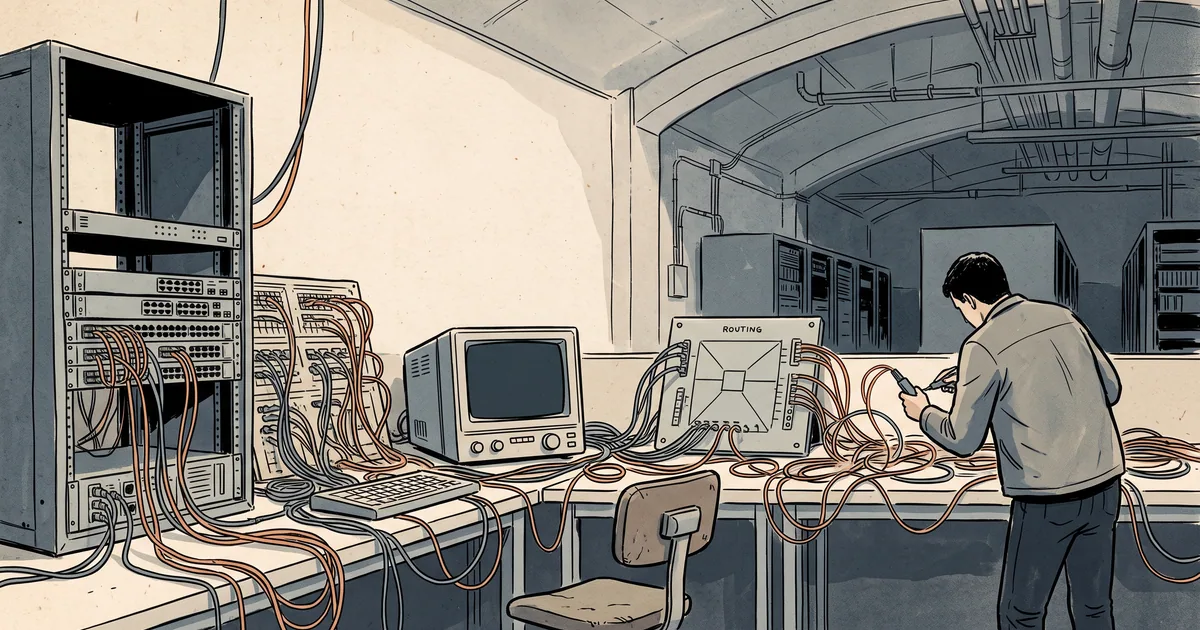
As of September 30, 2017, protocols break down when physical medium access control overhead exceeds channel capacity, causing packet collisions and control synchronization loops to stall across narrow common control channels.
During September 2017, contemporary networking investigations revealed severe structural vulnerabilities at the intersection of wireless control planes and physical transport realities. Theoretical models that cleanly decoupled supervisory distributed algorithms from hardware channel behavior proved fragile when deployed over interference-prone, energy-constrained links, as substantiated in (Transactions on Emerging Telecommunications Technologies). When algorithmic consensus routines presuppose instantaneous state convergence, real-world propagation anomalies dismantle system stability. Network designers are forced to confront an enduring systems question:
Why Do Spectrum Negotiation Protocols Breakdown Over Physical Channels?
The September 2017 findings highlight the critical operational risk of abstracting distributed control logic away from physical transport realities, as co-channel interference and power scavenging dynamics directly bound system reliability (Transactions on Emerging Telecommunications Technologies). The evaluation of cognitive radio ad hoc coordination confirms an architectural bottleneck where higher-layer spectrum negotiation protocols break down if physical medium access control overhead exceeds available channel capacity (Sensors). Medium access control protocols in cognitive radio ad hoc networks face severe synchronization and contention overhead during distributed spectrum sensing and common control channel allocation (Sensors). Embedded multi-agent architectures in industrial wireless sensor networks require explicit agent-level negotiation mechanisms to handle packet delivery constraints across volatile industrial radio environments (Radioengineering). Wireless powered relay networks exhibit severe performance degradation in instantaneous transmission rates when operational policies execute under imperfect channel state information (Transactions on Emerging Telecommunications Technologies). Two-way communication channels utilizing RF energy harvesting relays experience marked increases in outage probability when subjected to external co-channel interference (Sensors). The breakdown emerges directly when physical signaling realities contradict control-plane abstractions. Recent investigations into cognitive radio systems demonstrate this boundary failure vividly. The evaluation of cognitive radio ad hoc coordination confirms an architectural bottleneck where higher-layer spectrum negotiation protocols break down if physical medium access control overhead exceeds available channel capacity, as surveyed in (Sensors). Specifically, medium access control protocols in cognitive radio ad hoc networks face severe synchronization and contention overhead during distributed spectrum sensing and common control channel allocation. When cognitive radios continuously broadcast control messages to discover dynamic spectral vacancies, the signaling traffic itself congests the narrow control channels. Under dense deployments, the negotiation traffic induces packet collisions, causing control synchronization loops to stall while nodes wait for channel clearance that never arrives. Similar dysfunctions manifest across industrial sensing and energy-scavenging wireless networks. Embedded multi-agent architectures in industrial wireless sensor networks require explicit agent-level negotiation mechanisms to handle packet delivery constraints across volatile industrial radio environments, according to empirical research in (Sensors). In such deployments, autonomous software agents execute distributed consensus to balance sensor workloads, but high ambient noise and multi-path fading delay agent messages, causing internal state divergences. Compounding this friction, wireless powered relay networks exhibit severe performance degradation in instantaneous transmission rates when operational policies execute under imperfect channel state information, as detailed in (Radioengineering). When policies attempt rate adaptation without clean channel telemetry, relay scheduling fails. Furthermore, two-way communication channels utilizing RF energy harvesting relays experience marked increases in outage probability when subjected to external co-channel interference, as documented in (Transactions on Emerging Telecommunications Technologies).
How Can Network Topologies Segregate Signaling From Payload Transport?
To prevent distributed coordination systems from collapsing under transport-level delays, system architectures must strictly segregate control-plane signaling from user payload transport. In wireless mesh topologies, routing algorithms and distributed schedule updates compete for identical physical resources. When control traffic is treated as standard data packets, an increase in network payload naturally delays critical topological updates. Architectural handoffs require explicit out-of-band control bandwidth or dedicated contention-free time slots. Without deterministic isolation, feedback loops form: escalating transmission loss triggers rapid rerouting messages, which consume the remaining link budget and induce total transport paralysis. A resilient routing boundary must enforce strict packet validation boundaries, discarding stale state updates rather than propagating speculative route repairs based on outdated physical observations. System operators must confront fundamental trade-offs between synchronization accuracy and network survivability. Conventional software designs often rely on fine-grained telemetry to maintain coherent distributed state tables across all peer nodes. In volatile wireless environments, however, achieving exact global coherence is mathematically intractable without exhausting available spectrum. Telemetry contracts must therefore replace instantaneous convergence requirements with bounded eventual consistency. Operators must configure protocol interfaces to expose physical link characteristics, such as packet error rates, residual energy thresholds, and local interference indices, directly to the coordination logic. Rather than assuming transparent message delivery, distributed coordination routines need explicit interface contracts that throttle negotiation exchanges whenever underlying physical layer telemetry indicates rising interference or depleted power reserves. Structural resilience ultimately depends on autonomous fallback policies and fault containment zones within each participating node. When transport delays exceed conservative thresholds, distributed nodes cannot wait indefinitely for global consensus. Instead, nodes must downgrade their operational posture to local, decoupled decision algorithms. In industrial multi-agent frameworks, this implies transitioning from multi-node collaborative scheduling to isolated rate limiting based solely on local queue lengths. In cognitive radio topologies, nodes must retreat to pre-allocated, safe fall-back frequency channels whenever common control channel contention spikes. Decoupling survival policies from continuous distributed negotiation ensures that transport latency degrades network performance gracefully rather than triggering catastrophic cascading disconnections across the entire network cluster.
Can Distributed Control Planes Maintain Coordination Invariants Over Hostile Channels?
By late September 2017, distributed wireless research proved that control logic cannot remain agnostic to underlying physical medium constraints. Abstracting away channel delays, interference profiles, and energy harvesting limitations inevitably produces systemic instability. As networks incorporate more distributed software agents and self-organizing radio architectures, system designers must resolve an unresolved architectural dilemma: How can distributed control planes reliably maintain global coordination invariants when physical transport latencies are fundamentally unpredictable, non-zero, and bounded by hostile radio environments?
Sources
- Transactions on Emerging Telecommunications Technologies: Outage analysis in two‐way communication with RF energy harvesting relay and co‐channel interference, 2017-09-20
- Sensors: Medium Access Control Protocols for Cognitive Radio Ad Hoc Networks: A Survey, 2017-09-16
- Sensors: An Embedded Multi-Agent Systems Based Industrial Wireless Sensor Network, 2017-09-14
- Radioengineering: Wireless Powered Relaying Networks Under Imperfect Channel State Information: System Performance and Optimal Policy for Instantaneous Rate, 2017-09-15