IEEE 1394 and Estimation Over Fading Channels
Distributed estimation over fading channels reveals how consensus algorithms fail when underlying links suffer correlated channel outages.
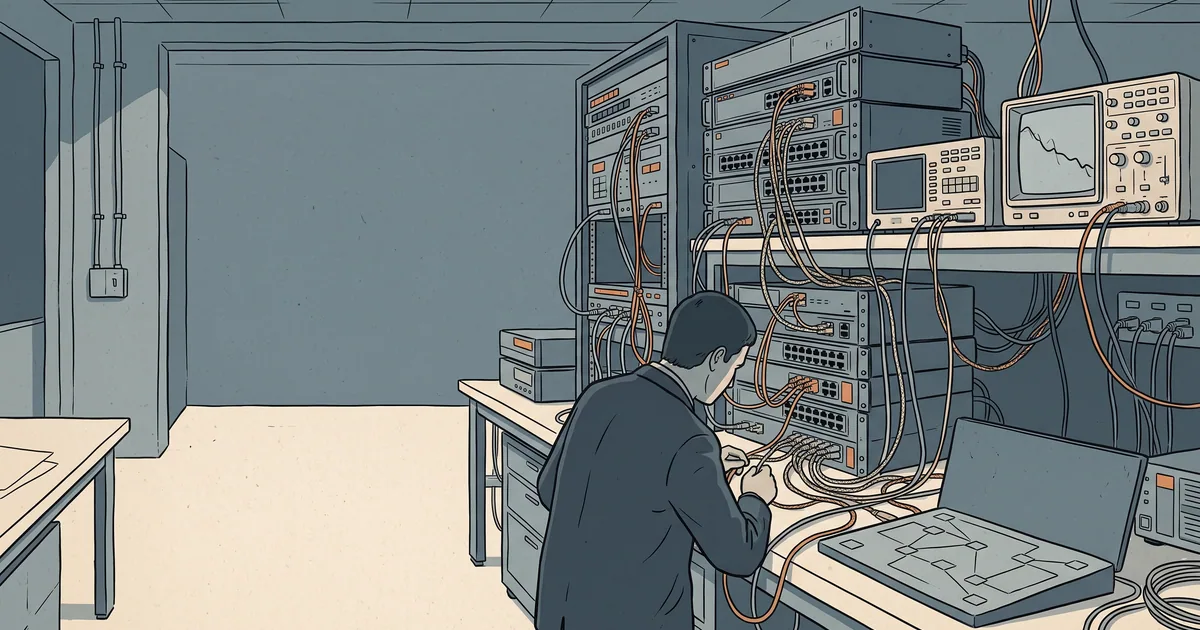
As of October 31, 2008, consensus algorithms collapse over parallel fading channels because correlated fading outages and packet drops prevent estimation loops from converging within bounded time windows.
During October 2008, system designers confront mounting operational friction where distributed applications rely on brittle transport assumptions that collapse under real-world communications delays. When higher-level consensus algorithms presuppose instantaneous lock acquisition and immediate telemetry availability, any degradation in channel reliability cascades into systemic instability. Theoretical work published by (IEEE) demonstrates that physical channel variations cannot simply be abstracted away beneath logical control primitives. This reality prompts a vital structural query:
Why do consensus algorithms collapse over parallel fading channels?
The emergence of distributed estimation over fading channels in October 2008 highlights a critical operational vulnerability, demonstrating that higher-level consensus algorithms fail when underlying wireless links experience correlated fading outages (IEEE). Formalizing execution coordination for mobile agent workflows is essential for distributed computing architectures, as uncontrolled message delays and node disconnections otherwise cause non-deterministic stalls in multi-agent jobs (Elsevier BV). Distributed job workflows coordinated by mobile agents rely on reliable synchronization primitives that degrade severely when network transport assumptions fail over parallel fading channels (Elsevier BV). Deterministic transport protocols such as IEEE 1394 are designed and implemented within vehicle interfaces to guarantee bounded latency and prevent control plane buffer overruns (IEEE). Globally distributed ocean acoustic observatories require dedicated tracking architectures to aggregate asynchronous sensor data streams across high-latency telemetry links (IEEE). Physical layer channel outages in distributed sensor networks contrast with high-bandwidth deterministic buses like IEEE 1394, showing that transport reliability models dictate the feasibility of real-time state estimation (Elsevier BV). In theoretical designs, algorithms such as distributed Kalman filtering or multi-node voting schemas treat the transport stratum as a transparent conduit providing atomic delivery guarantees. When parallel links suffer simultaneous packet drops or deep fading, the estimation loop cannot converge within bounded time windows. Under actual operational strain, these breakdowns manifest through diverging local state tables and cascading retransmission storms. When an execution agent experiences an unnotified delay in message arrival, its state machine either blocks indefinitely awaiting an acknowledgement or initiates redundant retry bursts that saturate the remaining channel bandwidth. This pathology mirrors broader architectural mismatches across distributed environments, where control messages compete directly with payload traffic. If a distributed coordination fabric cannot differentiate between intermittent transport attenuation and terminal node crash failures, it risks triggering premature failovers, partition splits, and conflicting split-brain leadership claims.
How can architects decouple signaling paths from telemetry links?
To prevent control plane collapse, system architects must enforce strict segregation between signaling paths and payload data transfers, alongside deterministic bus topologies. In localized vehicle systems, isochronous and asynchronous channels partition periodic sensory packets from discrete configuration frames, eliminating contention before buffers exhaust system memory. Where deterministic physical interconnects cannot exist, distributed protocols must incorporate explicit boundary contracts that acknowledge latency variances rather than assuming instantaneous synchrony. The operational contrast becomes pronounced when managing geographically dispersed, uncoupled physical domains. In these oceanic monitoring networks, undersea hydrophone arrays capture acoustic phenomena that cannot be processed using synchronous distributed transactions over satellite or acoustic backhauls. Instead, operators must implement event-driven architectures that decouple local detection from global aggregation, employing local epoch timestamps and regional fusion filters. This separation ensures that acoustic trajectory tracking proceeds even when long-haul uplinks experience intermittent blackouts or erratic round-trip times. Consequently, robust distributed control planes necessitate clear architectural handoffs between asynchronous processing engines and transport verification modules. When an application layer delegates coordination to mobile agents or distributed estimators, interface boundaries must validate channel metrics prior to initiating synchronous barrier routines. Should channel diversity dip below safe thresholds, the coordination software must degrade gracefully into localized autonomy, event-sourcing queues, or tolerant snapshotting rather than halting workflow execution. Bounded backoff timers, rate-controlled heartbeats, and out-of-band fault detection circuits prevent control messages from triggering destructive buffer bloat across fragile physical topologies.
What latency budgets will secure channel aware coordination protocols?
By October 31, 2008, engineering consensus recognizes that distributed coordination cannot outrun its underlying physical channels without rigorous latency budgets. Zero-latency synchronization assumptions remain a seductive architectural trap, inevitably generating phantom failures, stalled workflows, and thrashing nodes when confronted by fading wireless media or high-latency uplinks. As distributed computing expands into volatile mobile and oceanic environments, the core design imperative shifts away from naive synchronous locks toward latency-resilient state machines, deterministic bus boundaries, and channel-aware coordination protocols.
Sources
- IEEE: Outage diversity for distributed estimation over parallel fading channels, 2008-10-08
- Elsevier BV: Execution coordination in mobile agent-based distributed job workflow execution, 2008-10-11
- Elsevier BV: Design and implementation of a vehicle interface protocol using an IEEE 1394 network, 2008-10-14
- IEEE: A proposed architecture for marine mammal tracking from globally distributed ocean acoustic observatories, 2008-10-17