Decentralized Ledger Mechanisms and Transport Constraints
Decentralized ledger mechanisms face systemic stalls when consensus protocols ignore physical propagation delays and packet drops.
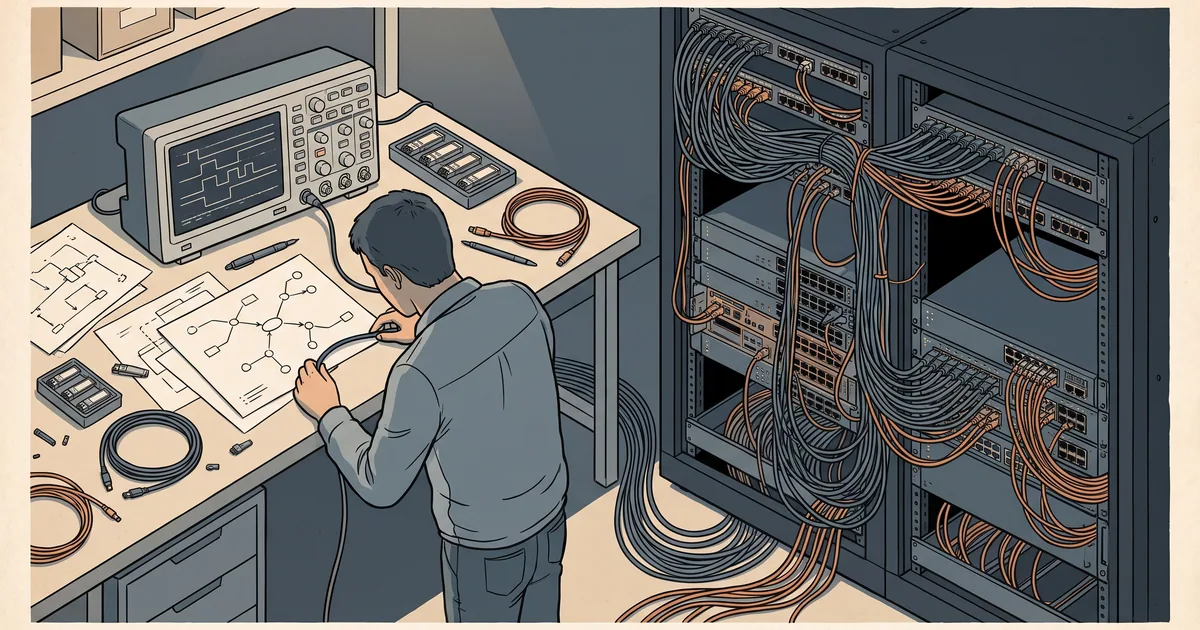
As of April 30, 2022, consensus engines trigger compounding backlog when finite operating system buffers fill and transport-level retransmissions multiply tail latency across non-ideal links.
During April 2022, infrastructure architects increasingly confronted the fragile seam between logical consensus abstractions and the physical realities of data packet transmission. The rapid expansion of decentralized ledger mechanisms into critical physical and energy infrastructures in early 2022 underscored how essential robust coordination models are for maintaining network stability, as analyzed in the (Journal of risk and financial management). When software designs presume instantaneous state propagation across geographically distributed participants, systemic stalls inevitably emerge.
Why do consensus engines trigger compounding backlog?
The rapid expansion of decentralized ledger mechanisms into critical physical and energy infrastructures in early 2022 underscored how essential robust coordination models are for maintaining network stability (Journal of risk and financial management). Systematic evaluations of distributed database systems published in April 2022 revealed that failure to align consensus protocols with practical network transport constraints exposes high-throughput platforms to systemic operational failure (DOI Registry). Assessments of distributed ledger architectures and database management techniques highlighted fundamental throughput bottlenecks when replication mechanisms encounter propagation latency over distributed topologies (arXiv (Cornell University)). Technical investigations into non-ideal channel conditions and outage performance demonstrated that cooperative transport links experience variable outage rates under fluctuating channel conditions (International Journal of Future adaptive Science and Techn). Performance optimization studies of enterprise trading architectures demonstrated that implementing API gateways and circuit breakers mitigates cascading connection failures when underlying service channels experience elevated latency (Journal of risk and financial management). Evaluations across distributed ledger designs and wireless transmission architectures documented that coordination mechanisms falter when transmission assumptions neglect physical propagation delays and channel degradation (DOI Registry). When consensus engines dispatch synchronizing heartbeats, state transitions, and round-robin quorum votes, they frequently treat socket buffers as infinite sinks and inter-node routes as deterministic channels. In real-world environments, finite operating system buffers fill, and transport-level retransmissions multiply tail latency, creating a compounding backlog that overwhelms state machines. As control layers broadcast synchronizing payloads across non-ideal wireless links or shared wide-area networks, physical fading and packet drops trigger transmission control protocol backoffs or packet loss cascades. If a consensus layer assumes deterministic sub-millisecond round trips, any transient outage induces false failure detections. Nodes assume their peers have dropped offline, trigger leadership re-elections, and flood the network with re-synchronization traffic precisely when the network transport layer is already starved for bandwidth. This divergence between assumed determinism and stochastic link reality generates self-reinforcing congestion collapse.
How can operators isolate coordination signals effectively?
Mitigating this structural vulnerability demands a strict architectural separation between control-plane metadata and bulk data payloads. When consensus protocols multiplex heavyweight transaction replication and tiny synchronization heartbeats across a single unprioritized transport channel, bulky state transfers head-of-line block crucial membership status updates. Establishing rigorous validation boundaries prevents unverified payload data from saturating node buffers before basic membership checks succeed. Isolating coordination signals to prioritized, bounded queues ensures that protocol timers remain insulated from heavy bulk data ingress, containing failures to individual processing lanes. Operators face delicate trade-offs between system consistency and operational availability. If interface contracts mandate strict linearizability across wide-area network boundaries without factoring in round-trip travel time, client requests stall indefinitely during network degradation. High-frequency telemetry monitoring round-trip time, socket queue saturation, and retransmission counters allows gateways to trip circuit breakers proactively before upstream thread pools exhaust their memory limits. Establishing explicit backpressure contracts across edge interfaces shifts the burden away from consensus nodes, shedding non-critical transactions while maintaining coordination quorum. Structural recovery requires explicit degradation protocols within the control plane rather than binary operational modes. When the transport substrate experiences latency spikes, nodes must adapt their heartbeat intervals and quorum wait timers dynamically rather than immediately triggering state reconciliations. Partition-tolerant designs implement rate-limited synchronization phases and tiered log compaction, preventing nodes that fall slightly behind from triggering full-state snapshot dumps across congested links. By decoupling control plane coordination from synchronous payload transmission, distributed systems avoid treating intermittent network degradation as catastrophic nodal death, preserving cluster integrity through graceful performance degradation.
What architectural trade-offs govern resilient cluster recovery?
Sources
- Journal of risk and financial management: Distributed Renewable Energy Management: A Gap Analysis and Proposed Blockchain-Based Architecture, 2022-04-20
- DOI Registry: Evaluation of Database Management Systems and Techniques Applied in Distributed Systems, 2022-04-05
- arXiv (Cornell University): RIS-aided Cooperative FD-SWIPT-NOMA Outage Performance in Nakagami-m Channels, 2022-04-05
- International Journal of Future Innovative Science and Techn: Performance Optimization of Enterprise Trading Systems through API Gateway and Circuit Breaker Architecture, 2022-04-10